
DIE UPENDERS AND MOLD TIPPERS
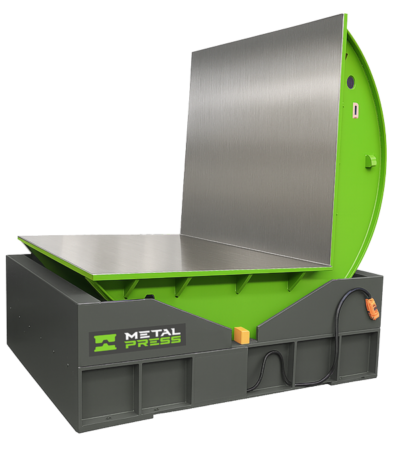
MDR SERIES
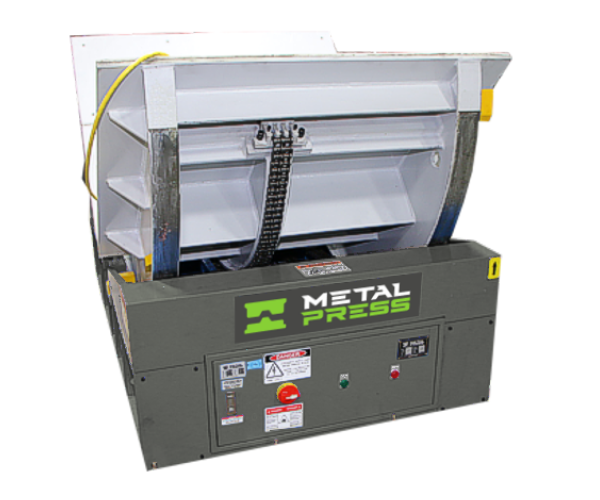
Our heavy duty all electric mechanical die upenders, also known as mold flippers, have a wide variety of industrial uses. They simplify the process of turning over heavy loads and increase productivity while protecting employees from hazardous heavy object handling operations.
TECHNICAL OVERVIEW
A die upender is essential for safely rotating heavy dies, molds, and tooling from horizontal to vertical orientation—or the reverse—without risking damage or operator injury. Dies are extremely dense and difficult to maneuver, and improper handling can lead to dangerous load shifts, crushed edges, or catastrophic drops. A die upender provides controlled, stable rotation while fully supporting the die’s weight throughout the movement. This prevents cracking, misalignment, and surface damage that can occur when using forklifts, chains, or manual methods. For stamping plants, injection‑molding facilities, and toolrooms, a die upender ensures safer workflows, faster die transitions, and improved productivity. It is a critical piece of equipment for any operation that requires reliable, repeatable die positioning.
A die upender offers a safer, more controlled alternative to rotating dies with forklifts, slings, pry bars, or manual positioning. Forklift‑based rotation often leads to unstable loads, chipped die shoes, and unnecessary risk to operators. A die upender eliminates these hazards by cradling the die securely and rotating it through a smooth, guided motion. This reduces the chance of dropped loads, equipment damage, and workplace injuries. It also improves efficiency by allowing operators to reposition dies quickly and consistently without relying on multiple personnel or improvised handling methods. For facilities that value safety, repeatability, and reduced downtime, a die upender provides a purpose‑built solution that enhances both workflow and die integrity.
The die upender is engineered for safe, stable, and efficient rotation of heavy dies and molds used in stamping, forming, and injection‑molding operations. Its reinforced frame and heavy‑duty cradle support a wide range of die sizes and weights, ensuring reliable performance in demanding industrial environments. The machine provides smooth, controlled rotation to prevent die damage and maintain alignment. Safety features may include mechanical locks, anti‑slip surfaces, and operator‑friendly controls that simplify loading and unloading. Many models integrate seamlessly with die carts, forklifts, and toolroom equipment, improving overall material‑handling flow. By reducing manual handling and forklift‑based rotation, the die upender enhances workplace safety, protects tooling investments, and increases operational efficiency.
VIDEO OVERVIEW
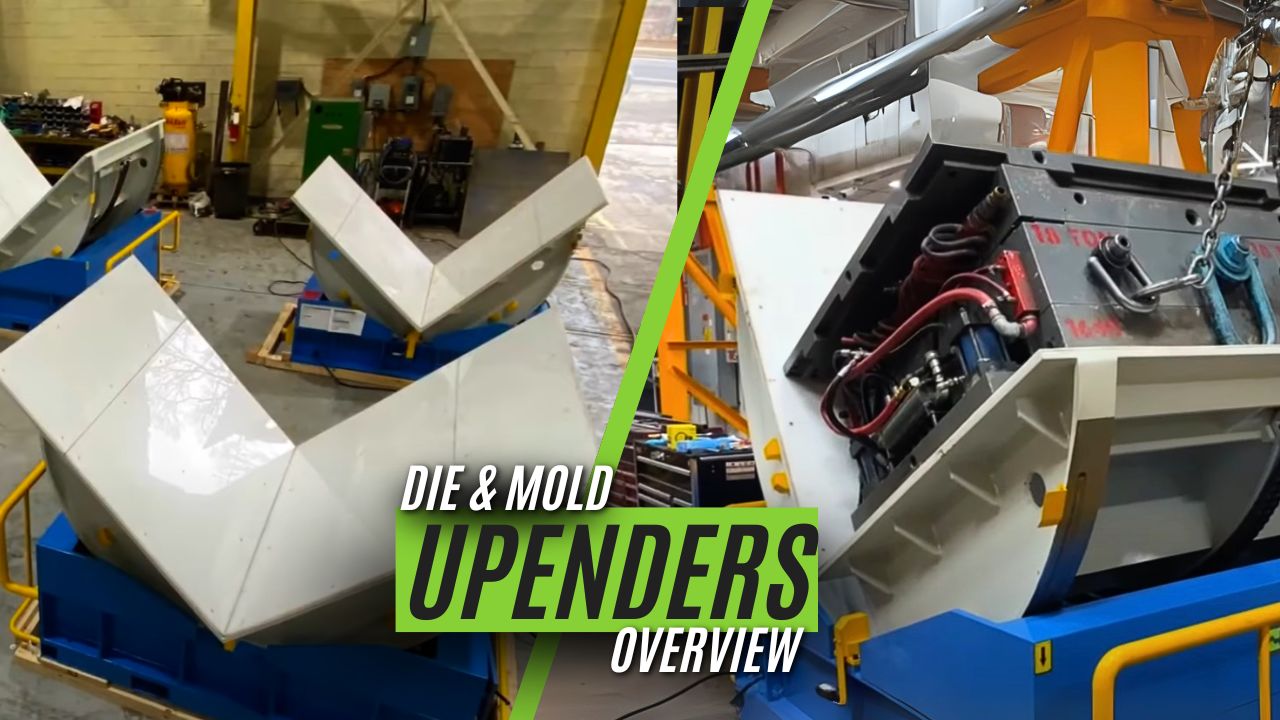
See What This Die Upender Unit Has to Offer.
Our upenders feature a very robust design, and are loaded with features and value. Operator safety, quick setup and competitive pricing were primary consideration in this design. Available in various sizes and different options.
HEAVY DUTY CONSTRUCTION
Made to Stand Up to Constant Use.
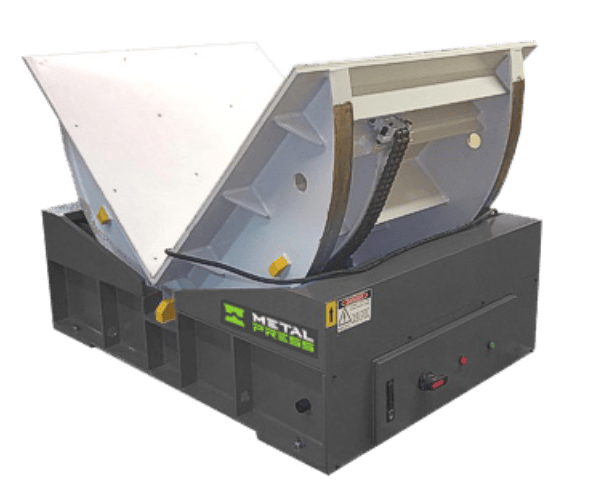
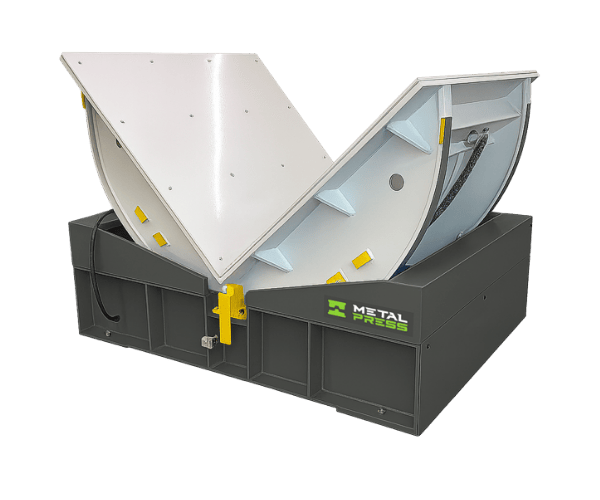
Our upenders are made of robust reinforced welded steel construction. They are driven by a gear motor which drives a dual chain sprocket which enables rotation. The cradle has two flat platforms. Heavy-duty sealed bearings help the rollers support the load. A brake motor and gear reducer provide a smooth rotating cycle without jerking or sudden speed changes which could destabilize the load.
EIGHT TABLE DESIGNS
We Have You Covered
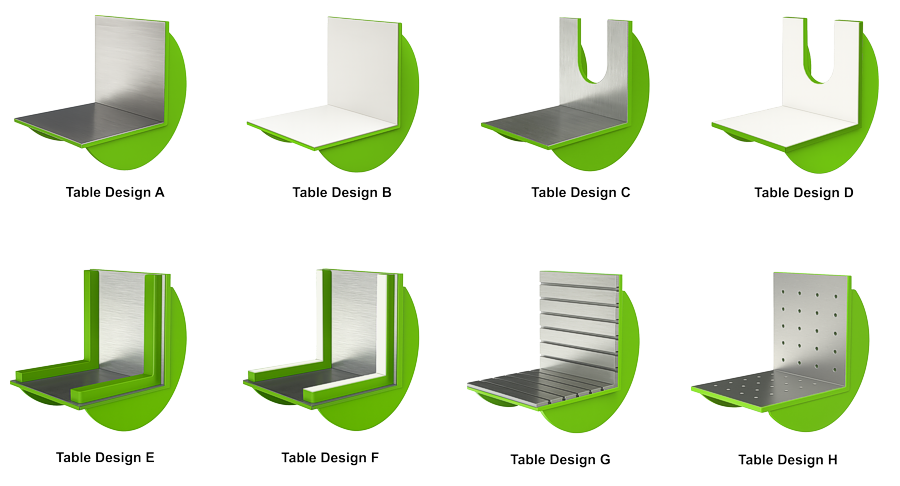
Our die upender offers eight versatile table designs to meet every tooling need. Options include flat steel platens, U-cut profiles, T-slot surfaces, threaded hole tables, and reinforced guide rail configurations. Each table is engineered for strength, precision, and adaptability, with thin plastic overlays available for protection. Designed for durability and easy clamping, these solutions ensure safe, efficient die handling while accommodating a wide range of industrial applications.
VISUAL FEEDBACK
See What is Happening in Real Time
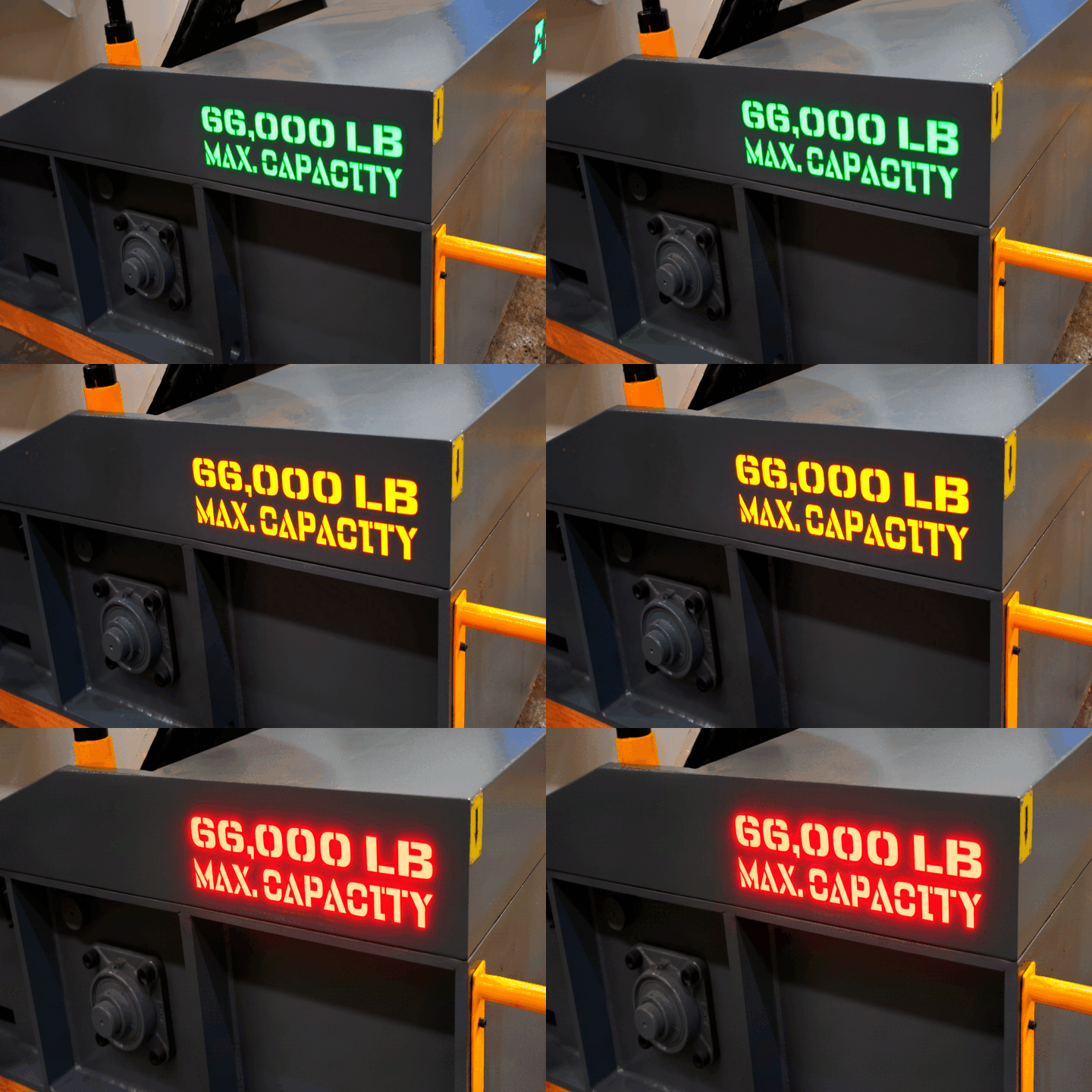
MetalPress side-mounted tri-color LED lights are integrated into the “Maximum Capacity” sign located on both sides of the unit. This gives instant and easily visible machine statues.
The lights give clear, at-a-glance safety cues.
Green = in position/ready;
Yellow = tipping/indexing or attention (load clamp/wait);
Flashing Yellow = rotary motion or warning-zone presence;
Red = protective stop/fault.
Bright, vibration-proof LED lights are visible to crane/forklift operators and boost safety, cut downtime, and enhance plant-floor visual management. Compatible with our optional 180° rotary table and optional proximity scanner.
SAFETY FIRST
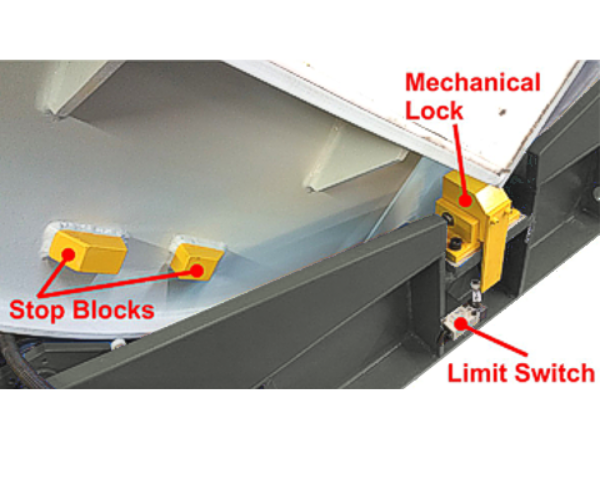
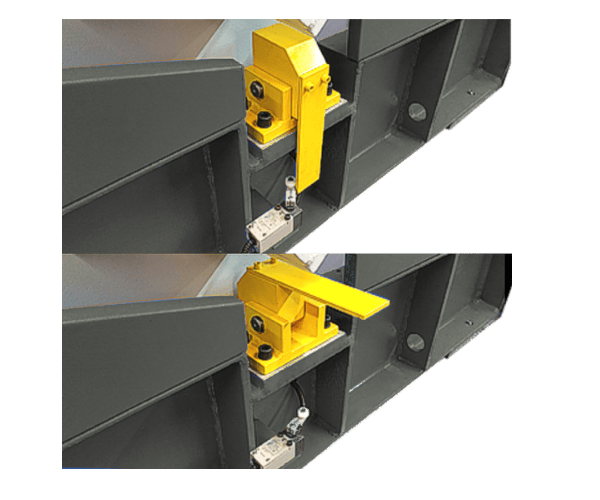
A Mechanical Locking Pin For Worker Safety is Standard
Die updenders or flippers are heavy machines with heavy tables. Our MDR Series features mechanical safety pins which are locked during machine cleaning and maintenance. Electronic limit switches provide a secondary layer of safety lock confirmation that disables the upender from stating up.

FULL 90° ROTATION
Flexible Application
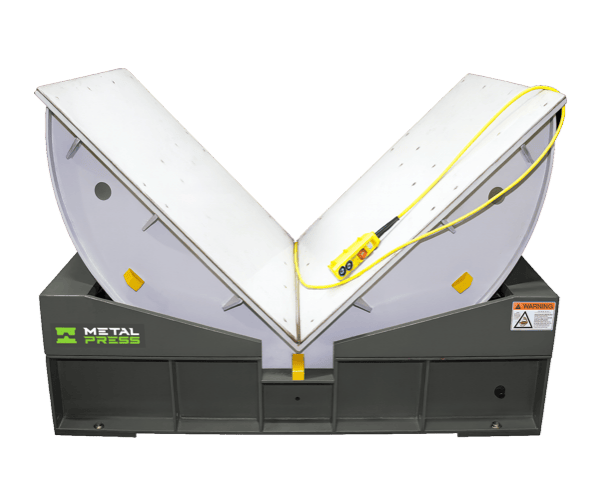
This series rotates a full 90 degrees in both directions. Rotation is smooth and can be stopped and started at any time and in any position.
ALL ELECTRIC
No Leaky Hydraulics
We use an electric-powered gear motor that drives a dual chain sprocket which provides smooth and safe rotation. There is no messy and leaking hydraulics to deal with.

HIGH QUALITY COMPONENTS
We Use Brand Name Components You Know, Already Use and Trust.
We use only the finest quality components that are open source, and readily available locally in your area, or from our online parts store.We do not use any impossible to find proprietary components.
STANDARD FEATURES INCLUDED
| Item | Price |
| Fast Operation | Included |
| Easy to Use | Included |
| Simple to Maintain | Included |
| Safer to Use Than Conventional Methods | Included |
| Can be Used for Dies or Molds | Included |
| Can be Used for Other Heavy Loads | Included |
| Voltage Choice: 380V, 50 Hz, 3 ph, 480V, 60 Hz, 3 ph, 575V, 60 Hz, 3 ph | Included |
ADDED PROTECTION
Add an Extra Layer of Surface Protection
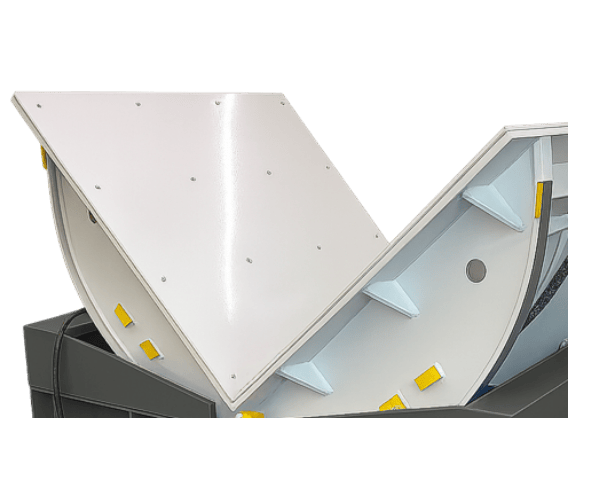
Our upenders are available with optional removable polycarbonate table surface covers which are screwed into the metal table surface. These reduce damage to the upender table surface and to die / mold surfaces.
SAFETY GUARD RAILS
Added Protection
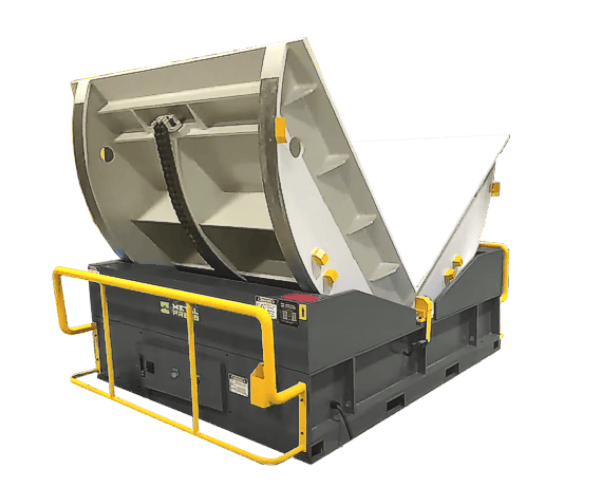
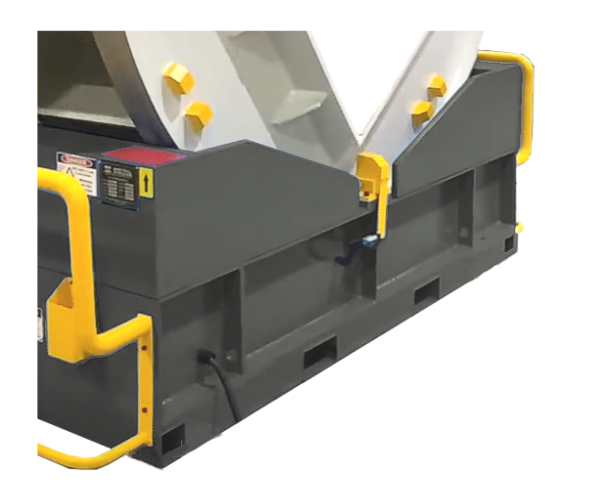
Our MDR Series is available with optional safety rails on both ends for added protection and safety .

LASER SAFETY SYSTEM
Active Laser Scanner
Our MDR Series is also available with an optional safety laser scanner that uses time-of-flight technology. In real time, the scanner calculates position based on the time it takes for the laser to bounce off an object and return to the unit. If anyone or anything approaches the predefined zone the Die Upender stops. The zones are fully definable and programmable. An optional camera is also available to record what triggered the shut down.
FORKLIFT TRANSPORT BASE
Use It Where You Need It
Our upenders are available with optional base designed for frequent forklift transport from one location to another. This is especially handy when you want to upend dies or molds in multiple locations in your facility.
FULL 180° ROTATING BASE
More Flexibility
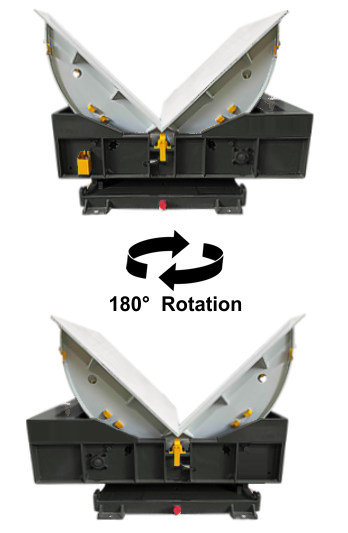
Our MDR Series is also available with an optional 180 degree rotating base. With a rotating base, the need for manual handling and repositioning of heavy dies is significantly reduced. This leads to faster turnaround times and improved workflow efficiency in manufacturing and maintenance operations. The rotating base ensures stable and controlled movement of the die, which enhances overall safety during the handling process.
HIGHEST RETURN ON INVESTMENT
We Give You More Value for Your Money.
To be competitive today’s economy requires that manufactures run their operations more efficiently and cost effectively than ever before. We offer the highest ROI (return on investment) in the industry. MetalPress gives you high quality products for are resonable investment and with more features than any other company

EIGHT STANDARD SIZES
Flexible Range of Applications.
Available from 11,000 lbs (5,000 kg) all the way to 150,000 lbs (70,000 kg) the MDR Series of upenders or flippers can handle any application.
| SPECIFICATIONS – US STANDARD | ||||||||
| Item | MDR-5 | MDR-10 | MDR-15 | MDR-20 | MDR-30 | MDR-40 | MDR-50 | MDR-70 |
| Overturn Capacity | 5.5 tons (11,023 lbs) | 11 tons (22,046 lbs) | 16.5 tons (33,069 lbs) | 22 tons (44,092 lbs) | 33 tons (66,138 lbs) | 44 tons (88,000 lbs) | 55.1 tons (121,473 lbs) | 75 tons (150,000 lbs) |
| Table Size | 47 x 47 inches | 55.1 x 55.1 inches | 66.9 x 66.9 inches | 78.7 x 78.7 inches | 78.7 x 78.7 inches | 78.7 x 98.4 inches | 98.4 x 98.4 inches | 98.4 x 118 inches |
| Table Height | 22.8 inches | 26.8 inches | 30.7 inches | 36.6 inches | 38 inches | 48.4 inches | 48.4 inches | 51.6 inches |
| Center of Gravity | 23.6 inches | 27.5 inches | 33.5 inches | 39.4 inches | 39.4 inches | 39.4 inches | 49.2 inches | 49.2 inches |
| Center of Rotation | 17.7 inches | 19.7 inches | 25.2 inches | 29.5 inches | 29.5 inches | 29.5 inches | 35.4 inches | 36.4 inches |
| Motor Power | 2 hp | 4 hp | 5 hp | 7 hp | 10 hp | 15 hp | 25 hp | 30 hp |
| Machine Size (L x W x H) | 84 x 47 x 70 inches | 89 x 55 x 81.9 inches | 103.1 x 66.9 x 97.6 inches | 120.5 x 78.7 x 116.7 inches | 124 x 78.7 x 116.7 inches | 130 x 98.4 x 146.8 inches | 130.7 x 98.4 x 148.8 inches | 130 x 120 x 148.8 inches |
| Machine Weight | 1.8 tons (3,594 lbs) | 2.6 tons (5,200 lbs) | 4.2 tons (8,422 lbs) | 6.7 tons (13,288 lbs) | 8.9 tons (17,637 lbs) | 13.2 tons (26,400 lbs) | 16.5 tons (33,000 lbs) | 19.8 tons (39,600 lbs) |
| SPECIFICATIONS – METRIC STANDARD | ||||||||
| Item | MDR-5 | MDR-10 | MDR-15 | MDR-20 | MDR-30 | MDR-40 | MDR-50 | MDR-70 |
| Overturn Capacity | 5 tonnes (5,000 kg) | 10 tonnes (10,000 kg) | 15 tonnes (15,000 kg) | 20 tonnes (20,000 kg) | 30 tonnes (30,000 kg) | 40 tonnes (40,000 kg) | 50 tonnes (50,000 kg) | 70 tonnes (70,000 kg) |
| Table Size | 1200 x 1200 mm | 1400 x 1400 mm | 1700 x 1700 mm | 2000 x 2000 mm | 2000 x 2000 mm | 2000 x 2500 mm | 2500 x 2500 mm | 2500 x 3000 mm |
| Table Height | 580 mm | 680 mm | 780 mm | 930 mm | 965 mm | 1230 mm | 1230 mm | 1310 mm |
| Center of Gravity | 600 mm | 700 mm | 850 mm | 1000 mm | 1000 mm | 1000 mm | 1250 mm | 1250 mm |
| Center of Rotation | 450 mm | 500 mm | 640 mm | 750 mm | 750 mm | 750 mm | 900 mm | 900 mm |
| Motor Power | 1.5 kW | 3 kW | 4 kW | 5.5 kW | 7.7 kW | 11 kW | 18.5 kW | 22 kW |
| Machine Size (L x W x H) | 2130 x 1200 x 1780 mm | 2270 x 1400 x 2080 mm | 2620 x 1700 x 2480 mm | 3060 x 2000 x 2965 mm | 3150 x 2000 x 2965 mm | 3300 x 2500 x 3730 mm | 3320 x 2500 x 3780 mm | 3320 x 3050 x 3780 mm |
| Machine Weight | 1.6 tonnes (1630 kg) | 2.5 tonnes (2500 kg) | 3.8 tonnes (3820 kg) | 6 tonnes (6035 kg) | 8 tonnes (8020 kg) | 12 tonnes (12000 kg) | 15 tonnes (15000 kg) | 18 tonnes (18000 kg) |
Applications of the Die Upender
The die upender is essential for safely rotating heavy dies, molds, and tooling from horizontal to vertical orientation—or the reverse—without risking damage or operator injury. Dies are extremely dense and difficult to maneuver, and improper handling can lead to dangerous load shifts, cracked die shoes, or catastrophic drops. The die upender provides controlled, stable rotation while fully supporting the die’s weight, preventing edge damage, misalignment, and surface deformation. This makes it ideal for stamping plants, injection‑molding facilities, and toolrooms that handle large, high‑value tooling. By standardizing die rotation, the die upender improves safety, reduces downtime, and protects expensive tooling investments.
Die upenders play a critical role in preparing dies for installation into stamping presses or removal for maintenance. Many dies must be oriented vertically for loading onto die carts or horizontally for bolting and setup. The die upender performs this transition safely and efficiently, eliminating the need for forklifts, pry bars, or manual repositioning. This reduces the risk of die damage and ensures proper alignment before the die reaches the press. For facilities that change dies frequently, the die upender significantly speeds up changeovers, improves workflow consistency, and enhances overall pressroom efficiency.
In toolrooms, dies often need to be rotated for inspection, cleaning, repair, or maintenance. A die upender provides the controlled rotation required to access all sides of the die safely. This prevents technicians from having to manually reposition heavy tooling, reducing the risk of injury and improving maintenance accuracy. The stable cradle supports the die during detailed work, ensuring it remains secure and properly aligned. Whether technicians are replacing components, cleaning surfaces, or performing precision adjustments, the die upender provides a safer, more efficient handling method that protects both personnel and tooling.
Die upenders integrate seamlessly with die carts, forklifts, and other material‑handling equipment used in stamping and molding facilities. Many operations position the upender at the start or end of their die‑handling workflow to ensure dies are oriented correctly before transport or storage. The controlled rotation provided by the upender makes it easier to align dies with carts, racks, or press setups, reducing the risk of misalignment or accidental damage. This integration improves overall material flow, reduces handling steps, and enhances safety across the entire die‑handling process.
Die storage systems often require dies to be oriented in specific positions for safe racking or shelving. The die upender provides the controlled rotation needed to position dies correctly without risking damage to die shoes, guide pins, or precision surfaces. This is especially important for large dies that cannot be safely rotated manually or with forklifts. By ensuring dies are stored in the correct orientation, the upender helps maintain tooling integrity, reduces the risk of accidental damage, and supports more organized, efficient storage practices in toolrooms and press departments.
Dies contain precision‑machined surfaces, guide pins, bushings, and alignment features that can be easily damaged during improper handling. The die upender cradles the die securely, distributing weight evenly to prevent chipping, cracking, or surface deformation. This is especially important for high‑value tooling used in progressive stamping, deep‑draw operations, and injection molding. By maintaining die integrity, the upender helps ensure consistent part quality, reduces scrap, and extends tooling life. It also minimizes the risk of costly repairs or premature die replacement.
One of the most important applications of the die upender is improving workplace safety. Manual die rotation and forklift‑based tipping are leading causes of die‑handling injuries, equipment damage, and lost‑time incidents. The die upender eliminates these risks by providing a controlled, stable rotation mechanism that requires minimal operator intervention. Safety features such as mechanical locks, anti‑slip surfaces, and guided rotation help prevent accidents and ensure consistent handling. Facilities that implement die upenders see significant reductions in injuries, downtime, and tooling damage, making it a key component of modern safety‑focused die‑handling systems.
For facilities that work with large or oversized dies, manual rotation or forklift‑based tipping is unsafe and impractical. The die upender provides a stable, reinforced platform capable of supporting heavy die weights and large footprints. Its controlled rotation prevents sudden shifts or instability, protecting both operators and equipment. This makes it ideal for automotive stamping plants, appliance manufacturers, and heavy‑gauge forming operations where die weights exceed safe manual‑handling limits. By reducing risk and improving handling precision, the die upender ensures safe, repeatable rotation of even the largest dies.
Frequently Asked Questions About Die Upender
A die upender is essential because it eliminates the risks associated with manually rotating heavy dies or using forklifts, pry bars, or chains for tipping. Dies are extremely dense and can shift unpredictably when lifted improperly, creating a major safety hazard. A die upender provides controlled, stable rotation from horizontal to vertical orientation—or the reverse—while fully supporting the die’s weight. This prevents cracked die shoes, chipped edges, misalignment, and accidental drops. Facilities that handle stamping dies, molds, or large tooling rely on die upenders to maintain safe workflows, reduce downtime, and protect both personnel and high‑value tooling.
A die upender is designed to handle a wide range of dies, molds, and tooling used in stamping, forming, injection molding, and metal fabrication. This includes progressive dies, transfer dies, deep‑draw dies, injection molds, and large precision tooling. The reinforced cradle and heavy‑duty frame support both compact and oversized dies, as well as tooling with irregular shapes or uneven weight distribution. Because the upender supports the load evenly during rotation, it prevents damage to precision surfaces, guide pins, and die shoes. Whether used in a pressroom, toolroom, or molding facility, the die upender provides reliable, repeatable handling for virtually any die type.
A die upender improves workflow efficiency by eliminating the slow, labor‑intensive process of manually repositioning dies or relying on forklifts for rotation. Many dies must be oriented vertically for transport or horizontally for maintenance and press setup. The die upender performs this transition quickly, safely, and consistently, reducing setup time and minimizing bottlenecks. Operators can position dies correctly for die carts, storage racks, or press installations with minimal effort. By standardizing die orientation and reducing handling steps, the die upender increases throughput, reduces labor requirements, and supports smoother material flow across the entire facility.
Yes — die upenders integrate seamlessly with die carts, forklifts, overhead cranes, and toolroom equipment. Many facilities position the upender at the start or end of their die‑handling workflow to ensure dies are oriented correctly before transport, storage, or press installation. The controlled rotation provided by the upender makes it easier to align dies with carts, racks, or press setups, reducing the risk of misalignment or accidental damage. Whether used as a standalone unit or part of a fully coordinated die‑handling system, the die upender enhances safety, consistency, and workflow efficiency.
Yes — die upenders are available to customers throughout the United States, Canada, and Mexico. Many North American manufacturers rely on die upenders to improve safety, protect tooling investments, and streamline die‑handling operations. Regional availability ensures faster delivery, reliable technical support, and easy access to replacement parts. Customers can choose from multiple weight capacities, cradle sizes, and rotation configurations to match their specific die‑handling requirements. Whether you operate a stamping plant, toolroom, or molding facility, North American‑supplied die upenders provide dependable performance and long‑term support.
Die UPENDER WHITEPAPER
Is an Upender Really Necessary for Your Operation?
Have you ever wondered if you really need an upender? Download this informative whitepaper on why you should always use an upender.
