
WATER CHANNEL CLEANING UNIT

MOLD CHANNEL CLEANING UNIT
- 2–7 cleaning circuits across five standard MDM models
- Forward and reverse pulsed flow to loosen internal deposits
- PLC-controlled automatic cycles for repeatable maintenance
- Flow, pressure and leakage checks for documented verification
- Automatic blow drying after cleaning and rinsing
- 30–250 L/min maximum flow for small through large molds and dies
- Non destructive: No chemicals, no high-pressure flow
GET A QUICK WATER CHANNEL CLEANER QUOTE
Send us your cooling-circuit details and we’ll help select the correct MDM unit.
HELP US SIZE THE RIGHT MDM CLEANING UNIT
For the fastest recommendation, include:
Number of Circuits & Connections
How many passages will be connected and their fitting sizes
Passage Geometry
Known channel lengths, diameters and conformal or complex sections
Mold or Die Size
Overall tooling dimensions and whether cleaning is in place
Deposit Condition
Scale, rust, sludge, minerals or biological contamination
Flow & Pressure Limits
Baseline flow, allowable pressure and desired verification method
Utilities
Available compressed air, water, drain and electrical supply
Process Requirements
Leak checks, automatic drying, records and cleaning frequency
Not sure of every specification?
No problem. Send us what you know and our engineering team can help determine the correct configuration.
MDM-11
2 cleaning circuits
8 gal/min – 30 L/min
Small molds and dies
MDM-15
4 cleaning circuits
13 gal/min – 50 L/min
Small to medium molds
MDM-22
4 + 1 cleaning circuits
22 gal/min – 83 L/min
Medium molds and dies
MDM-30
6 + 1 cleaning circuits
44 gal/min – 166 L/min
Medium to large tooling
MDM-55
6 + 1 cleaning circuits
66 gal/min – 250 L/min
Large molds and dies
VIDEO OVERVIEW
See What This Unit Has to Offer.
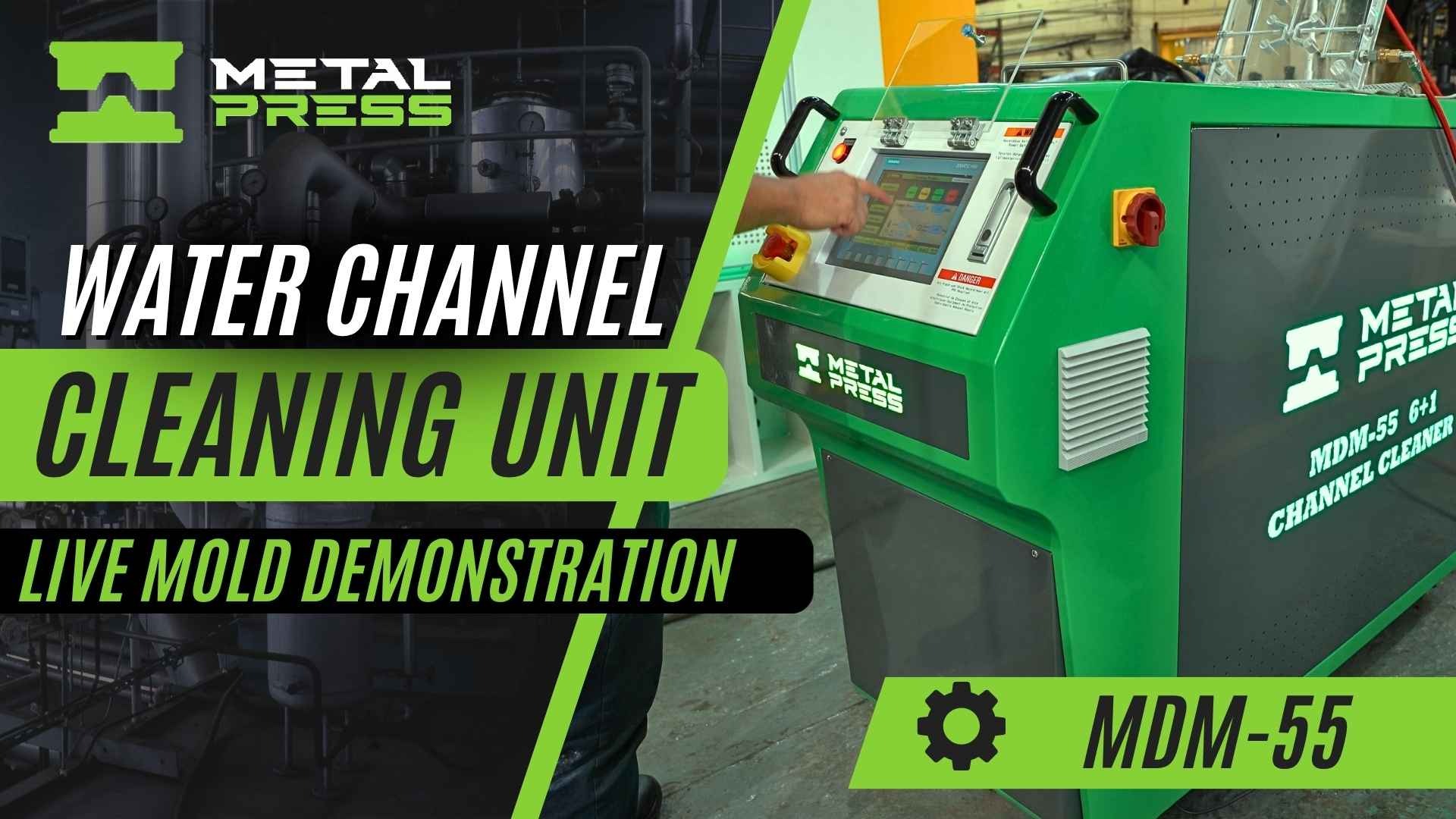
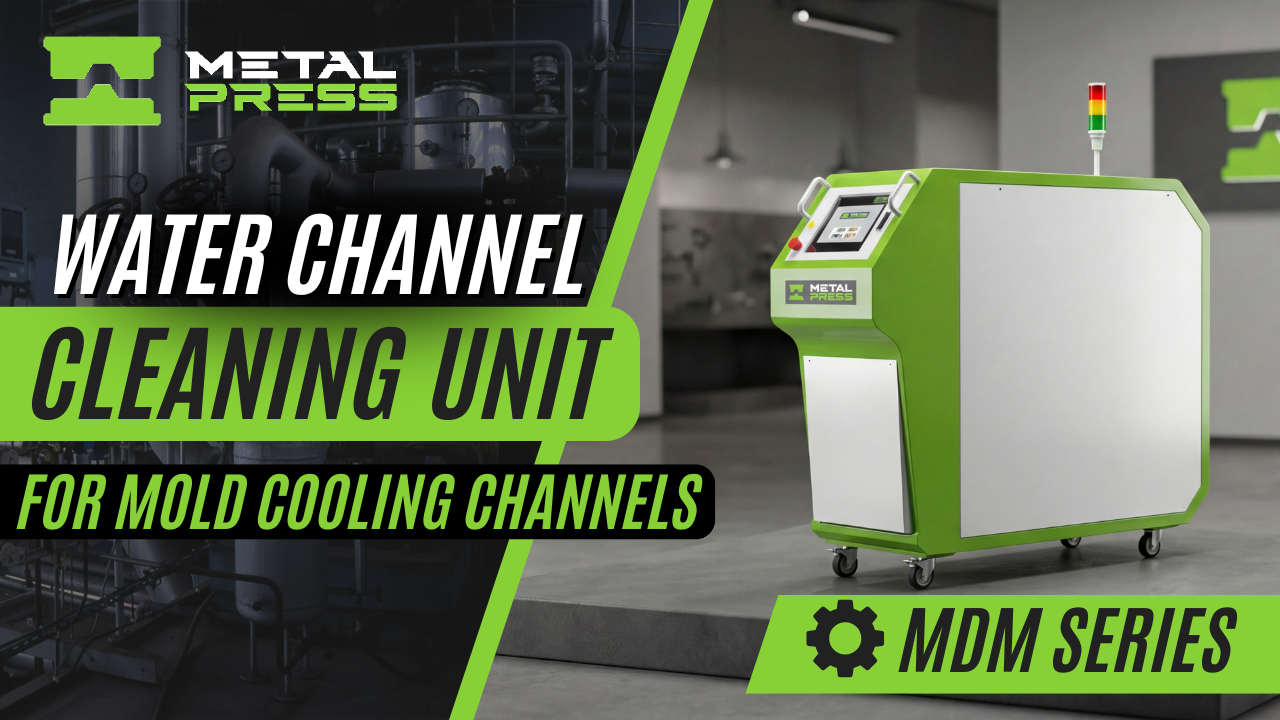
The MDM Series combines heavy-duty construction with automated, repeatable cleaning for industrial mold and die maintenance. Five standard sizes provide 2 to 7 cleaning circuits and different connection, tank, flow, and pressure ranges. Select the model from the verified cooling-circuit layout and maintenance duty—not mold weight alone.
AUTOMATIC MOLD CHANNEL CLEANING MACHINE: TECHNICAL OVERVIEW
A water channel cleaning unit is industrial maintenance equipment that connects to a mold, die, or compatible water circuit and runs a controlled cleaning cycle to remove deposits from internal passages. The MDM Series uses pulsed air-and-water action, forward and reverse flow, and monitored operating conditions to restore circulation without routine mold disassembly.
Basic hose flushing may move loose debris but may not provide repeatable pulse action, bidirectional flow, circuit-by-circuit control, measured flow, pressure and leak checks, drying, or maintenance records. A dedicated automatic mold channel cleaning machine makes the procedure more controlled and repeatable for injection-molding, die-casting, and toolroom maintenance teams.
Confirm the required number of simultaneous circuits, connection sizes, flow and pressure range, tank volume, filtration, controls, forward/reverse cleaning, blow drying, flow measurement, leak and pressure testing, and recordkeeping. Cleaning-media and material compatibility must be verified for the actual mold, seals, piping, deposits, and plant procedure.
WHY YOUR COMPANY NEEDS THIS MACHINE - PROBLEMS WITH MOLD PIPELINES
Internal Deposits and Contamination Reduce Cooling Efficiency and Production Stability
During production, mold pipelines circulate cooling media such as water or processing fluids to control mold temperature. Over time, repeated heating and cooling cycles cause mineral scale buildup, corrosion deposits, rust formation, and biological contamination including bacteria and algae growth inside cooling channels.
These contaminants restrict internal pipeline diameter and reduce heat exchange efficiency. As cooling performance declines, manufacturers may experience unstable mold temperatures, increased defect rates, longer cycle times, and higher overall production costs.

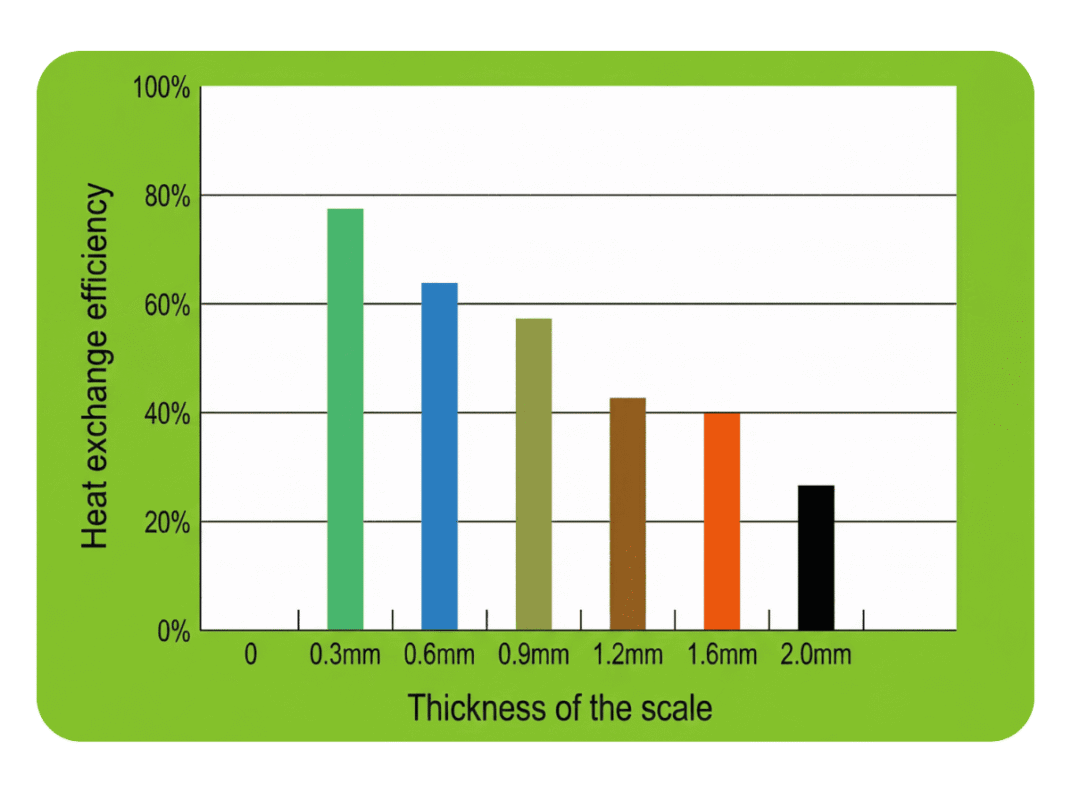
Industry research indicates that even small levels of scale buildup inside cooling pipelines can significantly reduce heat exchange performance. Maintaining clean cooling channels is essential to preserving mold efficiency, maintaining product quality, and minimizing production downtime.
WHAT IS THE IMPACT OF CLOGGED WATER CHANNELS ON PRODUCTION & EFFICIENCY?
Cooling Channel Contamination Reduces Product Quality, Slows Cycle Times, and Increases Manufacturing Costs
Defective Products:
The surface temperature of the mold cavity is not uniform, resulting
in large shrinkage and warping deformation of the product.
Lower Efficiency:
Reduced heat exchange efficiency increases cooling cycle duration and slows overall production throughput, reducing manufacturing efficiency.
Higher Costs:
Increased costs and longer production cycle times lead to higher
overall production costs for the enterprise.
Industry research indicates that even small levels of scale buildup inside cooling pipelines can significantly reduce heat exchange performance. Maintaining clean cooling channels is essential to preserving mold efficiency, maintaining product quality, and minimizing production downtime.
HOW TO RESTORE COOLING FLOW AND IMPROVE PRODUCTION EFFICIENCY IN MACHINERY?
Increase Heat Exchange Performance and Reduce Cycle Times
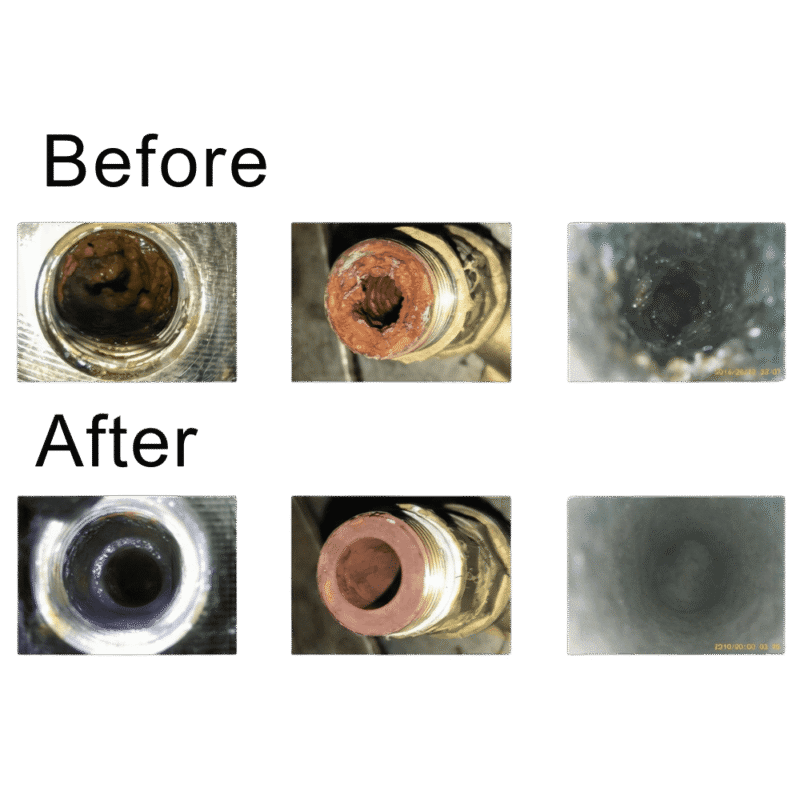
Scale buildup, rust, and biological contamination inside mold cooling channels restrict coolant flow and reduce heat exchange efficiency. Even minor buildup inside cooling pipelines can significantly increase mold surface temperatures, resulting in longer cooling times, unstable product quality, and higher defect rates.
The MDM Series restores internal channel diameter and cooling flow by removing contamination from mold cooling circuits. Improved coolant circulation stabilizes mold temperature and enhances heat transfer efficiency, allowing manufacturers to shorten cooling cycles and improve overall production throughput. In documented customer cases, improved flow performance has resulted in measurable cycle time reductions and increased hourly production output.
By restoring cooling performance, the MDM Series helps manufacturers maintain consistent part quality while maximizing production efficiency and reducing energy consumption.
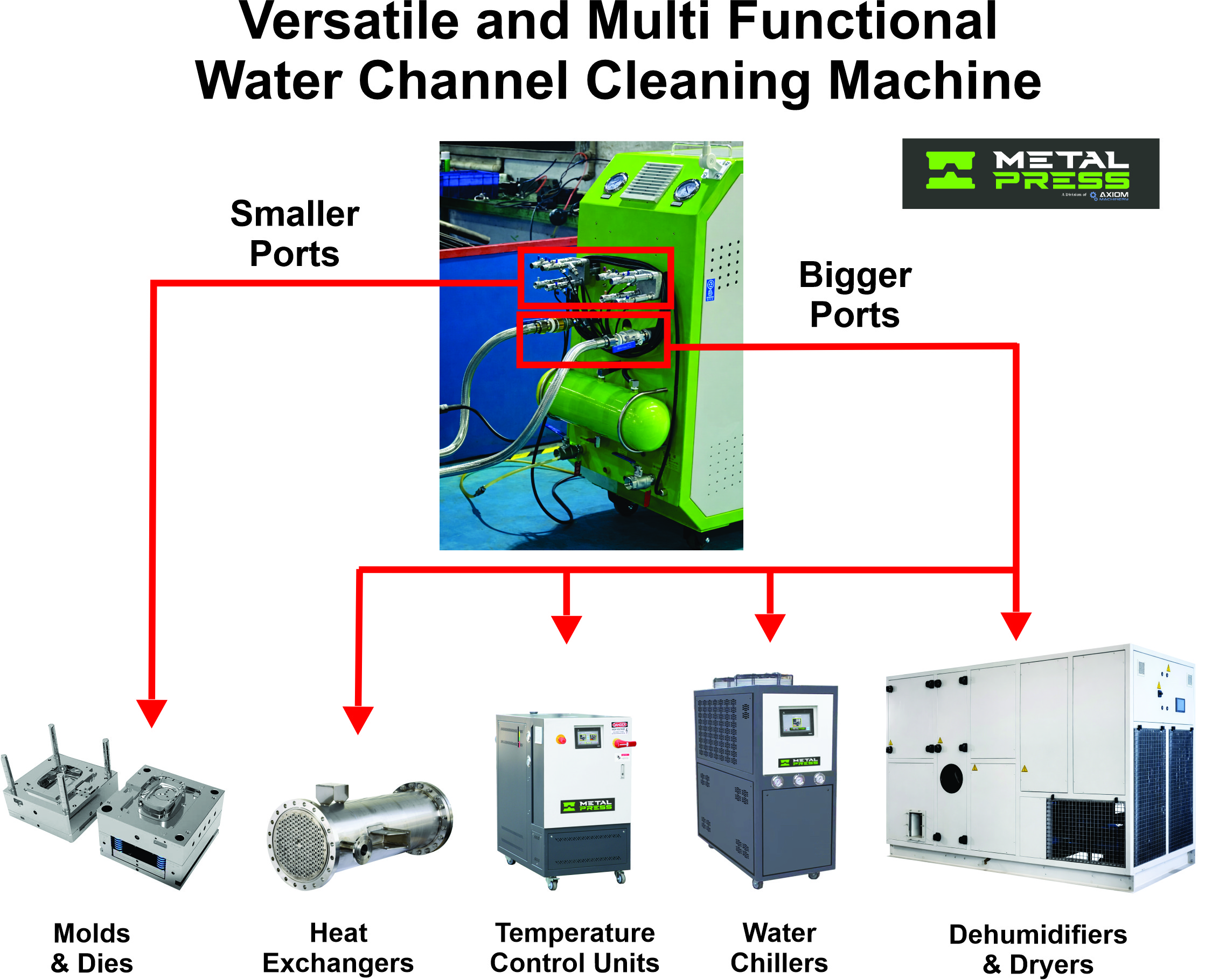
CAN THIS MACHINE CLEAN MORE THAN JUST MOLDS?
Yes. this Machine is Both Versatile and Multi Functional
The MDM Series is engineered to do far more than standard mold and die cooling channel cleaning. Designed for maximum versatility and performance, this advanced cleaning system features two independent port sizes to handle a wide range of industrial applications.
The smaller ports are optimized specifically for precision cleaning of mold and die cooling circuits, restoring proper flow, improving heat transfer efficiency, and reducing cycle times. The larger ports expand the machine’s capability beyond tooling, allowing operators to effectively clean heat exchangers, temperature control units (TCUs), water chillers, dehumidifiers, dryers, and other process equipment with internal cooling lines.
Over time, scale, rust, algae, and mineral buildup restrict flow and reduce system efficiency. The MDM Series helps eliminate these blockages, extending equipment life, stabilizing production quality, and lowering energy costs.
With its dual-port flexibility and heavy-duty industrial design, the MDM Series is a complete solution for maintaining optimal cooling performance across your entire facility.
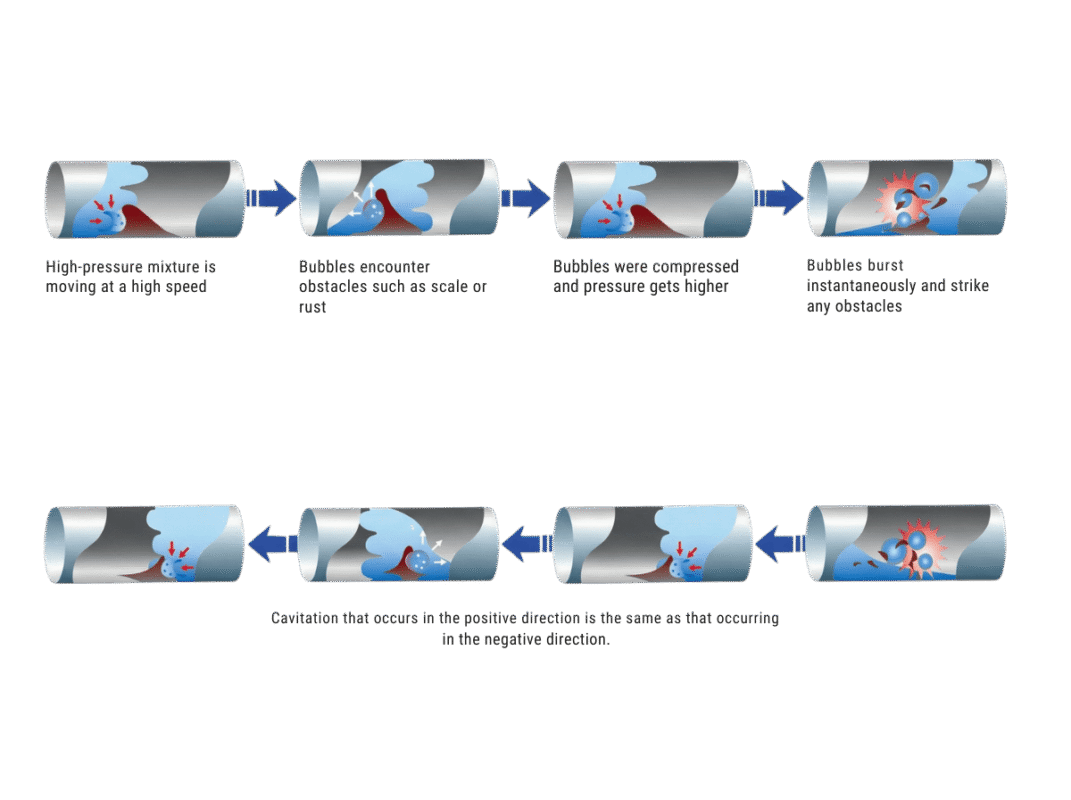
HOW DOES CAVITATION PULSE TECHNOLOGY WORK TO CLEAN WATER CHANNELS?
Simple Yet Powerful Bi-Directional Flushing for Complete Channel Cleaning Coverage
The MDM Series combines compressed air and water in controlled pulses that create rapid pressure changes and cavitation effects inside the connected passage. Alternating forward and reverse flow helps disturb deposits and move loosened contamination out of long, narrow, or complex cooling circuits. The cycle parameters must be selected for the passage geometry, blockage condition, materials, seals, and allowable pressure.
Cleaning-technology terminology: the process is also described as pulsed water channel cleaning, air water pulse cleaning, cavitation mold channel cleaning, bidirectional mold channel cleaning, forward and reverse flushing, or reverse flow cooling channel cleaning. The MDM is therefore relevant when engineers compare a water pulse channel cleaning machine, pulse mold channel cleaner, cavitation cooling channel cleaner, or cavitation pulse cleaning machine.
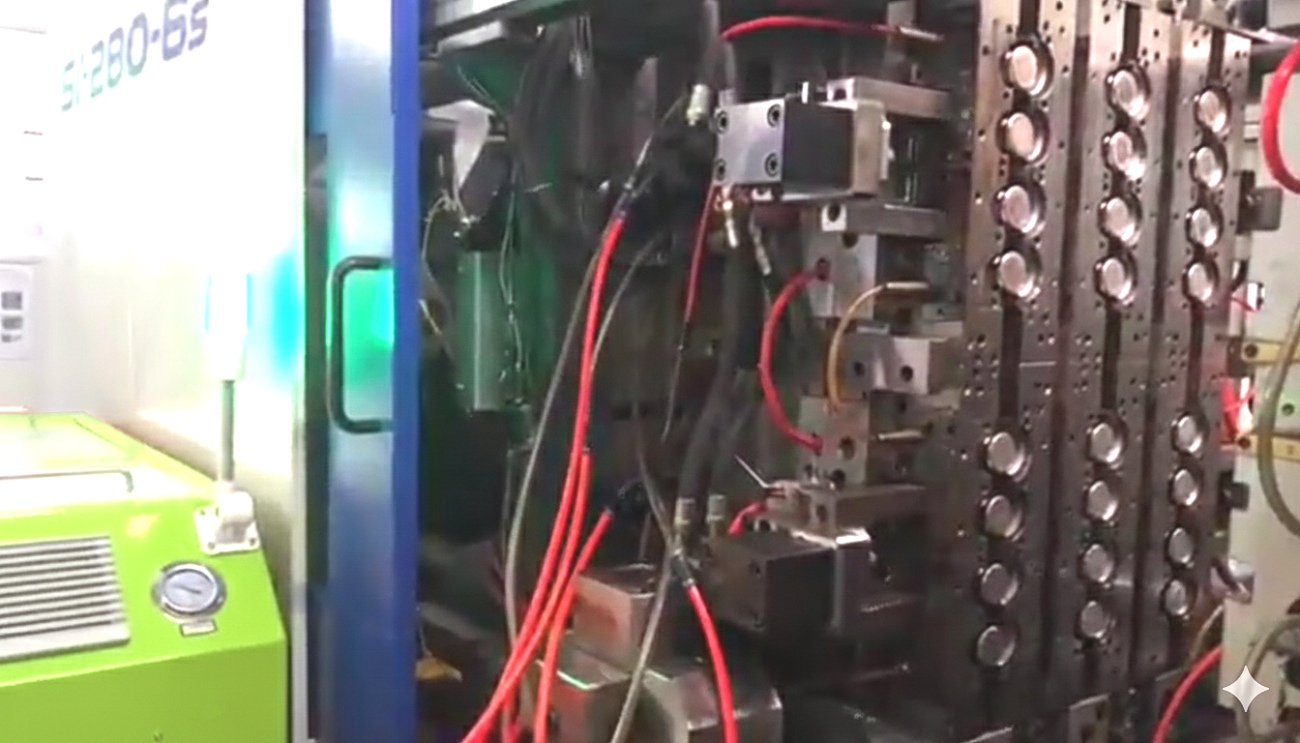
CAN YOU CLEAN MOLD CHANNELS WITHOUT REMOVING THE MOLD?
Reduce labor and Maintenance Downtime by Leaving the Mold in The Molding Machine
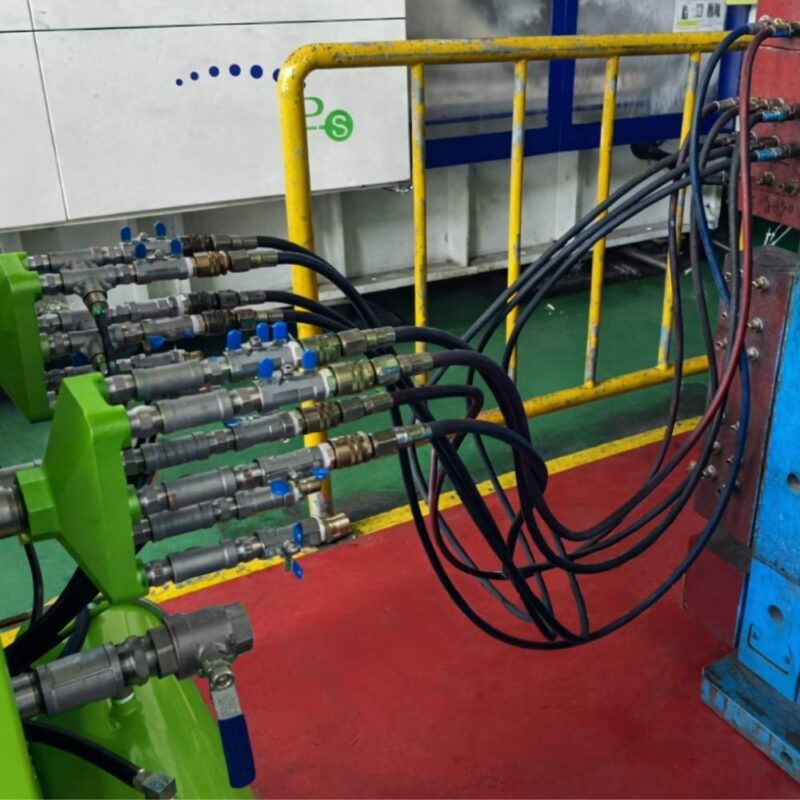
Yes. The MDM Series can clean connected mold cooling channels while the mold remains installed on an injection-molding or die-casting machine, avoiding routine removal and disassembly. The production machine must be stopped, isolated, depressurized, and prepared for maintenance before hoses are connected. In-place cleaning can reduce handling and maintenance time while protecting mold alignment and making a documented before-and-after flow check easier.
This is mold channel cleaning without mold removal, in place mold cooling channel cleaning, and mold channel cleaning without disassembly—but only within a controlled maintenance shutdown.
DOES THIS MACHINE HAVE MULTIPLE CHANNELS TO SPEED UP CLEANING?
Clean More Channels and Molds in Less Time.
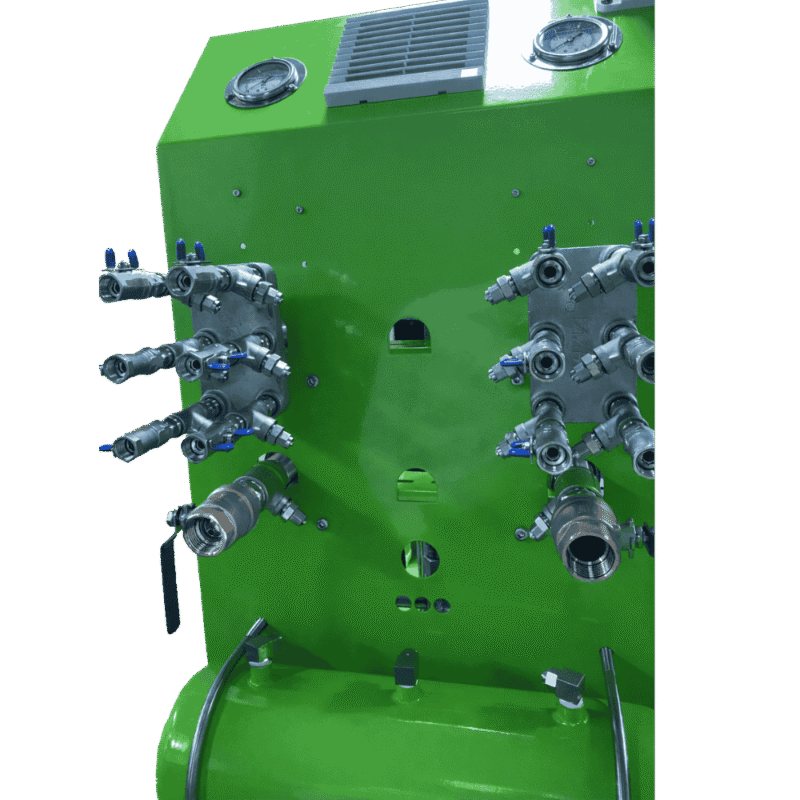
MDM models provide multiple independent cleaning circuits so several compatible mold passages can be connected during one maintenance setup. Each circuit uses controlled pulsed cleaning, while model selection determines the number of channels, connection sizes, flow, pressure, and tank capacity available. This multi-circuit arrangement helps high-volume injection-molding and die-casting facilities reduce setup time and standardize the cleaning process.
For purchasing specifications, this can be described as a multi channel cleaning machine for molds, a multi circuit mold cleaning unit, or simultaneous cooling channel cleaning equipment. Confirm the number of circuits that can be connected and independently verified on the selected model.
DOES THIS MACHINE HAVE LEAKAGE AND PRESSURE DETECTION?
Built-In Monitoring for Safe and Reliable Cleaning Performance
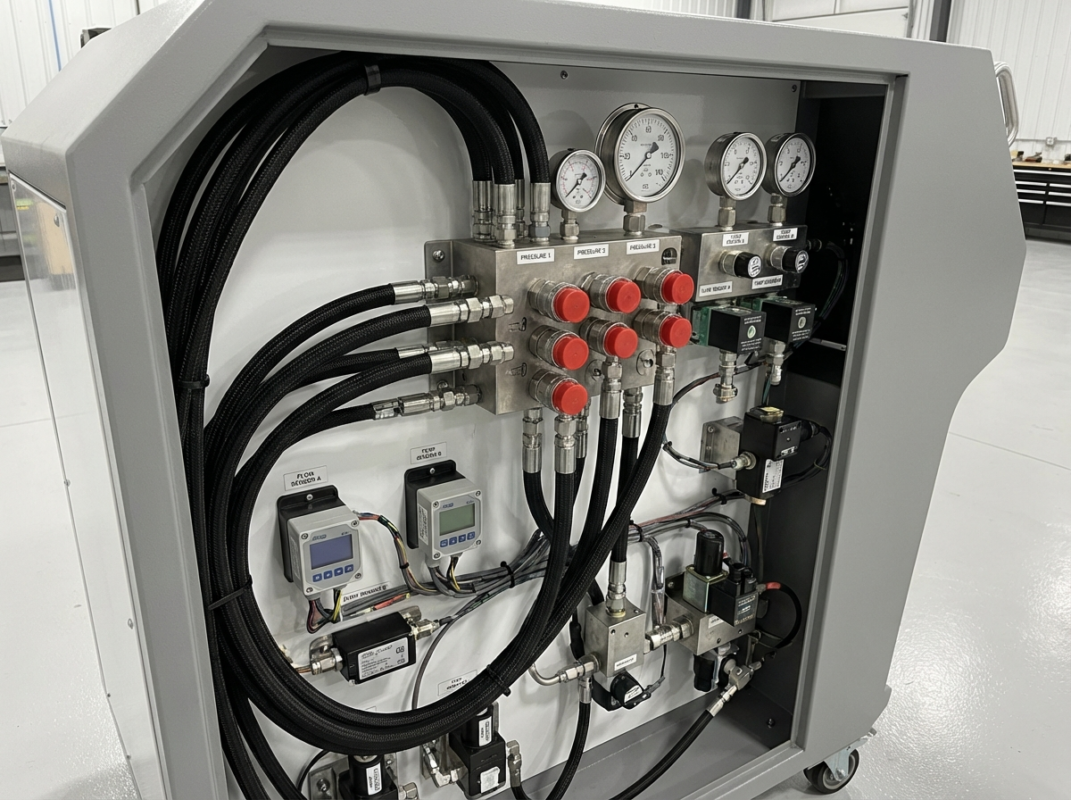
The MDM Series can check pressure and leakage conditions in the connected mold or system. These functions help maintenance teams identify abnormal pressure behavior, restrictions, and possible leakage before the tool returns to production. Final test pressure, acceptance limits, and the interpretation of results must follow the mold builder’s specifications and the plant’s approved procedure.
These functions support mold cooling channel flow testing, mold cooling circuit flow measurement, cooling channel flow verification, a before and after cleaning flow test, mold cooling channel leak testing, a mold water circuit leak test, and cooling circuit pressure testing. Acceptance limits remain application-specific.
CAN THIS MACHINE ALSO AUTOMATICLY BLOW DRY THE WATER CHANNELS AFTER CLEANING?
Remove Residual Moisture to Prevent Corrosion and Contamination
The MDM Series includes automatic blow drying to purge residual water after the cleaning and rinse cycle. Removing retained moisture helps prepare the passage for storage, inspection, reconnection, or return to service and can reduce the conditions that encourage internal corrosion and biological growth.
The drying function supports mold cooling channel drying, automatic air purge after cleaning, and cooling channel blow drying as documented maintenance steps.
DOES THIS MACHINE HAVE A FULLY AUTOMATED CLEANING AND MONITORING SYSTEM?
Consistent, Repeatable Maintenance With Minimal Operator Input
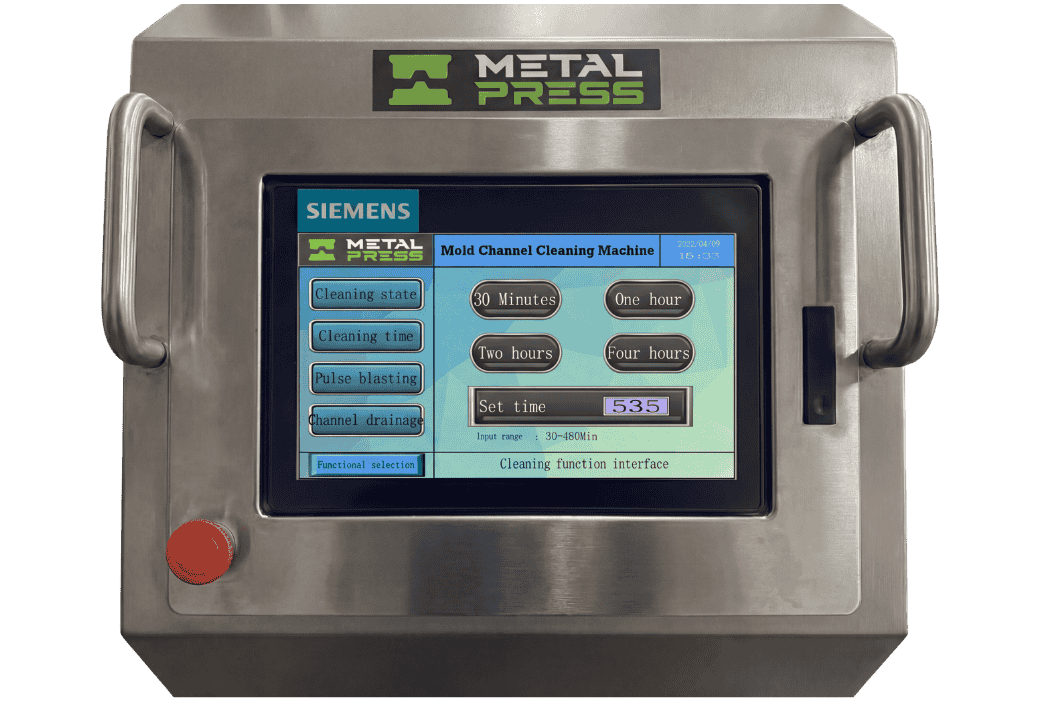
The MDM Series uses PLC and touchscreen controls to manage cleaning sequences and regulate operating parameters. Built-in monitoring can track flow, pressure, and leakage conditions, while downloadable cleaning data and maintenance logs support repeatable procedures, before-and-after verification, preventive-maintenance scheduling, and quality records.
This feature set supports automated cooling channel cleaning and the use of a PLC controlled channel cleaner in repeatable production-maintenance programs.
FASTER MAINTENANCE
FASTER THAN TRADITIONAL CLEANING METHODS
Reduce Downtime While Eliminating Mold Removal and Chemical Cleaning
| Items | Maintenance Method | Remove Mold Required | Cleaning Time | Consumables | Deficiency |
|---|---|---|---|---|---|
| MetalPress MDM | Cavitation blasting, physical flushing, positive and negative direction cleaning | Mold can be cleaned on the injection machine – no removal required | 30 minutes to 4 hours | No | No |
| Manual Cleaning | Iron tools, brushes, electric drill, and other manual tools | Mold must be removed and opened | 4 hours to 72 hours | No | Frequent removal can affect mold precision and requires significant labor and time |
| Chemical Cleaning | Acid and alkaline chemical flushing | Mold must be removed from injection machine | 2 hours to 8 hours | Chemicals required | Potential corrosion risk and chemical handling concerns |

WE USE ONLY HIGH QUALITY COMPONENTS
We Use Brand Name Components You Know, Already Use and Trust.
We use only the finest quality components that are open source, and readily available locally in your area, or from our online parts store.We do not use any impossible to find proprietary components.
WE OFFER THE HIGHEST RETURN ON INVESTMENT
We Give You More Value for Your Money.
To be competitive today’s economy requires that manufactures run their operations more efficiently and cost effectively than ever before. We offer the highest ROI (return on investment) in the industry. MetalPress gives you high quality products for are resonable investment and with more features than any other company

MOLD / DIE SIZE CLASSIFICATION
Typical Applications Based on Size
MOLD / DIE SIZE CLASSIFICATION TABLE – US STANDARD | |||||
| Model | Mold/Die Size | Footprint (inches) | Height (inches) | Weight (lbs) | Typical Applications |
| MDM-11 | Small | Up to 18″ x 18″ | 6 – 18 | 50 – 500 | Small plastic injection molds, prototype injection molds, small rubber compression molds |
| MDM-15 | Small to Medium | 18″ – 36″ | 12 – 24 | 500 – 3,000 | Plastic injection molds, structural foam molds, blow molds, thermoset molds |
| MDM-22 | Medium | 36″ – 60″ | 24 – 48 | 3,000 – 15,000 | Large plastic injection molds, multi-cavity molds, aluminum die casting molds, compression molds |
| MDM-30 | Medium to Large | 60″ – 96″ | 36 – 60 | 15,000 – 40,000 | Automotive injection molds, large die casting molds, structural foam molds, SMC/BMC compression molds |
| MDM-55 | Large | 96″ – 144″+ | 48 – 72+ | 40,000 – 150,000+ | Large automotive injection molds, bumper/fascia molds, high-pressure die casting molds, large compression molds |
MOLD / DIE SIZE CLASSIFICATION TABLE – METRIC STANDARD | |||||
| Model | Mold/Die Size | Footprint (mm) | Height (mm) | Weight (kg) | Typical Applications |
| MDM-11 | Small | Up to 450 x 450 | 150 – 450 | 25 – 225 | Small plastic injection molds, prototype injection molds, small rubber compression molds |
| MDM-15 | Small to Medium | 450 – 900 | 300 – 600 | 225 – 1,360 | Plastic injection molds, structural foam molds, blow molds, thermoset molds |
| MDM-22 | Medium | 900 – 1500 | 500 – 1200 | 1,500 – 7,000 | Large plastic injection molds, multi-cavity molds, aluminum die casting molds, compression molds |
| MDM-30 | Medium to Large | 1500 – 2400 | 900 – 1500 | 7,000 – 18,000 | Automotive injection molds, large die casting molds, structural foam molds, SMC/BMC compression molds |
| MDM-55 | Large | 2400 – 3600+ | 1200 – 1800+ | 20,000 – 70,000+ | Large automotive injection molds, bumper/fascia molds, high-pressure die casting molds, large compression molds |
5 STANDARD MDM SIZES
Flexible Range of Applications.
| SPECIFICATIONS – US STANDARD | |||||
| Model | MDM-11 | MDM-15 | MDM-22 | MDM-30 | MDM-55 |
| Number of Channels (each channel has 1 input and 1 output) | 2 | 4 | 4 + 1 | 6 + 1 | 6 + 1 |
| Connection Size | 3/8″ × 4 | 3/8″ × 8 | 3/8″ × 8 + 1″ × 2 | 3/8″ × 12 + 1″ × 2 | 1/2″ × 12 + 1-1/2″ × 2 |
| Applicable Mold/Die Size | Small Mold/Die | Small to Medium Mold/Die | Medium Mold/Die | Medium to Large Mold/Die | Large Mold/Die |
| Water Tank Volume | 10.6 gal | 26.4 gal / 13.2 gal + 13.2 gal | 26.4 gal / 13.2 gal + 13.2 gal | 31.7 gal / 15.8 gal + 15.8 gal | 31.7 gal / 15.8 gal + 15.8 gal |
| Water Flow | 8 gal/min (max) | 13 gal/min (max) | 22 gal/min (max) | 44 gal/min (max) | 66 gal/min (max) |
| Number Of Water Tanks | One | One or two | One or two | One or two | One or two |
| Power of Water Pump | 1.5 hp | 2 hp | 3 hp | 4 hp | 7.5 hp |
| Overall Dimension (L × W × H) | 39.4 × 19.7 × 31.5 in | 55.1 × 19.7 × 47.2 in | 55.1 × 19.7 × 47.2 in | 63 × 23.6 × 47.2 in | 63 × 23.6 × 47.2 in |
| Weight | 397 lbs | 794 lbs | 860 lbs | 1,014 lbs | 1,014 lbs |
| SPECIFICATIONS – METRIC STANDARD | |||||
| Model | MDM-11 | MDM-15 | MDM-22 | MDM-30 | MDM-55 |
| Number of Channels (each channel has 1 input and 1 output) | 2 | 4 | 4 + 1 | 6 + 1 | 6 + 1 |
| Connection Size | DIN 10 × 4 | DIN 10 × 8 | DIN 10 × 8 + DIN 25 × 2 | DIN 10 × 12 + DIN 25 × 2 | DIN 15 × 12 + DIN 40 × 2 |
| Applicable Mold/Die Size | Small Mold/Die | Small to Medium Mold/Die | Medium Mold/Die | Medium to Large Mold/Die | Large Mold/Die |
| Water Tank Volume | 40 L | 100 L / 50 L + 50 L | 100 L / 50 L + 50 L | 120 L / 60 L + 60 L | 120 L / 60 L + 60 L |
| Water Flow | 30 L/min (max) | 50 L/min (max) | 83 L/min (max) | 166 L/min (max) | 250 L/min (max) |
| Number Of Water Tanks | One | One or two | One or two | One or two | One or two |
| Power of Water Pump | 1.1 kW | 1.5 kW | 2.2 kW | 3 kW | 5.5 kW |
| Overall Dimension (L × W × H) | 1000 × 500 × 800 mm | 1400 × 500 × 1200 mm | 1400 × 500 × 1200 mm | 1600 × 600 × 1200 mm | 1600 × 600 × 1200 mm |
| Weight | 180 kg | 360 kg | 390 kg | 460 kg | 460 kg |
Applications of the Water Channel Cleaning Unit
Injection molds rely on precise cooling to maintain cycle times and part quality. Over time, internal channels accumulate scale, rust, and mineral deposits that restrict flow. The MDM Series removes these blockages through controlled flushing, restoring coolant circulation and stabilizing mold temperature. This application is essential for facilities experiencing longer cycle times, inconsistent cooling, or hot‑spot defects.
Die‑casting molds operate under extreme thermal loads, making clean cooling channels critical for preventing thermal fatigue and premature mold wear. The MDM Series flushes out oxide buildup, corrosion, and casting residue that accumulate inside cooling circuits. This improves heat extraction, reduces thermal shock, and extends mold life in high‑pressure die‑casting environments.
Modern molds often use conformal cooling channels created through additive manufacturing. These channels are narrow, complex, and prone to clogging. The MDM Series provides the controlled flow and pressure needed to clean these intricate pathways without damaging the mold. This application ensures that conformal cooling systems maintain their designed thermal performance.
Mold shops use the MDM Series as part of routine preventive maintenance to keep molds in optimal condition before they return to production. Regular cleaning prevents scale buildup, reduces emergency repairs, and ensures molds perform consistently across long production runs. This application supports predictable scheduling and reduces unplanned downtime.
Beyond molds, many facilities use the MDM Series to clean internal passages in heat exchangers, temperature control units (TCUs), and auxiliary cooling equipment. Removing scale and sludge improves heat‑transfer efficiency, reduces energy consumption, and stabilizes coolant temperatures across the entire thermal‑control system.
Molds with long or narrow channels are especially vulnerable to flow restriction. The MDM Series uses controlled flushing cycles to dislodge deposits that accumulate deep inside the cooling circuit. This application is valuable for molds that show uneven cooling, pressure spikes, or reduced flow rates during production.
High‑cavity molds require uniform cooling across all cavities to maintain dimensional accuracy and cycle consistency. The MDM Series ensures that each cooling circuit is free of blockages, preventing cavity‑to‑cavity temperature variation. This application is essential for packaging, medical, and consumer‑goods manufacturers running high‑volume production.
During mold repair or refurbishment, the MDM Series is used to clean cooling channels before inspection or reassembly. Removing internal contamination allows technicians to verify flow rates, detect leaks, and ensure the mold is ready for production. This application improves mold reliability and reduces startup issues after maintenance.
FREQUENTLY ASKED QUESTIONS ABOUT THE MDM MOLD CHANNEL CLEANER
The physical pulsed-cleaning process is intended to loosen and flush scale, rust, mineral buildup, sludge, biological contamination, and other deposits that restrict compatible water passages. The deposit type, passage material, seals, and cleaning-media compatibility must be reviewed before the procedure.
Record baseline flow, pressure behavior, temperature symptoms, and the affected circuit before cleaning. After cleaning and rinsing, repeat the flow and pressure checks under comparable conditions, inspect the discharged contamination, perform the approved leak test, and save the maintenance record.
The controlled pulse and bidirectional-flow process can be considered for long, narrow, and conformal passages. Verify the channel geometry, additive-manufactured material, allowable pressure, deposit type, and connection method. See conformal cooling passage cleaning for application guidance.
Yes. A preventive program can establish baseline flow, intervention thresholds, cleaning intervals, before-and-after verification, drying, and records. See the preventive mold cooling maintenance guide for planning factors.
Yes. MetalPress serves buyers evaluating a mold channel cleaning machine supplier, water channel cleaning machine supplier, mold cooling channel cleaner manufacturer, or industrial mold channel cleaner. Rather than offering one fixed mold water channel cleaning machine for sale or water channel cleaning unit for sale, the team matches model, circuits, connections, flow, pressure, controls, testing, drying, and records to the application. Request a mold channel cleaning machine quote, water channel cleaning unit quotation, or mold cooling circuit cleaner quote with the verified duty. If the project is described as a mold descaling machine for sale, also identify the deposit and approved cleaning method.
Related Projects & Posts
Water Channel Cleaning Units: The Essential Solution for Mold Cooling System Maintenance
Maintaining efficient mold cooling systems is one of the most critical factors in achieving consistent product quality, reducing cycle times, and extending mold life in industrial manufacturing. Water channel cleaning unit is not only an option but also a necessity for a an efficient cooling system.
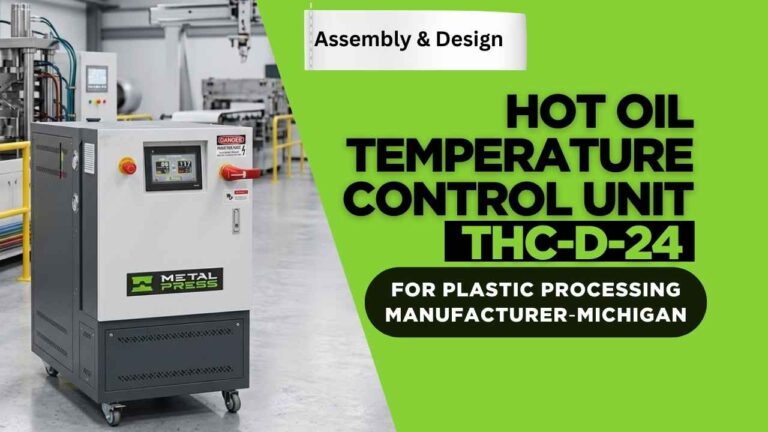
THC-D-24 Hot Oil Temperature Control Unit Design & Assembly Project
Read the rocess of ordering, design and assembly of a THC-D-24 hot oil control temperature unit for a plastic manufacturer in Michigan, USA
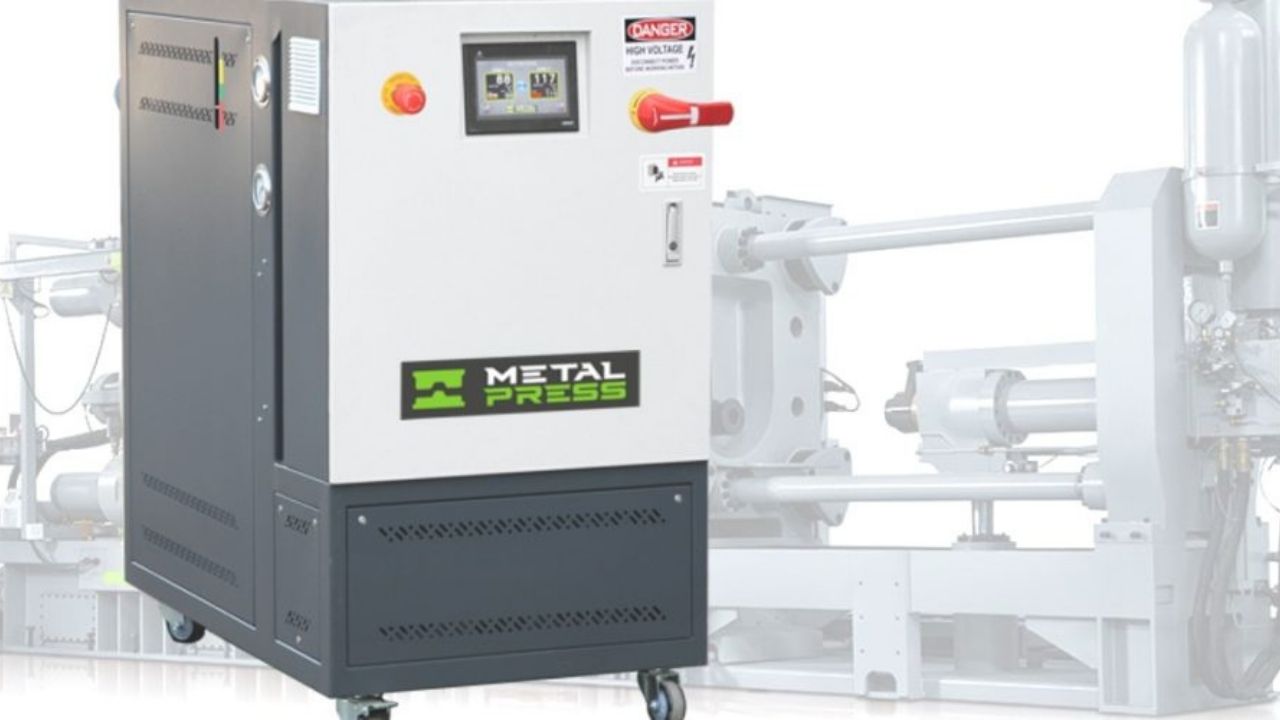
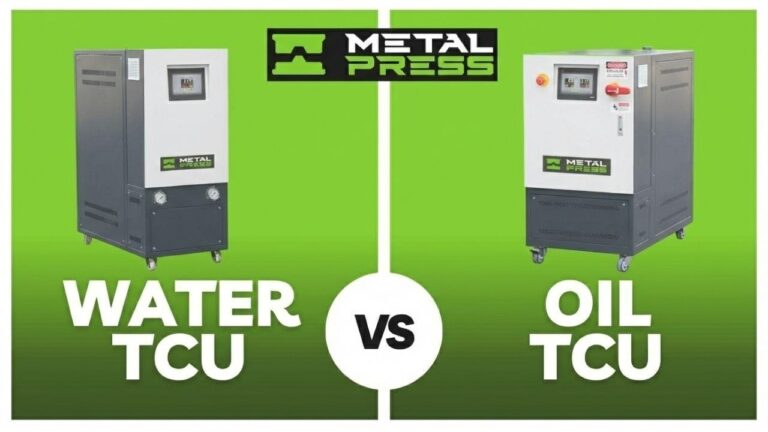
Importance of temperature control unit sizing
To increase the stability and efficiency of the die casting system, the characteristics and sizing of the temperature control unit is of vital importance.

WATER CHANNEL CLEANING UNITS: THE ESSENTIAL SOLUTION FOR MOLD COOLING SYSTEM MAINTENANCE
Learn how water channel cleaning units help maintain mold cooling performance and reduce contamination in tooling channels.
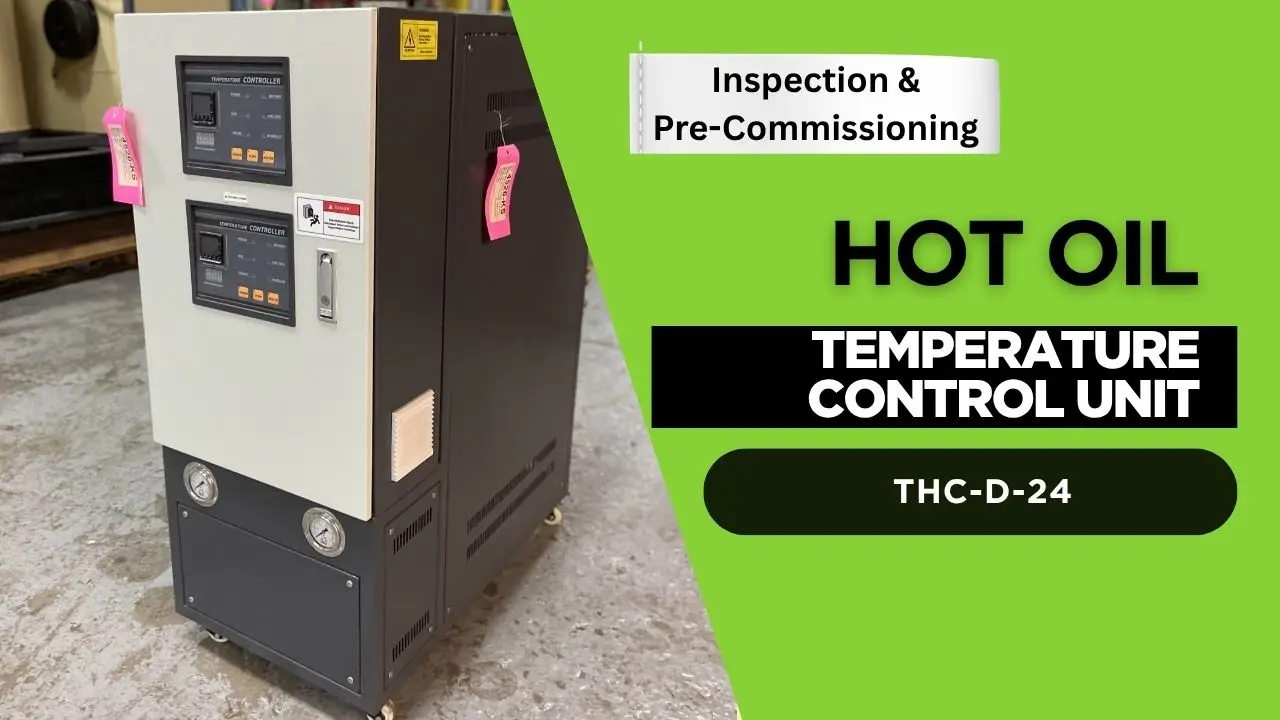
FINALIZING & PRECOMMISSIONING THE THC‑D‑24 HOT OIL TEMPERATURE CONTROL UNIT
See finalizing and precommissioning steps for a hot-oil temperature control unit before delivery.
Expert Advice
Specify the circuit, not just the machine name
A correct MDM selection starts with the actual cooling circuit: passage geometry, number of connections, materials, allowable pressure, deposit condition, baseline flow, test method, drying requirement, and maintenance frequency. The product page should remain the source for MDM specifications and quotation intent; supporting pages explain when and how the equipment fits the process.
Common equipment terminology: Water channel cleaning machine, water channel cleaner, water channel cleaning system, mold water channel cleaning machine, mold water channel cleaning unit, mold channel cleaner, mold channel cleaning machine, mold cooling channel cleaning machine, mold cooling channel cleaner, cooling channel cleaning unit, cooling channel cleaning equipment, mold cooling circuit cleaning unit, mold cooling circuit cleaner, mold cooling system cleaning machine, cooling circuit cleaning equipment, mold water line cleaning machine, mold cooling passage cleaner, and mold cooling line cleaning equipment are common sourcing names for this same maintenance-equipment family. The verified circuit duty determines the correct MDM configuration.
Related engineering resources: Application hub · Cleaning and verification guide · TCU application guidance
The MetalPress MDM Series is an automatic water channel cleaning unit for injection molds, die-casting dies, conformal cooling circuits, and other compatible water systems. Controlled air-and-water pulses with forward and reverse flow help remove scale, rust, mineral deposits, sludge, and contamination that restrict coolant flow and heat transfer.
Multiple cleaning circuits, PLC control, flow monitoring, pressure and leakage checks, maintenance records, and automatic blow drying support a repeatable process. MetalPress selects the MDM size from the circuit layout, passage geometry, connection sizes, blockage condition, cleaning frequency, utilities, and verification requirements.