

Blog
Compression Molding, Powder Pressing, and Advanced Press Technologies


Introduction
Beyond traditional metal forming and forging, hydraulic presses play a critical role in a range of advanced manufacturing processes that rely on controlled pressure, temperature, and dwell time. Among these, compression molding, powder pressing, and related advanced press technologies are essential for producing polymer, composite, ceramic, and powder-metal components with consistent mechanical properties and dimensional stability.
These processes differ from conventional metal forming in that material flow, consolidation, and bonding often occur simultaneously. Hydraulic presses are particularly well suited for these applications because they can apply uniform pressure over large areas, maintain force for extended periods, and integrate thermal and electronic control systems. This article provides a technical overview of compression molding, powder pressing, and related advanced press technologies, with emphasis on process mechanics and press requirements.
Overview of Compression-Based Manufacturing Processes
Fundamentals of Compression Molding
Compression molding is a manufacturing process in which a measured amount of material is placed into a heated mold cavity and compressed under pressure until it takes the shape of the mold.
The process typically consists of:
Material placement
Mold closure
Pressure application
Heat-assisted curing or flow
Controlled cooling and demolding
Compression molding is widely used for thermoset polymers, rubber compounds, and fiber-reinforced composites.
Why Hydraulic Presses Are Used in Compression Molding
Hydraulic presses offer several advantages for compression molding:
Ability to apply uniform pressure across the mold surface
Precise control of closing speed and force
Capability to maintain pressure during long cure cycles
Integration with heated platens
Mechanical presses are generally unsuitable for long dwell times, making hydraulic presses the standard choice.
Applications of Compression Molding
Compression molding is used in industries such as:
Automotive (structural and semi-structural components)
Electrical insulation and enclosures
Industrial elastomer products
Composite panels and laminates
Uniform pressure application is critical for achieving consistent part thickness and mechanical properties.
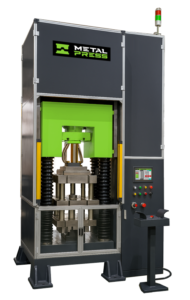
MetalPress MAchinery provides a wide variety of different presses inculding powder compaction servo press (MPC-SV Series)
👉 Looking for more information about our MPC-SV Series? Click to read more and find the request for information on our MPC-SV products.
Heated Platen Hydraulic Presses
Heated platen presses are a specialized type of hydraulic press used in compression molding and laminating operations.
Key features include:
Electrically or fluid-heated platens
Precise temperature control
Parallel platen motion
These presses are commonly used for:
Rubber molding
Composite curing
Thermoset plastic processing
Temperature uniformity across the platen surface is a critical design consideration.
Powder Pressing and Powder Metallurgy
Fundamentals of Powder Pressing
Powder pressing involves compacting metal, ceramic, or composite powders into a defined shape using compressive force. The resulting “green compact” is subsequently sintered to achieve final strength and density.
Key variables in powder pressing include:
Compaction pressure
Dwell time
Powder particle size and distribution
Die wall friction
Hydraulic presses provide the force control necessary to manage these variables effectively.
Hydraulic Presses in Powder Metallurgy
In powder metallurgy, hydraulic presses are used for:
Uniaxial pressing
Multi-level pressing
Large or complex compacts
Hydraulic presses allow gradual pressure application, reducing density gradients and minimizing cracking.
Advantages Over Mechanical Presses
Hydraulic presses are preferred for powder pressing when:
High compaction pressures are required
Part geometry is complex
Density uniformity is critical
Mechanical presses are typically used for very high-speed, high-volume powder compaction but offer less control.
Ceramic and Advanced Material Pressing
Hydraulic presses are also used to compact ceramic powders and advanced materials.
Applications include:
Structural ceramics
Technical ceramics
Refractory components
These materials often require precise pressure profiles to avoid defects such as lamination or cracking.
Composite Pressing and Lamination
Composite materials, such as fiber-reinforced polymers, require controlled pressure and temperature to ensure proper fiber wet-out and bonding.
Hydraulic presses are used for:
Sheet molding compound (SMC) processing
Laminate consolidation
Structural composite panels
Press stiffness and platen parallelism are essential to prevent thickness variation and fiber distortion.
Elastomer and Rubber Pressing
Rubber and elastomer processing often involves compression molding using heated hydraulic presses.
Key process requirements include:
Controlled pressure during curing
Uniform heat distribution
Long dwell times
Hydraulic presses are capable of maintaining pressure throughout the curing process, ensuring consistent material properties.
Advanced Press Control Technologies
Rubber and elastomer processing often involves compression molding using heated hydraulic presses.
Key process requirements include:
Controlled pressure during curing
Uniform heat distribution
Long dwell times
Hydraulic presses are capable of maintaining pressure throughout the curing process, ensuring consistent material properties.
Servo-Hydraulic Systems
Servo-hydraulic presses integrate servo-controlled pumps or valves to improve:
Energy efficiency
Response time
Process precision
These systems reduce energy consumption by matching pump output to process demand.
Automation and Process Integration
Advanced hydraulic presses can be integrated with:
Robotic material handling
Automated mold loading
Data acquisition systems
Automation improves consistency, traceability, and production efficiency, especially in high-value manufacturing environments.
Quality Control and Process Monitoring
Hydraulic presses support real-time monitoring of:
Applied force
Displacement
Temperature
Data collected during pressing cycles can be used for:
Statistical process control
Defect detection
Traceability
This capability is particularly important in regulated industries.
Economic and Production Considerations
Compression molding and powder pressing processes often involve:
Higher cycle times
Lower production volumes
Higher part value
Hydraulic presses provide the flexibility required to accommodate product variation without extensive retooling.
Safety Considerations
Presses used for compression molding and powder pressing operate under high force and, often, elevated temperatures.
Safety measures include:
Thermal insulation
Guarding and interlocks
Pressure relief systems
Compliance with applicable safety standards is essential.
Conclusion
Hydraulic presses are indispensable in compression molding, powder pressing, and advanced material processing applications. Their ability to deliver controlled pressure, maintain force during dwell, and integrate thermal and electronic controls makes them uniquely suited for these manufacturing processes.
As industries increasingly adopt advanced materials and composites, hydraulic press technology continues to evolve to meet the demands of precision, efficiency, and reliability.
References
Groover, M. P. Fundamentals of Modern Manufacturing, Wiley.
German, R. M. Powder Metallurgy and Particulate Materials Processing, Metal Powder Industries Federation.
Kalpakjian, S., & Schmid, S. Manufacturing Processes for Engineering Materials, Pearson Education.
ASM Handbook, Volume 21: Composites, ASM International.
ASTM B243 – Standard Terminology of Powder Metallurgy.
ISO 4413:2010 – Hydraulic Fluid Power — General Rules and Safety Requirements.
Strong, A. B. Plastics: Materials and Processing, Pearson.
Let Us Make Your Next Press
Whether you’re located in the USA, Canada, Mexico, or South America, you can contact us for more information, pricing, and consultations through our online forms, or by phone or email.