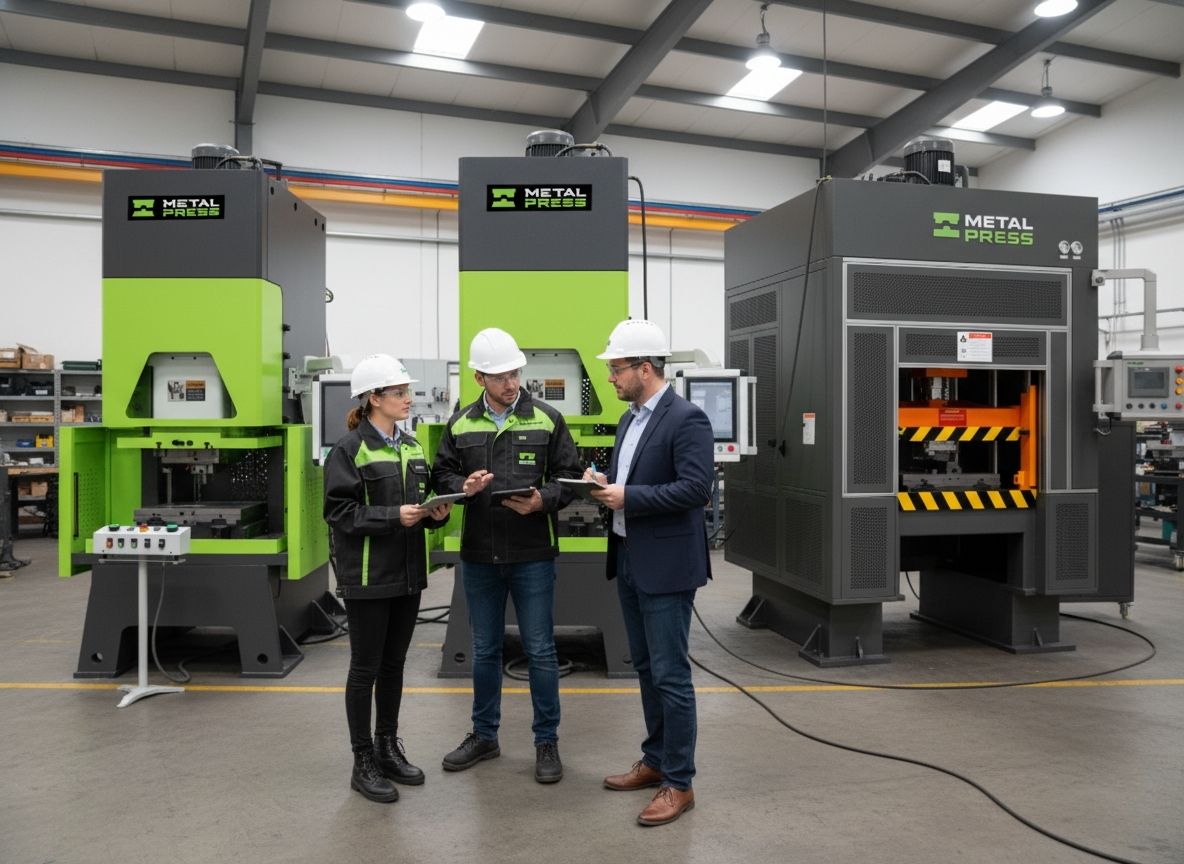
Selecting, operating, and maintaining a hydraulic press involves far more than choosing a tonnage rating. From an engineering and operational standpoint, hydraulic presses are capital-intensive industrial assets whose performance, safety, and lifecycle cost depend on proper specification, installation, operation, and maintenance.
Inadequate press selection can result in excessive deflection, premature wear, safety risks, and reduced product quality. Conversely, a well-specified and properly maintained hydraulic press can operate reliably for decades. This article provides a technical overview of how hydraulic presses are evaluated for purchase, how pricing is influenced, and how safety and maintenance practices ensure long-term reliability and compliance.
Factors to Consider When Buying a Hydraulic Press
Required Tonnage
Tonnage refers to the maximum force the press can apply. It is determined by:
Material yield strength
Part geometry
Tooling design
Safety margin
Under-sizing a press can lead to:
Incomplete forming
Excessive wear
Structural overload
Over-sizing, while safer, increases capital and operating costs. Engineers typically calculate required tonnage using material flow stress models and apply a conservative safety factor.
Stroke Length and Daylight
Stroke length is the maximum travel of the ram, while daylight refers to the maximum distance between the bed and ram when fully open.
These parameters must accommodate:
Tool height
Workpiece thickness
Loading and unloading requirements
Insufficient daylight can severely limit tooling options.
Press Frame Type
Frame design directly impacts stiffness, accuracy, and safety.
Common considerations include:
C-frame presses for accessibility
H-frame presses for rigidity
Four-column presses for precision and parallelism
Frame deflection under load must remain within acceptable limits to maintain dimensional accuracy.
Control System and Automation
Modern hydraulic presses may include:
Force control
Position control
Programmable dwell times
Data logging
Automation compatibility is increasingly important for traceability, quality control, and integration into manufacturing cells.
👉 MetalPress provides sophisticated designs and engineered products in metal stamping industy. Visit our product pages and contact our specialists for any inquiry
Improper foundations can lead to misalignment and premature failure.
Hydraulic System Commissioning
Commissioning includes:
Hydraulic fluid flushing
Pressure testing
Leak inspection
Control system verification
Contamination control during commissioning is critical for long-term reliability.
Maintenance of Hydraulic Presses
Preventive Maintenance Philosophy
Hydraulic presses benefit from preventive maintenance, which addresses wear and degradation before failure occurs.
Key objectives include:
Maintaining performance
Reducing unplanned downtime
Extending component life
Hydraulic Fluid Maintenance
Hydraulic fluid condition directly affects system performance.
Maintenance tasks include:
Regular fluid sampling
Filtration monitoring
Fluid replacement at defined intervals
Contaminated fluid is one of the leading causes of hydraulic system failure.
Beyond fluid level and visual condition, long-term press reliability depends on controlling hydraulic fluid contamination, moisture content, and particle levels, which may require periodic filtration, sampling, or oil analysis in demanding production environments.
Periodic inspection helps detect fatigue or misalignment early.
Seal and Hose Maintenance
Seals and hoses degrade over time due to:
Pressure cycling
Temperature
Chemical exposure
Replacing worn seals prevents leaks and pressure loss.
Hydraulic press maintenance isn’t one-size-fits-all — frequency and depth depend on usage, environment, and machine design. Light production shops may perform basic daily checks, while heavy production or multi-shift environments benefit from a formal schedule (daily visual checks, weekly fluid inspections, and quarterly in-depth component servicing). Always follow the manufacturer’s specific maintenance schedule and involve trained maintenance technicians for any adjustments beyond basic checkpoints.
Calibration and Accuracy Verification
Hydraulic presses used in precision applications may require periodic calibration.
Calibration verifies:
Force output
Pressure sensor accuracy
Position measurement
Calibration is particularly important in testing and regulated manufacturing environments.
Troubleshooting Common Hydraulic Press Issues
Common issues include:
Inconsistent pressure
Slow ram movement
Excessive noise or vibration
Fluid leaks
Systematic troubleshooting typically involves:
Pressure testing
Flow measurement
Component inspection
Accurate diagnosis prevents unnecessary component replacement.
Service Life and Rebuilding
Hydraulic presses are often designed for long service lives.
Rebuilding may include:
Cylinder re-machining
Seal replacement
Control system upgrades
A properly rebuilt press can often achieve performance comparable to new equipment.
Environmental and Energy Considerations
Modern hydraulic presses increasingly incorporate:
Variable-speed pumps
Energy-efficient motors
Improved fluid formulations
These features reduce energy consumption and environmental impact over the machine’s lifecycle.
Documentation and Operator Training
Proper documentation and training are essential for safe and efficient operation.
Training typically covers:
Operating procedures
Safety systems
Basic troubleshooting
Well-trained operators contribute significantly to press longevity and safety.
Conclusion
Buying and operating a hydraulic press requires careful technical evaluation, not only of tonnage and size, but also of frame design, control systems, safety features, and maintenance requirements. While hydraulic presses represent a significant investment, proper selection, installation, and preventive maintenance ensure long-term reliability, safety, and economic value.
When treated as engineered systems rather than simple machines, hydraulic presses remain among the most durable and versatile assets in industrial manufacturing.
References
Groover, M. P. Fundamentals of Modern Manufacturing, Wiley.
Esposito, A. Fluid Power with Applications, Pearson.
Kalpakjian, S., & Schmid, S. Manufacturing Processes for Engineering Materials, Pearson Education.
ISO 4413:2010 – Hydraulic Fluid Power — General Rules and Safety Requirements.
Shigley, J. E., et al. Mechanical Engineering Design, McGraw-Hill.
ASTM E9 – Standard Test Methods of Compression Testing of Metallic Materials.
ASM Handbook, Volume 11: Failure Analysis and Prevention, ASM International.
Let Us Make Your Next Press
Whether you’re located in the USA, Canada, Mexico, or South America, you can contact us for more information, pricing, and consultations through our online forms, or by phone or email.