Hydraulic presses are foundational machines in industrial manufacturing due to their ability to deliver controlled, repeatable, and extremely high compressive forces. Unlike many machine tools that are limited to a single process, hydraulic presses are process-enabling systems—their function is defined largely by tooling, control logic, and operating parameters rather than by the press alone.
Across industries such as automotive manufacturing, aerospace, metal fabrication, energy, consumer goods, and food processing, hydraulic presses perform tasks ranging from precision assembly to large-scale metal deformation. This article provides a technical overview of the primary industrial applications of hydraulic presses, explaining why hydraulic technology is preferred in these contexts and how press characteristics align with specific production requirements.
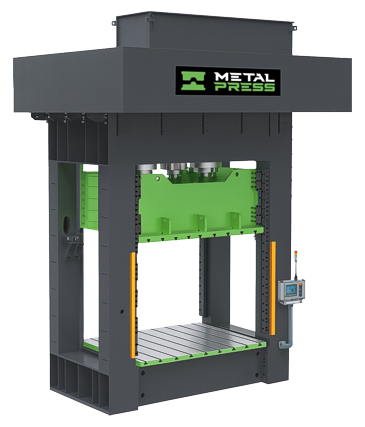
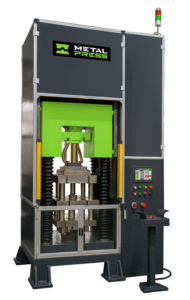
At MetalPress Machinery, our hydraulic presses are engineered to support these industrial applications with robust construction, precision control, and configurations that match production demands — from high-tonnage forming to precision assembly. Below are common ways hydraulic presses are deployed in metalworking, fabrication, and assembly operations.
Why Hydraulic Presses Are Widely Used in Industry
The widespread industrial adoption of hydraulic presses is driven by several inherent characteristics:
Ability to generate very high forces in compact systems
Full tonnage availability throughout the stroke
Precise control of force, speed, and dwell time
Adaptability to diverse tooling and materials
Inherent overload protection via pressure regulation
From an engineering perspective, hydraulic presses are particularly well suited to processes where material flow, deformation rate, and pressure uniformity must be controlled.
One of the most common industrial uses of hydraulic presses is sheet metal forming. In these processes, flat metal sheets are plastically deformed into three-dimensional shapes.
Typical operations include:
Bending
Stretch forming
Drawing
Coining
Hydraulic presses are favored over mechanical presses for forming operations that require:
Variable stroke length
Adjustable forming speed
Uniform pressure application
These characteristics are critical when forming high-strength steels or aluminum alloys used in structural and automotive components.
Deep Drawing
Deep drawing involves pulling a metal blank into a die cavity using a punch while controlling material flow with a blank holder. Hydraulic presses are particularly suitable for deep drawing because they allow independent control of:
Punch force
Blank holder force
Stroke speed
This level of control reduces wrinkling, tearing, and thinning, especially in complex geometries.
Forging Applications
Hot Forging
In hot forging, metal is heated above its recrystallization temperature and then shaped under compressive force.
Hydraulic forging presses offer advantages such as:
Controlled deformation rate
Uniform strain distribution
Ability to apply force over long strokes
These characteristics reduce internal defects and improve mechanical properties compared to impact-based forging methods.
Cold Forging
Cold forging is performed at or near room temperature and requires extremely high forces.
Hydraulic presses are used for:
Precision cold forging
Coining
Upsetting
The ability to precisely regulate pressure is critical for maintaining dimensional accuracy and minimizing tool wear.
Compression Molding and Polymer Processing
Hydraulic presses are widely used in compression molding, a process in which heated material is shaped under pressure within a closed mold.
Industries using compression molding include:
Automotive components
Electrical insulation
Industrial elastomers
Hydraulic presses are preferred because they:
Maintain constant pressure during curing
Accommodate long dwell times
Provide uniform mold closure
These characteristics are essential for producing parts with consistent density and mechanical properties.
Powder Compaction and Powder Metallurgy
In powder metallurgy, metal or ceramic powders are compacted into a desired shape prior to sintering.
Hydraulic presses are used for:
Uniaxial powder compaction
Multi-level pressing
Controlled density distribution
The ability to precisely control pressure and dwell time directly influences part density, porosity, and mechanical strength.
Hydraulic presses are commonly used for assembly processes that require controlled force application.
Examples include:
Bearing installation
Shaft and bushing assembly
Interference-fit components
Hydraulic presses provide:
Smooth force application
Real-time force monitoring
Reduced risk of component damage
These characteristics are particularly important in automotive and industrial machinery assembly.
Automotive Manufacturing Applications
The automotive industry is one of the largest users of hydraulic press technology.
Typical applications include:
Body panel forming
Structural component forming
Assembly operations
Rubber and composite part molding
Hydraulic presses are especially important for forming high-strength steels and aluminum alloys used in lightweight vehicle design.
Aerospace and High-Performance Manufacturing
In aerospace manufacturing, hydraulic presses are used for:
Precision forming of aluminum and titanium alloys
Composite material consolidation
Structural panel forming
The ability to control force and deformation rate is critical when working with materials that exhibit limited formability or high sensitivity to strain rate.
Food and Beverage Processing
Hydraulic presses are also used outside traditional metalworking industries.
Examples include:
Food pressing and extraction
Packaging forming
Specialty processing equipment
In these applications, hydraulic presses are valued for their cleanliness, controllability, and ability to generate consistent pressure.
Laboratory and Testing Applications
Hydraulic presses are used in laboratories for:
Material testing
Compression testing
Sample preparation
Standards organizations often specify hydraulic presses for controlled testing environments due to their accuracy and repeatability.
Automation in Industrial Press Applications
Modern industrial hydraulic presses are increasingly integrated with:
Programmable logic controllers (PLCs)
Sensors for force, displacement, and temperature
Data acquisition systems
Automation improves:
Process repeatability
Quality control
Traceability
This trend is especially important in regulated industries such as automotive and aerospace manufacturing.
Economic Considerations in Industrial Use
From a production economics perspective, hydraulic presses offer:
Lower tooling costs for complex parts
Reduced scrap rates
Flexibility across multiple product lines
While initial capital costs may be higher than some mechanical systems, lifecycle cost benefits often justify the investment.
Safety in Industrial Press Applications
Given the high forces involved, industrial hydraulic press applications require:
Proper guarding
Interlocks and emergency stops
Operator training
Preventive maintenance
Safety standards emphasize risk mitigation through engineering controls rather than operator intervention alone.
Conclusion
Hydraulic presses are indispensable tools across a wide spectrum of industrial applications. Their ability to deliver controlled, repeatable force makes them uniquely suited to metal forming, forging, molding, powder compaction, assembly, and testing operations. As manufacturing continues to demand greater precision, flexibility, and automation, hydraulic press technology remains a core enabler of modern industrial production.
Understanding how hydraulic presses are applied across industries allows manufacturers to optimize process selection, improve product quality, and enhance operational efficiency.
MetalPress Machinery’s portfolio includes C-frame, H-frame, and four-column hydraulic presses designed to meet the needs outlined above. Whether you require high-volume production forming, precision assembly work, or heavy-duty blanking and bending, we can help spec the right press architecture, tonnage, and control system for your process.
References
Groover, M. P. Fundamentals of Modern Manufacturing, Wiley.
Kalpakjian, S., & Schmid, S. Manufacturing Processes for Engineering Materials, Pearson Education.
ASM Handbook, Volume 14: Forming and Forging, ASM International.
ASTM E9 – Standard Test Methods of Compression Testing of Metallic Materials.
ISO 4413:2010 – Hydraulic Fluid Power — General Rules and Safety Requirements.
German, R. M. Powder Metallurgy and Particulate Materials Processing, Metal Powder Industries Federation.
Hosford, W. F., & Caddell, R. M. Metal Forming: Mechanics and Metallurgy, Cambridge University Press.
Let Us Make Your Next Press
Whether you’re located in the USA, Canada, Mexico, or South America, you can contact us for more information, pricing, and consultations through our online forms, or by phone or email.