
LARGE HYDRAULIC PRESSES
Industrial high-tonnage press systems for large parts, heavy tooling, deep forming, straightening, molding, forging, and tool tryout.
What Is Considered a Large Hydraulic Press?
Direct answer: there is no single tonnage threshold that makes a hydraulic press “large.” In industrial metalworking, the term usually describes a press engineered around high forming force, a large working area, heavy or off-center tooling, long stroke and daylight, demanding deflection limits, or a substantial installation and material-handling plan.
The correct large hydraulic press must be sized around the complete load case—not tonnage alone. Part geometry, material strength, tooling dimensions, force through the working stroke, platen area, rigidity, cycle rate, dwell, access, foundations, and controls determine the practical configuration. Explore the broader Press Applications hub or compare established options in the Hydraulic Press resource hub.
When a Large Hydraulic Press Is Required
A large press becomes necessary when the part, die, force profile, production duty, or installation demands exceed the practical limits of a compact standard machine. These six factors should be reviewed together before selecting a frame and tonnage class.
Large Part Footprint
Wide or long components require enough usable bed and platen area for the die, clamps, guides, sensors, and safe loading clearance.
High Forming Force
Thick, strong, or highly formed materials can require substantial force throughout the working stroke—not only at one point in the cycle.
Deep Stroke & Daylight
Deep-draw tooling, tall fixtures, long parts, and ejection systems may demand greater stroke, open height, and controlled motion.
Heavy or Off-Center Tooling
Large dies and uneven load cases require a rigid frame, guided motion, suitable platens, and defined deflection limits.
Dwell & Process Control
Forging, molding, assembly, straightening, and forming operations may need programmed speed, pressure, position, and dwell.
Handling & Integration
Die change, part loading, transfer equipment, guarding, maintenance access, foundations, and utilities must be planned with the press.
Hydraulic Press Families for Large Parts and Tooling
These established press families provide practical starting points for large-part forming and heavy toolroom work. Their product pages remain unchanged; use them to review machine-family capabilities before a custom engineering discussion.
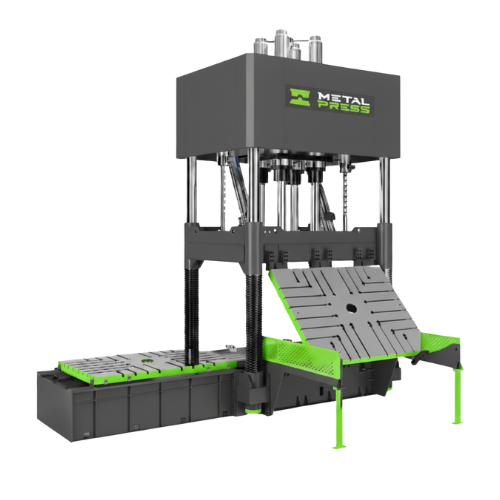
Large Hydraulic Press Selection by Tonnage
Buyers often search for a 200-ton, 300-ton, 400-ton, 500-ton, 600-ton, or larger hydraulic press. These numbers identify a force class, but they do not define a safe or productive machine by themselves. Exact availability and configuration must be confirmed through engineering review of the part, tooling, bed size, stroke, daylight, speed, duty cycle, force curve, deflection, and off-center loading.
Large Production Parts
A common starting point for larger forming, assembly, straightening, and fixture-based work. Confirm working area and force through stroke.
Heavy Forming
Evaluate this class when material strength, contact area, forming depth, or tooling load exceeds mid-range production requirements.
Large Dies & Tooling
Bed dimensions, platen construction, guidance, rigidity, and die-handling access become as important as nominal force.
High-Force Projects
Heavy-duty projects require detailed review of frame style, hydraulics, deflection, foundations, utilities, safety, and service access.
Tool Tryout & Custom Work
Very large force classes are application-specific and must be matched to the full load case, tooling, operating sequence, and installation.
Tonnage & Geometry
Unusual parts may require a custom working envelope, multiple cylinders, specialized platens, long stroke, or a purpose-built frame.
Heavy-Duty Hydraulic Press Applications
Large industrial hydraulic presses support processes where the press must deliver controlled force across a substantial working envelope. Review these established application pages to compare process-specific tooling, motion, and production requirements.
Forming and Force Applications
Tooling and Industry Applications
Engineering Requirements for a Large Hydraulic Press
A useful quotation starts with the part and load case. Provide drawings, material, process steps, tooling dimensions and weight, required force, bed and platen dimensions, stroke, daylight, speeds, dwell, accuracy, cycle target, loading method, controls, safety, utilities, floor space, foundations, installation access, and maintenance requirements.
Press Structure & Load Case
- Force and force-through-stroke
- Bed, platen, stroke, and daylight
- Tool weight, size, and clamping
- Centered and off-center load cases
- Deflection, guidance, and accuracy
Plant, Handling & Installation
- Part and die handling method
- Floor loading and foundation needs
- Utilities, guarding, and controls
- Rigging and installation access
- Maintenance clearances and service plan
Large Industrial Hydraulic Press Manufacturer & Supplier
Organizations searching for a large hydraulic press for sale usually need more than a tonnage number. MetalPress can evaluate custom industrial hydraulic press requirements for large metal parts, deep forming, straightening, forging, molding, tool tryout, assembly, and heavy-duty production.
A manufacturer and supplier review should align the press frame, usable working area, force profile, stroke, daylight, speeds, duty cycle, tooling interface, controls, safety, material handling, installation, training, and service expectations with the actual process.
Large Hydraulic Press FAQs
There is no universal cutoff. A press may be considered large because of high tonnage, a wide bed, long stroke, tall daylight, heavy tooling, strict rigidity requirements, or the scale of its handling and installation system.
Calculate the real process force from the material, part geometry, contact area, forming depth, tooling, and safety margin. Then verify the force available through the working stroke together with bed size, rigidity, speed, and duty cycle.
Four-post and straight-sided arrangements are common starting points. The correct structure depends on usable access, tooling, load distribution, deflection limits, guidance, stroke, and installation constraints.
It may. Foundation requirements depend on machine mass, footprint, dynamic loads, floor capacity, leveling, vibration, anchors, and local site conditions. These factors should be reviewed before final design and installation.
A standard family may work when force, working envelope, tooling, and duty cycle fit established parameters. Unusual geometry, heavy off-center loading, long stroke, multiple cylinders, or specialized handling often requires custom engineering.
Provide part and tool drawings, material, process description, required force, bed and platen size, stroke, daylight, speeds, dwell, cycle rate, accuracy, loading and unloading method, controls, safety, utilities, foundation, and access constraints.
Expert Advice
Do not select a large hydraulic press by nominal tonnage alone. A machine can have adequate rated force and still be a poor fit if the bed is undersized, the frame deflects beyond the tooling requirement, the load is off-center, the working stroke does not deliver the needed force, or the plant cannot handle the die and installation. Define the full load case, usable working envelope, rigidity, motion profile, handling route, foundation, and maintenance access before freezing the press design.
RELATED LARGE HYDRAULIC PRESS GUIDES & PROJECTS

Benchtop Press vs. Industrial Hydraulic Press
Compare light-duty benchtop equipment with an industrial hydraulic press using force, duty cycle, working area, controls, safety, and long-term production requirements.

Servo-Hydraulic vs. Traditional Hydraulic Presses
Compare motion control, repeatability, energy use, flexibility, maintenance, and application fit before choosing the press drive system.
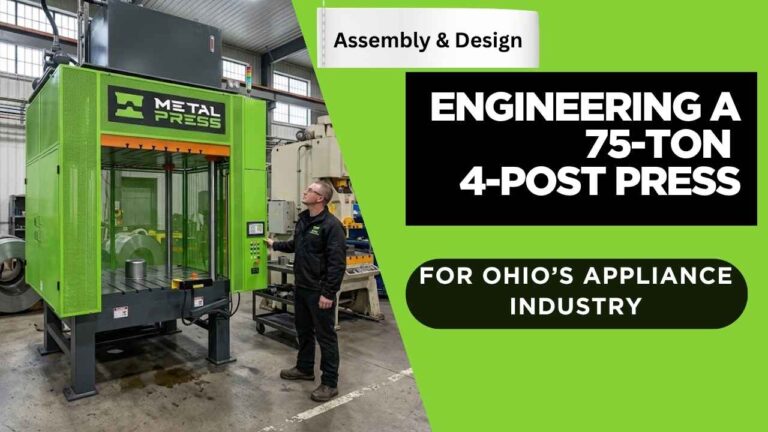
Engineering a 75-Ton 4-Post Press
Follow an industrial hydraulic press project from production requirements and engineering decisions through testing and preparation for delivery.