

Blog
Real Life Project: 200-Ton Straight Sided Servo Hydraulic Press At Precommissioning Stage


From Initial Consultation to a Fully Engineered Solution
In Phase One, the project began when an Ohio‑based manufacturer reached out with a clear need: a high‑precision, high‑force press capable of delivering consistent forming performance with modern energy efficiency and advanced motion control. Their existing equipment lacked the accuracy and programmability required for their expanding production line. After reviewing their application, part geometry, and cycle requirements, our engineering team recommended a 200‑ton straight‑sided servo‑hydraulic press—a machine designed for precision, rigidity, and repeatable forming accuracy.
Phase One covered the early stages of the project: requirements analysis, engineering design, structural modeling, servo‑hydraulic system selection, and the initial fabrication of the press frame and components. Readers who want to revisit the beginning of the project can explore Phase One.
Now, in Phase Two, the focus shifts from engineering to validation—assembling, testing, and preparing the machine for shipment to the Ohio facility.
👉 Review the design and assembly process here:
Machine Specifications: Straight‑Sided Servo‑Hydraulic Press Overview
Before diving into the testing and inspection process, it’s important to highlight the core specifications and capabilities of the 200‑ton straight‑sided servo‑hydraulic press. These features define the machine’s performance and ensure it meets the customer’s forming requirements.
👉 The Midwestern manufacturing team filled information request form. This is for you if you need information on our MHS-SV Series.
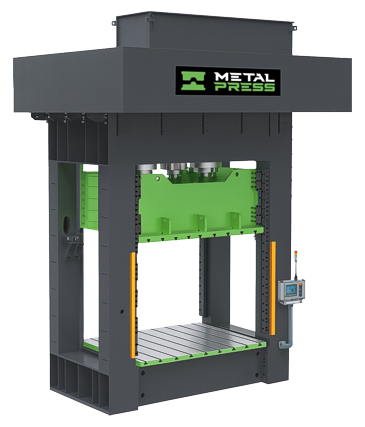
The press is built on a straight‑sided frame, engineered for maximum rigidity and minimal deflection under load. This structural design ensures consistent part quality, even during high‑force forming cycles. The servo‑hydraulic system provides precise control over ram speed, position, and force, allowing operators to program complex motion profiles for forming, drawing, punching, and precision assembly applications.
The machine includes a servo‑driven hydraulic pump, which reduces energy consumption, lowers noise levels, and provides instant response during forming operations. The press is equipped with a high‑accuracy linear transducer for ram positioning, ensuring repeatability within tight tolerances. The hydraulic circuit includes proportional valves, pressure sensors, and safety interlocks to maintain stable and reliable operation.
The control system features a touchscreen HMI, allowing operators to adjust stroke parameters, speed profiles, dwell times, and pressure settings. The press also includes programmable recipes, data logging, and diagnostic tools for maintenance and troubleshooting.
These specifications make the 200‑ton servo‑hydraulic press ideal for applications requiring precision, flexibility, and energy‑efficient forming performance.
The Advantages And Applications Of Straight-Sided Servo Press
The Straight-Sided Servo-Hydraulic Press represents a significant evolution in industrial forming, combining the high force capabilities of traditional hydraulic systems with the precision control of servo-electric technology. Unlike conventional presses that rely on fixed stroke profiles, these machines utilize sophisticated servo-driven pumps to provide infinitely adjustable slide speeds and millimetric accuracy throughout the entire cycle. This level of control makes them indispensable in the automotive industry for complex deep-drawing and high-strength steel stamping where material flow must be meticulously managed to prevent tearing. In the aerospace sector, the press is used for forming specialized alloy components that require consistent pressure dwell times and high repeatability. Furthermore, its energy-efficient “power on demand” system and vibration-damping characteristics are highly valued in the electronics and appliance industries for manufacturing precision enclosures and delicate internal components where surface finish and dimensional tolerances are critical.
Phase Two: Final Assembly, Testing, and Pre‑Commissioning
With the engineering and fabrication stages complete, Phase Two focuses on transforming the machine from a collection of components into a fully functional servo‑hydraulic forming press. This phase ensures that every mechanical, hydraulic, and electrical system performs exactly as designed.
Final Assembly: Bringing the Press to Life
The assembly process began with the installation of the straight‑sided frame, ensuring perfect alignment between the uprights, bolster, and ram. The servo‑hydraulic power unit was mounted and connected to the main hydraulic lines. The proportional valves, pressure sensors, and servo pump were installed and wired into the control cabinet.
The ram assembly was fitted with precision guide elements to ensure smooth, accurate motion. The bolster plate was machined and mounted to provide a stable working surface for tooling. The electrical cabinet was populated with drives, relays, safety circuits, and the HMI interface.
Once all components were installed, the machine began to take shape as a complete 200‑ton servo‑hydraulic press.
Hydraulic System Preparation and Calibration
The hydraulic reservoir was filled with high‑grade hydraulic oil, and the system was bled to remove any trapped air. The servo pump was activated at low speed to begin circulating oil through the system. Pressure levels were monitored to ensure stable operation, and all fittings were checked for leaks.
The hydraulic system is the heart of the press, and this stage ensures that it operates smoothly and efficiently. The proportional valves were calibrated to ensure accurate pressure control, and the servo pump was tuned for optimal response time.
Electrical and Control System Verification
The control panel was powered on, and the HMI interface displayed the system’s default configuration. The servo drive was initialized, and communication between the controller, sensors, and hydraulic components was verified.
The press’s motion control system was tested to ensure accurate ram positioning, smooth speed transitions, and proper response to operator inputs. The touchscreen interface was configured with the customer’s preferred settings, including stroke limits, pressure ranges, and safety parameters.
Dry‑Run Testing: Verifying Motion and Alignment
Before applying full tonnage, the press was cycled through a series of dry‑run tests. The ram was moved through its full stroke at various speeds to verify alignment, smoothness, and repeatability. The servo‑hydraulic system demonstrated precise control, with the ram stopping accurately at programmed positions.
Safety systems—including emergency stops, light curtains, and interlocks—were tested to ensure proper functionality. The press responded correctly to all safety triggers, confirming that the system was ready for load testing.
Load Testing and Pressure Verification
Once dry‑run testing was complete, the press was tested under load. Weighted blocks were placed on the bolster to simulate tooling mass. The press applied increasing levels of pressure, eventually reaching its full 200‑ton capacity.
During load testing, technicians monitored:
Pressure stability
Ram deflection
Frame rigidity
Servo response time
Hydraulic temperature
Noise levels
The press performed flawlessly, demonstrating stable force output and precise motion control. The straight‑sided frame showed minimal deflection, confirming the structural integrity of the design.
Thermal and Endurance Testing
To ensure long‑term reliability, the press was operated through extended cycles at varying speeds and pressures. This endurance testing helps identify any potential issues with heat buildup, hydraulic stability, or servo performance.
The servo‑hydraulic system maintained consistent temperature levels, and the hydraulic oil remained within optimal operating range. The ram maintained repeatable accuracy throughout the endurance test, confirming the reliability of the linear transducer and motion control system.
Noise and Vibration Analysis
One of the advantages of a servo‑hydraulic press is reduced noise and vibration compared to traditional hydraulic systems. During testing, technicians measured noise levels at various operating speeds. The servo pump demonstrated quiet operation, and the press frame absorbed vibration effectively.
This analysis confirmed that the machine would provide a comfortable and safe working environment for operators.

Pre‑Commissioning Review and Documentation
Before preparing the machine for shipment, a full pre‑commissioning review was completed. This included:
Verifying all electrical and hydraulic schematics
Finalizing operator manuals and maintenance documentation
Recording baseline performance data
Preparing installation guidelines for the customer
Completing a final inspection checklist
This ensures that the machine will be ready for immediate installation and commissioning once it arrives at the Ohio facility.
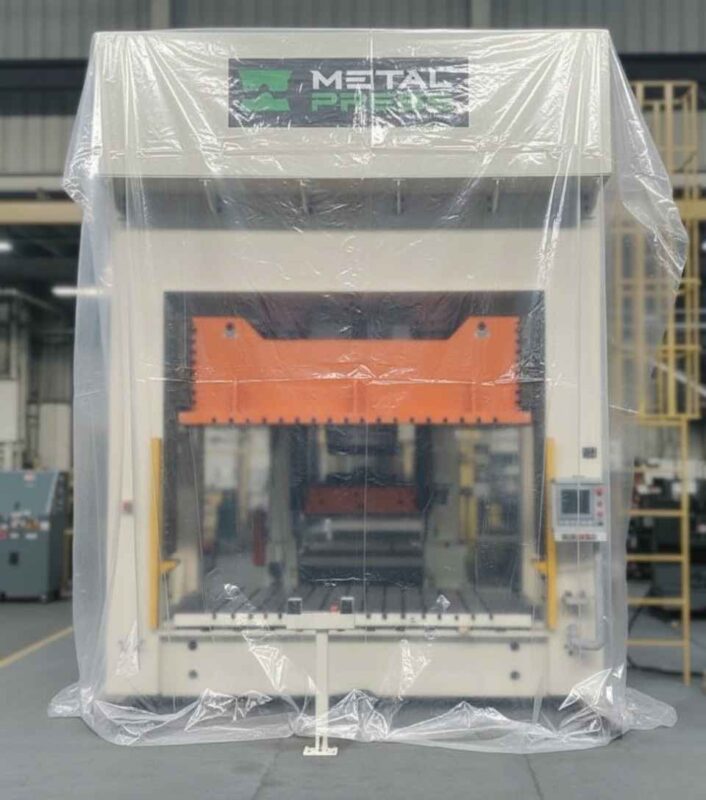
Phase Two Conclusion: A Fully Validated 200‑Ton Servo‑Hydraulic Press
By the end of Phase Two, the 200‑ton straight‑sided servo‑hydraulic press had completed its transformation from a fabricated structure into a fully tested, fully verified forming system. Every component—from the servo pump to the hydraulic valves to the ram assembly—was validated to ensure long‑term reliability and precision performance.
The machine is now ready for shipment, where Phase Three will begin: delivery, installation, commissioning, and operator training at the customer’s facility.
What Our Customers Think

Let Us Make Your Next Press
Our MH-SV Series is the solution for your safety, time loss and efficiency problems. Visit the product page to find out more.
For more information about this die splitter and tester
For more information about our other products