Industry, Product Showcase

The Evolution of Force: A Comprehensive Comparison of Modern Press Technologies

METALPRESS BLOG FEATURED IMAGES (1)

Choosing a press in 2026 is a balance of Volume vs. Flexibility. Traditional Mechanical presses win on pure speed, while Hydraulic units win on brute force. However, Servo technologies (Electric, Mechanical, and Hydraulic) are rapidly becoming the industry standard due to their 50-70% energy savings, programmable stroke profiles, and significantly longer tool life.

In the modern manufacturing landscape, the choice of a press is no longer just about “how much weight it can push.” It is about precision, energy efficiency, and the ability to integrate into Industry 4.0 environments. Whether you are stamping automotive panels or assembling delicate electronic components, the drive system of your press—be it servo-driven, hydraulic, or mechanical—dictates your scrap rate, cycle time, and bottom-line profitability.

Defining the Core Technologies

To compare these machines effectively, we must first define the fundamental mechanics that differentiate them.

Mechanical Presses

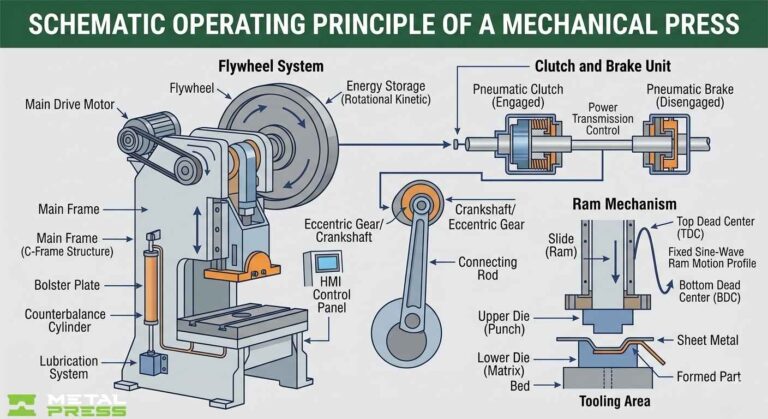
The traditional mechanical press is the workhorse of high-volume production. It uses a motor-driven flywheel to store energy, which is then transferred to a crankshaft or eccentric gear via a clutch and brake system. This motion moves the ram in a fixed stroke path.

  • Applications: High-speed blanking, simple stamping, and progressive die operations.

  • Industries: Automotive, appliance, and general metalworking.

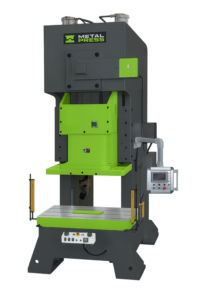
  • Product Reference: Explore our Mechanical Presses for high-speed, reliable mass production.

Schematic Operating Principle Of A Mechanical Press - Courtesy of MetalPress Machinery

Our Mechanical Presses

Hydraulic Presses

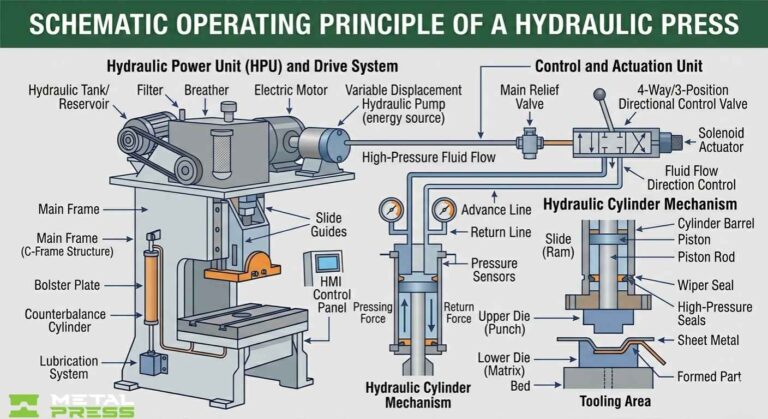
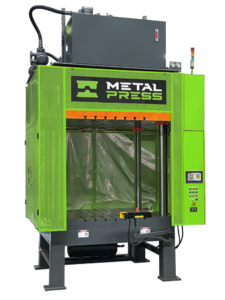
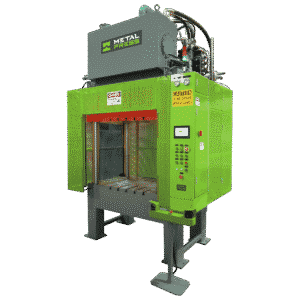
Hydraulic presses utilize fluid power. A motor drives a pump that forces oil into cylinders, moving the ram. Unlike mechanical presses, hydraulic systems can deliver full tonnage at any point in the stroke.

  • Applications: Deep drawing, heavy forming, and powder compaction.

  • Industries: Aerospace, forging, and heavy industrial manufacturing.

  • Product Reference: View our robust Hydraulic Presses designed for high-force forming.

Schematic Operating Principle Of A Hydraulic Press- MetalPtess Machinery

Our Hydraulic Presses

Servo Mechanical Presses

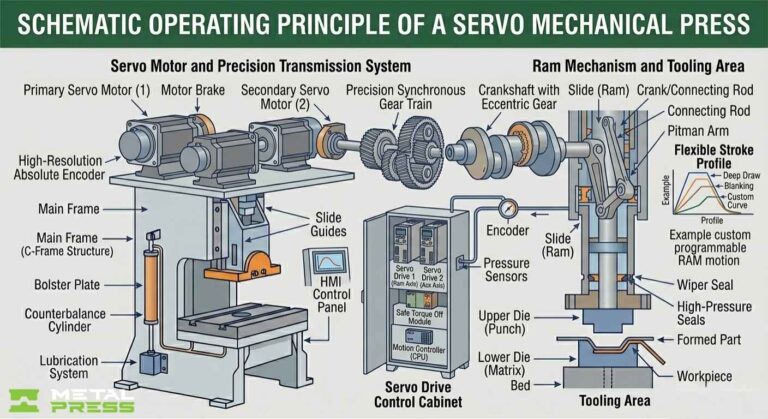
This is an evolution of the mechanical press. It replaces the flywheel, clutch, and brake with a high-torque servo motor. This allows for total control over the ram’s position, speed, and dwell time, essentially making the stroke “programmable.”

  • Applications: Complex forming, multi-step stamping, and high-precision bending.

  • Industries: Electronics, medical devices, and high-end automotive.

  • Product Reference: Discover the flexibility of our Servo Mechanical Presses.

Schematic Operating Principle Of A Servo Mechanical Press - MetalPress Machinery

Our Servo Mechanical Presses

Servo Hydraulic Presses

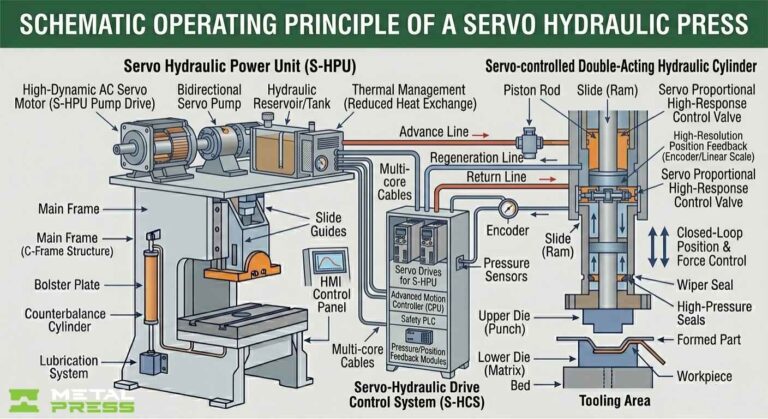
By replacing the standard induction motor and valve system with a servo-driven pump, the servo hydraulic press combines the brute force of hydraulics with the surgical precision of electronic control.

  • Applications: Precision deep drawing, mold tryouts, and high-tonnage forming where energy efficiency is a priority.

  • Industries: Mold and die, automotive structural parts, and specialized research.

  • Product Reference: Learn more about our Servo Hydraulic Presses and their industry-leading accuracy.

Schematic Operation Principle Of A Servo Hydraulic Press - MetalPress Machinery

Our Servo Hydraulic Presses

Technical Advantages and Performance Comparison

Control and Programmability

The most significant leap in technology is the transition from fixed cycles to programmable motion.

Traditional mechanical and hydraulic presses operate on a “start-to-stop” basis. A mechanical press follows a fixed sine-wave motion; once the cycle starts, the ram speed is dictated by the flywheel. In contrast, a Servo Mechanical Press allows the operator to slow the ram down as it touches the material to reduce impact (vibration) and then speed up on the return stroke to save time.


Servo Hydraulic systems offer a similar advantage. By controlling the pump speed via a servo motor, the press can “dwell” at a specific pressure with incredible accuracy, which is essential for materials that require time to flow, such as in deep drawing or composite molding.


Tonnage and Capacity

When it comes to raw power, Hydraulic and Servo Hydraulic presses remain the undisputed champions.

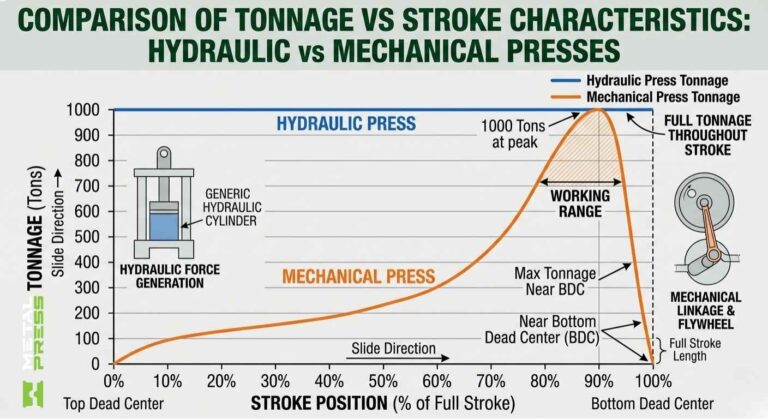
  • Hydraulic Systems: Can easily reach 2,000 to 5,000+ tons. They offer “full tonnage throughout the stroke,” meaning the press exerts maximum force the moment it comes into contact with the workpiece.

  • Mechanical Systems: Tonnage is only at its maximum near the bottom of the stroke (Bottom Dead Center).

  • Servo Electric: Usually capped at lower tonnages (typically under 200 tons) due to the physical limitations of screw-drive mechanisms.

Comparison Of Tonnage vs Stroke Characteristics Between Hydraulic and Mechanical press - MetalPress Machinery
TONNAGE AND STROKE CONTROL COMPARISON
Feature Mechanical Hydraulic Servo Mechanical Servo Hydraulic
Force Generation Maximum only at Bottom Dead Center (BDC) Full tonnage available at any point in stroke High force with variable speed control Full tonnage with precise servo-pump control
Stroke Length Fixed (Dictated by crankshaft) Variable and fully adjustable Programmable (Adjustable mid-cycle) Fully adjustable and programmable
Cycle Speed Very High (Ideal for blanking) Moderate (Limited by fluid flow) High (Optimized by variable ram speed) Moderate to High (Faster than standard hydraulic)
Precision/Repeatability High (Fixed mechanical path) Moderate (Varies with oil temp/valves) Ultra-High (Micron-level electronic control) Ultra-High (Closed-loop sensor feedback)

Economics of Work: Energy and Maintenance

The “Economics of Work” involves more than just the purchase price; it involves the Total Cost of Ownership (TCO).

 Energy Savings: Servo-driven systems (both mechanical and hydraulic) are significantly more efficient. In a traditional hydraulic press, the motor runs even when the press is idling. In a 4-Post Servo Press, the servo motor only consumes energy when the ram is moving or holding pressure, often resulting in 40-70% energy savings.

Servo hydraulic systems significantly reduce energy consumption compared to traditional hydraulics by eliminating constant motor operation.

Mechanical presses are efficient at high volumes but consume energy continuously due to flywheel rotation.

Hydraulic presses are typically the least efficient due to constant pump operation.


Economic Considerations and Total Cost of Ownership

The economics of press selection extend far beyond initial purchase price.

Servo electric presses have higher upfront costs but lower operating and maintenance expenses.

Servo hydraulic presses balance energy savings with high capability, making them cost-effective for complex forming.

Servo mechanical presses often provide the best ROI in high-volume environments due to flexibility and reduced scrap rates.

Traditional mechanical presses have lower upfront costs but less adaptability.

Hydraulic presses may have lower capital cost for high-tonnage applications but incur higher energy and maintenance costs over time.

PRESS TECHNOLOGY COMPARISON
Feature Mechanical Hydraulic Servo Mechanical Servo Hydraulic
Energy Efficiency Low (Flywheel always spinning) Medium (Pump runs constantly) High (Power only on demand) High (Power only on demand)
Maintenance High (Clutch/Brake wear) Medium (Oil leaks/seals) Low (Fewer moving parts) Low (Reduced heat/oil stress)
Tool Life Standard Standard Extended (Soft-touch technology) Extended (Controlled impact)

Scalability and Industry 4.0 Integration

In the era of “Smart Factories,” data is king.

  • Scalability: Servo systems are inherently more scalable because their software-driven nature allows for easy adjustments to new parts without changing mechanical cams or gears.

  • Data Logging: Servo presses provide real-time feedback on force, position, and temperature. This is vital for industries like aerospace where every single part must have a recorded “birth certificate” or production log.


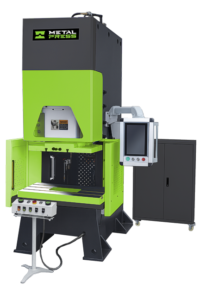
MetalPress Machinery’s Straight Sided Servo Hydraulic Presses feature advanced HMI (Human Machine Interface) systems that allow for remote monitoring and “Factory 4.0” readiness, ensuring that your production line stays ahead of the curve.

Technical Scalability and Capacity Limits

When planning your facility’s long-term growth, understanding the scalability of these technologies is essential.

Mechanical presses are easily scalable for speed; as you move into larger straight-sided models, they remain the fastest way to move metal. However, they are less “flexible” for different part types.

Hydraulic and Servo-Hydraulic presses are the kings of tonnage scalability. Because force is generated by pressure over area (F = P x A), increasing capacity simply requires larger cylinders or higher-pressure pumps. This makes them the primary choice for heavy-duty industries like aerospace or heavy automotive structural components.

Servo-Electric presses offer the best scalability for cleanroom and precision electronic assembly, though they currently face a “ceiling” in high-tonnage applications due to the heat generation and cost of extremely large electric ball screws.

Scalability Summary

  • Mechanical: Best for high-speed, high-volume consistency.

  • Hydraulic: Best for extreme force requirements (500 to 5,000+ tons).

  • Servo Technologies: Best for multi-product lines where quick changeovers and varied stroke profiles are required.

Flexibility and Production Versatility

Servo-driven technologies—both mechanical and hydraulic—offer the highest flexibility. Manufacturers can adjust stroke profiles, dwell times, and speeds for different parts without changing hardware.

Hydraulic presses are also versatile, particularly for varying part geometries and materials.

Mechanical presses are less flexible but excel in consistent, high-volume production.

Servo electric presses provide extreme precision but are limited in forming range.

Industry Applications and Sector Dominance

1. Automotive and EV Battery Production

The automotive sector is the primary driver of press innovation. Traditional internal combustion engine (ICE) parts like frames and brackets still utilize high-speed Mechanical Presses for sheer volume. However, the EV revolution has changed the requirements:

  • Battery Enclosures and Trays: These require deep drawing of high-strength, lightweight materials. Servo Hydraulic Presses are now the standard here because they provide the constant high tonnage needed for large aluminum trays while offering the “soft touch” to prevent micro-cracking in the material.

  • Precision Connectors: Small EV electronic components are increasingly made on Servo Electric lines to ensure micron-level accuracy and cleanroom-level cleanliness.

  • Structural Components: For complex “Body in White” (BIW) parts, Servo Mechanical Presses allow for optimized slide motion that improves material flow, especially in high-strength steel.

2. Aerospace and Defense

In an industry where every part requires a “birth certificate” (detailed production data), the data-logging capabilities of servo systems are non-negotiable.

  • Applications: Forming titanium engine components, structural ribs, and fuselage panels.

  • Preferred Tech: Hydraulic Presses (for raw tonnage) and Servo Hydraulic Presses (for precision forming of exotic alloys).

3. Home Appliances and Consumer Goods

Efficiency and surface finish (Class A surfaces) are the priorities for appliances like refrigerators and washing machines.

  • Applications: Deep drawing of stainless steel tubs, stamping of outer panels, and embossing logos.

  • Preferred Tech: Traditionally Hydraulic, but shifting toward Servo Hydraulic to reduce energy costs and improve cycle times.

4. Electronics and Medical Devices

Precision assembly and miniature part production define this sector.

  • Applications: Connector insertion, terminal crimping, and medical implant forming.

  • Preferred Tech: Servo Electric is the undisputed leader due to its lack of hydraulic fluids (zero contamination risk) and extreme repeatability.

Choosing the Right Press: A Comparative Summary

Deciding between these five types depends on your specific “Sweet Spot”:

  1. High Volume, Simple Parts? The traditional Mechanical Press is your most cost-effective solution for sheer speed.

  2. High Force, Deep Draw? A Hydraulic Press offers the necessary stroke length and constant tonnage.

  3. Maximum Precision & Energy Efficiency? The Servo Hydraulic Press provides the best of both worlds, especially for complex automotive or structural components.

  4. Complex Stampings with High Accuracy? The Servo Mechanical Press allows for customized stroke profiles to reduce tool wear and increase part quality.

  5. Small, Clean, Ultra-Precise Assembly? The Servo Electric (Direct Drive) is the go-to for cleanroom environments.

Choosing the right press depends on several factors:

  • Material thickness and type
  • Production volume
  • Required precision
  • Tooling complexity
  • Energy consumption goals
  • Automation requirements

High-volume automotive stamping typically favors servo mechanical or mechanical presses, while deep drawing applications require hydraulic or servo hydraulic presses.

Precision assembly environments lean toward servo electric presses.

STRATEGIC SUMMARY: WHICH PRESS IS RIGHT FOR YOUR BUSINESS?
Industry Segment Recommended Press Type Primary Reason
EV Battery Trays Servo Hydraulic Deep draw capability + constant high tonnage
High-Volume Blanking Mechanical Lowest cost per stroke at high speeds
Medical/Electronics Servo Electric Cleanliness and micron-level precision
Aerospace Alloys Hydraulic Brute force for high-strength materials
Complex Auto Panels Servo Mechanical Programmable motion for better material flow
COMPARATIVE OVERVIEW CHART
Feature Servo Electric Servo Hydraulic Servo Mechanical Hydraulic Mechanical
Precision Very High High High Medium Low
Speed Low Medium High Low Very High
Tonnage Low Very High High Very High High
Energy Efficiency Excellent High High Low Medium
Flexibility Very High High Very High High Low
Maintenance Low Medium Medium High Medium

Conclusion: Elevate Your Production with MetalPress Machinery

Navigating the transition from traditional pressing to servo-driven technology can be the difference between leading the market or falling behind in efficiency. At MetalPress Machinery, we specialize in bridge-building: helping manufacturers transition from the rigid limits of mechanical systems to the infinite flexibility of servo-controlled motion.

Our current lineup, including our Straight Sided Servo Hydraulic Presses, is designed for 2026 standards—integrating AI-driven predictive maintenance and Industry 4.0 connectivity as standard features. By choosing a partner that understands the nuances of servo electric vs. hydraulic systems, you aren’t just buying a machine; you’re securing a decade of optimized production.

Would you like to see a custom ROI analysis for your specific part production? Contact our Sales Engineering Team or explore our Full Machinery Catalog to find the exact tonnage and technology for your next project.

Frequently Asked Questions On Press Comparison

Is a Servo Hydraulic press more expensive than a standard Hydraulic press?

The initial capital expenditure (CAPEX) for a Servo Hydraulic Press is typically 20% to 30% higher than a traditional model. However, the return on investment (ROI) is often realized within 18 to 24 months through energy savings—often reducing electricity costs by up to 70%—and significantly lower cooling requirements, as the oil does not heat up nearly as much during idle periods.

 
Can I retrofit my existing Mechanical press with Servo technology?

While some partial upgrades to control systems are possible, a true "Servo Mechanical" conversion is rarely cost-effective. The entire drive train, including the removal of the flywheel and clutch, must be redesigned to handle the high-torque characteristics of servo motors. For most facilities, it is more economical to invest in a purpose-built Servo Mechanical Press that is engineered for these specific stresses.

 
Which press is best for "Deep Drawing" operations?

For deep drawing, Servo Hydraulic and traditional Hydraulic Presses are the primary choices. They provide full tonnage throughout the entire stroke length, which is critical when the material needs to flow into a deep die cavity. Servo Hydraulic models offer the added benefit of programmable "dwell" times and speed changes mid-stroke to prevent material tearing.

 
How does "Soft-Touch" technology impact tool life?

"Soft-Touch" is a feature of servo-driven presses where the ram slows down just millimeters before contacting the workpiece. This reduces the breakthrough shock and vibration that occurs in traditional mechanical blanking. By minimizing this impact, manufacturers often report a 30% to 50% increase in tool life, drastically reducing the frequency of die sharpening and replacement.

 
Are Servo Electric presses suitable for high-tonnage heavy industry?

Currently, Servo Electric (Direct Drive) presses are most efficient in the lower tonnage range (typically under 200 tons). As the required force increases, the physical size and cost of the ball screws and high-torque motors become prohibitive. For heavy-duty applications requiring 500 tons or more, Servo Hydraulic technology remains the more practical and scalable solution.


References

  • Precision Metalforming Association (PMA) – 2026 Industry Trends Report on Servo Adoption.

  • Journal of Advanced Manufacturing Technology – Comparing Energy Profiles of Servo vs. Traditional Drives.

  • Automotive Stamping & Tooling Association – Technical Bulletin on EV Battery Housing Production.

  • IEEE Transactions on Industry Applications – Control Theory in Servo-Mechanical Motion Profiling.

  • U.S. Department of Energy – Case Studies on Industrial Decarbonization via Servo-Electric Upgrades.

  • SME (Society of Manufacturing Engineers) – Metal Forming Fundamentals
  • PMA (Precision Metalforming Association) – Press Technology Resources
  • Machinery’s Handbook – Industrial Press Systems
  • DOE Industrial Energy Efficiency Reports
  • Academic journals on metal forming and servo press technology (non-commercial sources)

Let Us Make Your Next Press

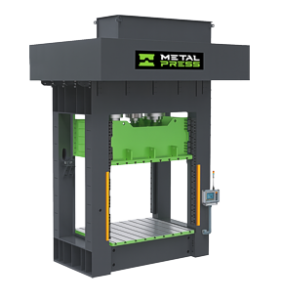
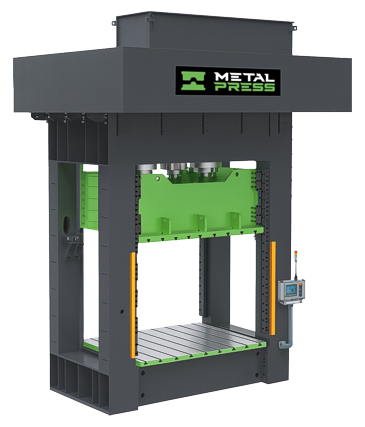
MHS-SV SERIES STRAIGHT SIDED SERVO HYDRAULIC PRESS

Now that you are completely familiar with different applications of press types, it is time to select the most appropriate press model fitting your production requirements. If still not 100 percent sure, contact our engineers by phone +1-519-624-9987 or fill the request for information form for each product that you want.

For more information about our other products