
STEEL SERVICE CENTER COIL HANDLING
Controlled coil rotation, transfer, staging, and line loading for steel distribution and processing operations.
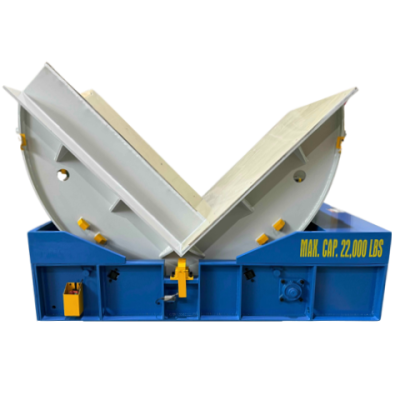
STEEL SERVICE CENTER COIL HANDLING EQUIPMENT
RECEIVING • STORAGE • SLITTING • CUT-TO-LENGTH • SHIPPING
Steel service centers manage coil orientation at several transfer points: inbound receiving, floor or rack storage, staging, slitting, cut-to-length processing, packaging, and outbound shipment. Each handoff must account for coil weight, outside diameter, width, eye orientation, surface condition, lifting access, and the geometry of the next machine. When a heavy coil arrives eye-to-sky but a line, pallet, or shipping fixture requires eye-to-side positioning, the purpose-built MetalPress coil tipper and coil upender becomes the priority machine for controlled 90-degree rotation.
A steel service center coil handling system may also use a motorized coil transfer cart to move coils between storage and production without relying on repeated forklift moves. The tipper changes orientation; the transfer cart changes location. Treating those as separate functions helps engineers define a safer, more predictable material-flow plan for carbon steel, stainless steel, coated sheet, aluminum, and other coiled metals.
MetalPress MCT Series all-electric coil tippers are available in models from 5 to 70 metric tons. Selection should be based on the complete load envelope—not tonnage alone—including coil OD, width, center of gravity, table size, loading method, duty cycle, guarding, and any interface with cranes, C-hooks, pallets, conveyors, or processing equipment.
A coil tipper for steel service centers is selected when the facility needs repeatable 90-degree rotation at receiving, storage, slitting, cut-to-length, packaging, or shipping handoffs.
For repeated movement among receiving, storage, slitting, cut-to-length, packaging, and shipping, use the MCC motorized steel coil transfer cart as the primary commercial reference.
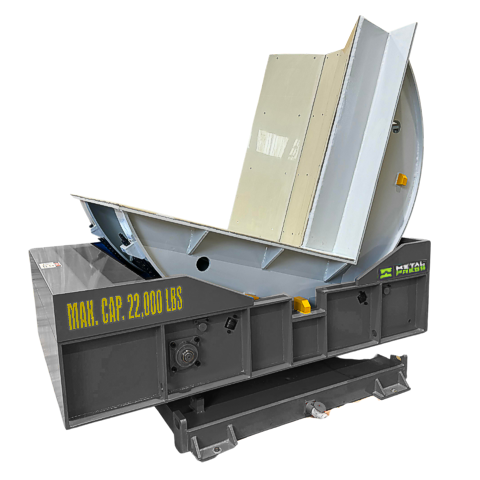
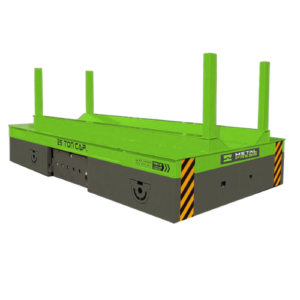
COIL TIPPERS AND TRANSFER CARTS FOR SERVICE-CENTER FLOW
Coil receiving and orientation change
Inbound coils may arrive in an orientation that does not match storage saddles, processing-line entry, or customer shipping requirements. A coil tipper—also searched as a coil upender, coil flipper, coil tilter, coil rotator, or coil turning machine—supports the load during a controlled 90-degree change between eye-to-sky and eye-to-side. The equipment must be matched to the coil’s mass and center of gravity so the load remains supported throughout the motion.
Storage-to-line coil transfer
A coil transport cart or steel coil transfer cart moves the coil along a defined plant path. A V-shaped or application-specific cradle helps restrain the cylindrical load, while travel controls and stopping logic support repeatable delivery to a staging position. Facilities should document travel distance, floor condition, aisle clearance, rail or trackless preference, loading height, traffic interaction, and how the cart aligns with storage saddles or line equipment.
Slitting and cut-to-length preparation
Slitting and cut-to-length lines depend on a reliable sequence: identify the coil, retrieve it, orient it, stage it, and present it to the uncoiler or loading device. Separating rotation from transport prevents the transfer cart from being specified as a tipper, or the tipper from being treated as a plant transporter. Where layout and production frequency justify it, both machines can be engineered as coordinated parts of the same coil handling workflow.
Surface and edge protection
For exposed, coated, stainless, or aluminum coil, contact surfaces and restraint geometry deserve the same attention as load capacity. Engineers should identify permitted contact areas, edge-clearance requirements, surface-protection materials, banding condition, and whether the load may telescope or shift. These inputs guide cradle design and operating procedures.
HOW TO SPECIFY A COIL UPENDER FOR A STEEL SERVICE CENTER
Begin with a coil data sheet covering minimum and maximum weight, OD, ID, width, material family, eye orientation at pickup, and required eye orientation at discharge. Then map each transfer point from receiving through shipment. Record the device that loads the machine, the operator’s location, the available floor envelope, the expected cycles per shift, and the condition that must be confirmed before rotation starts.
For the MCT Series, select the model whose rated capacity and table geometry cover the full operating envelope. Review center of gravity rather than using coil weight alone. Define electrical service, controls, emergency stops, guarding or perimeter protection, mechanical retention, maintenance access, and any communication with upstream or downstream equipment. OSHA’s general materials-handling guidance emphasizes using equipment whose rated capacity matches the load and maintaining safe clearances around mechanically moved materials; the final safeguarding solution must be based on the facility’s own risk assessment.
Use the coil tipper product page to compare MCT sizes, technical data, options, videos, and quote information. For a broader process map, return to the coil handling applications hub.
Frequently Asked Questions
The requirement depends on each transfer point. A coil tipper or upender changes orientation, while a coil transfer cart moves the load between receiving, storage, staging, slitting, cut-to-length, packaging, and shipping areas. Many facilities need both functions.
In steel coil handling, coil flipper, coil tilter, coil rotator, and coil upender are often buyer terms for equipment that rotates a cylindrical coil. The required rotation angle, cradle, controls, and load restraint should be defined instead of relying on the name alone.
Provide minimum and maximum coil weight, OD, ID, width, center of gravity, starting and finishing eye orientation, loading method, cycles per shift, floor space, electrical service, and safeguarding requirements.
Not when the process requires orientation change. A transfer cart changes the coil’s location; a tipper changes its orientation. A cart with a cradle may transport the coil safely but does not automatically provide controlled 90-degree rotation.
Applications commonly include carbon steel, stainless steel, coated steel, and aluminum coils. Final suitability depends on weight, dimensions, surface-protection needs, stability, and the engineered contact geometry.
Typical locations include receiving, storage-to-line staging, before a slitter or cut-to-length line, packaging, and shipping. The best position minimizes unnecessary lifts and keeps crane, forklift, operator, and aisle interactions controlled.
Expert Advice & Technical Resources
For service centers, the strongest specification starts with a transfer-point map and a complete coil envelope. Use the MCT product data as the commercial reference, then use the guides below for drive selection, safety, and terminology.