

Blog
How to Choose Heavy-Duty Coil Handling Equipment for Steel Processing

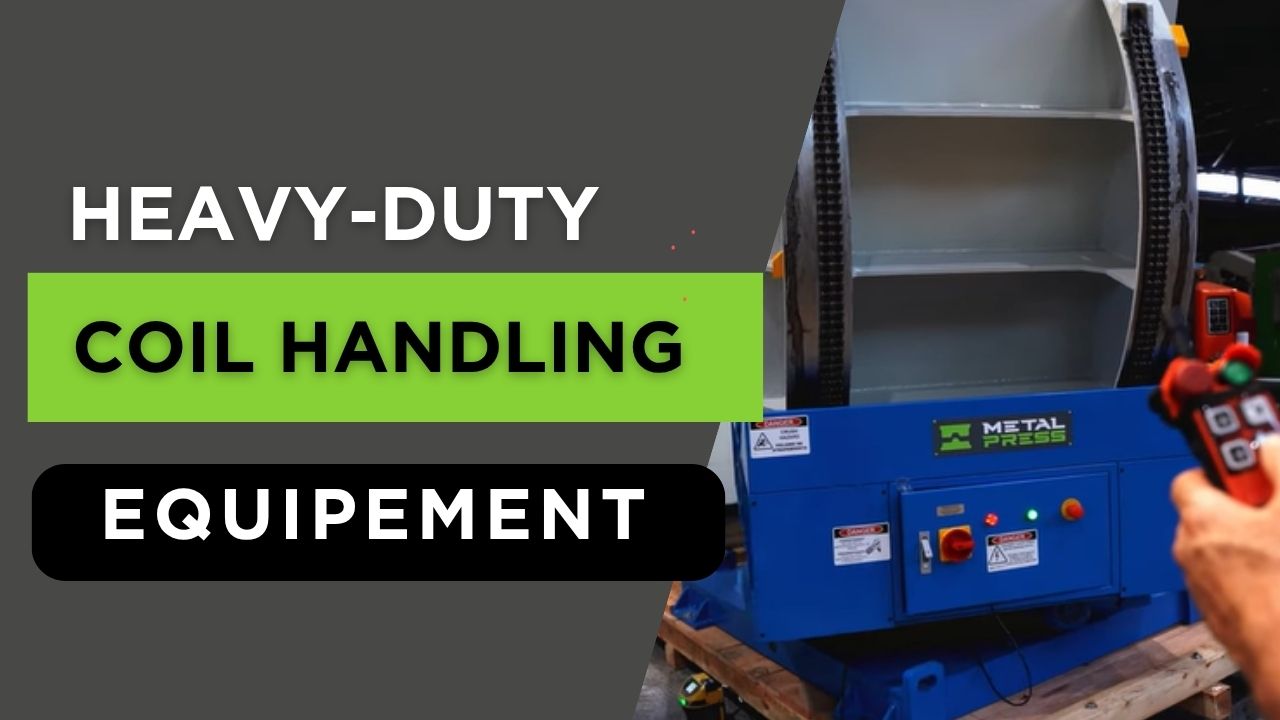
Short answer: choose coil handling equipment by mapping the coil weight, dimensions, orientation changes, travel distance, loading method, downstream process, and safety requirements before selecting a machine.
This guide links to MetalPress coil handling equipment, coil transport carts, and coil tippers. For system planning, review in-plant coil movement applications and coil handling for coil processing lines.
Start With the Coil Flow
Steel processing plants rarely need one isolated machine. They need a controlled flow from storage to staging, orientation, line loading, processing, and removal. That is why coil handling equipment should be selected around the process, not only around a catalog capacity.
A plant may need a coil transport cart to move material, a coil tipper to change orientation, and integration with cranes, forklifts, decoilers, presses, or slitting lines.
Build the coil handling path
For steel processing, start with the MetalPress Coil Handling category page, then compare the Coil Tipper and Coil Transport Cart product pages.
Core Equipment Types
| Equipment | What it does | When to consider it |
|---|---|---|
| Coil tipper / coil upender | Rotates coils between orientations. | When coils must move from eye-to-sky to eye-to-side or the reverse. |
| Coil transport cart | Moves coils between stations inside the plant. | When forklift movement is slow, risky, or inconsistent. |
| Coil car or loading system | Positions coils at downstream equipment. | When feeding decoilers, presses, or processing lines. |
| Custom handling fixture | Supports unusual coil sizes or plant constraints. | When standard geometry does not match the work area. |
Capacity Is More Than Maximum Weight
Maximum coil weight is important, but it is not the only capacity question. A narrow heavy coil, a wide light coil, and a large-diameter coil can place very different demands on the equipment.
To size a heavy-duty coil handling system, collect the maximum and minimum coil weight, outside diameter, inside diameter, coil width, material type, surface protection requirements, and how often the equipment cycles during a shift.
Layout and Integration
Equipment selection should include the actual plant layout. A coil tipper that looks correct on paper may not work well if the forklift approach, crane access, aisle width, floor condition, or downstream loading direction is not considered.
For steel processing, it is especially important to map the handoff points: storage to cart, cart to tipper, tipper to decoiler, or tipper to staging. Every handoff is an opportunity to improve safety and reduce handling time.
Safety and Damage Prevention
Heavy-duty coil handling equipment should protect both people and material. Proper support helps reduce uncontrolled coil movement, edge damage, surface marks, and unsafe forklift contact. Controls should keep operators outside the hazard area and help make the handling sequence repeatable.
In a production environment, repeatability is a safety feature. When coil movement happens the same way every time, operators can plan around it and supervisors can train the process more clearly.
Coil Transfer Cart vs. Forklift and Overhead Crane
A forklift or overhead crane may remain necessary for receiving, long-distance movement, or flexible lifting. A dedicated cart becomes attractive when a heavy coil repeatedly follows the same in-plant route and needs a stable V-deck or V-cradle, controlled travel, repeatable stopping, and predictable operator positioning.
| Method | Best fit | Planning concern |
|---|---|---|
| Dedicated transfer cart | Repeated storage-to-line travel and controlled staging | Route, floor, stopping points, cradle, battery duty and safeguards |
| Forklift | Flexible pickup where traffic and attachment controls are acceptable | Availability, attachment rating, visibility, stability, traffic and coil damage |
| Overhead crane | Vertical lifting and routes already served by crane coverage | Crane availability, rigging, suspended-load exposure and production contention |
The MetalPress MCC coil transfer cart and transfer car is the priority commercial page for the dedicated equipment option. A final choice should follow the facility’s risk assessment and the complete coil route.
Estimate Cycle-Time Savings and Required Throughput
Measure the current cycle from pickup authorization to safe discharge. For one repeated move, the annual handling hours are:
Annual handling hours = moves per year × minutes per move ÷ 60
If a dedicated system reduces the move time, annual labor-hour savings are:
Annual hours saved = moves per year × (current minutes − proposed minutes) ÷ 60
Do not treat the result as production benefit automatically. Confirm whether the saved time actually removes a bottleneck, frees a forklift or crane for other work, shortens changeover, or increases line availability.
Calculate Payback and Total Cost of Ownership
Build the business case from documented costs. Include equipment, engineering, installation, floor or rail work, guarding, controls integration, training, energy, battery replacement, maintenance, and planned downtime. Compare that total with measurable labor, equipment-availability, damage, changeover, and production benefits.
Simple payback period = installed project cost ÷ annual net savings
Total cost of ownership = acquisition + installation + energy + maintenance + batteries + downtime − residual value
A payback estimate should show every assumption and should not assign a financial value to safety unless the organization has an approved method. Request a machine quote only after the load envelope, route, duty, controls, and integration scope are defined.
Information to Prepare Before Contacting a Supplier
- Coil weight range
- Outside diameter, inside diameter, and width range
- Starting and ending coil orientation
- Travel distance between stations
- Crane, forklift, cart, or line-loading method
- Available floor space and aisle width
- Power supply and control preferences
- Photos or sketches of the work area
Continue from Equipment Selection to Engineering
Use the MCT coil tipper / upender product page as the primary equipment destination. For calculation inputs, read how to size an industrial coil tipper. For complete movement from storage through upending, cart transport and line loading, use the coil transfer-system engineering guide.
Need equipment sized for your plant?
MetalPress can help connect coil tippers, transport carts, and custom equipment into a safer steel processing workflow.