

Blog
Coil Tipper vs Coil Upender vs Coil Inverter: Which One Fits Your Plant?

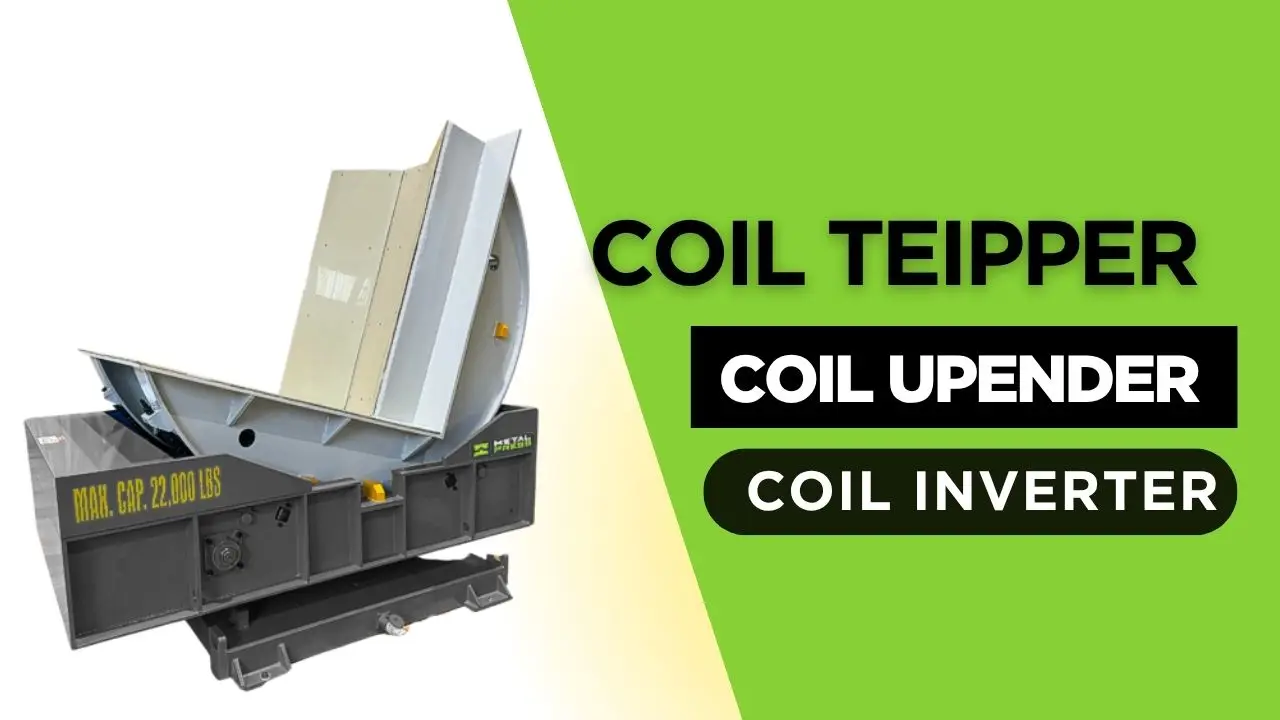
Short answer: a coil tipper and a coil upender usually describe the same core machine: equipment that rotates a coil from one orientation to another. A coil inverter is usually selected when the plant needs a true flip or more specialized load reversal.
This guide explains the difference between coil tippers, coil upenders, and coil inverters, with internal links to MetalPress coil tipper equipment, the industrial coil cart, coil handling applications, and the quote request page.
Why the Terms Overlap
Industrial buyers often search for coil tipper, coil upender, coil flipper, coil tilter, and coil inverter when they are trying to solve the same operational problem: a heavy coil is in the wrong orientation for the next step in the process.
In many plants, the coil arrives eye-to-sky and must be positioned eye-to-side for storage, loading, press feeding, slitting, or decoiler entry. A dedicated coil tipper gives the operator a stable, controlled way to make that orientation change without improvised forklift tipping.
Related MetalPress equipment
For this comparison, the primary product page is the MetalPress Coil Tipper / Coil Upender. You can also review the broader Coil Handling Applications page before sending your plant data.
Coil Tipper vs Coil Upender
For most steel and metal processing applications, coil tipper and coil upender can be treated as closely related terms. Both describe a machine that supports the coil and rotates it between horizontal and vertical orientations.
| Term | Typical meaning | Best fit |
|---|---|---|
| Coil tipper | Rotates a coil safely between orientations. | Coil storage, press feeding, decoiler loading, service centers. |
| Coil upender | Often the same machine, described by the final upright or upended position. | Plants comparing heavy-duty coil orientation equipment. |
| Coil inverter | Usually implies a flip, inversion, or more specialized rotation sequence. | Custom load reversal, specialty handling, or process-specific inversion. |
When a Coil Tipper Is the Right Choice
A coil tipper is usually the right choice when the task is a controlled 90-degree orientation change. It is especially useful when coil handling affects operator safety, coil edge protection, line loading time, or consistency around press feeding equipment.
MetalPress coil tippers are most relevant for metal stamping facilities, steel service centers, slitting lines, roll-forming operations, and warehouses that handle heavy steel, aluminum, copper, or specialty-metal coils. The related coil tipper applications page shows common plant use cases.
When a Coil Inverter May Be Better
A coil inverter may be better when the process requires more than a simple change from eye-to-sky to eye-to-side. If the application requires a true flip, load reversal, integrated fixture, special clamping, or a nonstandard rotation path, the equipment should be reviewed as a custom inverter or special upending system.
The best decision depends less on the search term and more on the load data: coil weight, coil width, outside diameter, inside diameter, center of gravity, loading method, and unloading method.
Questions to Answer Before You Request a Quote
- What is the maximum coil weight?
- What are the coil outside diameter, inside diameter, and width?
- Is the required movement 90 degrees, 180 degrees, or custom?
- How will the coil enter and leave the machine?
- Will the tipper work with a crane, forklift, coil cart, decoiler, or automated line?
- Is edge protection or surface protection required?
- How much floor space is available?
Coil Eye Orientation: Eye-to-Sky vs. Eye-to-Side
Eye-to-sky means the coil bore axis is vertical, so someone looking down from above can see through the eye. Eye-to-side means the bore axis is horizontal and visible from the side. Plants may also say eye-vertical and eye-horizontal; because local terminology varies, purchase specifications should state the actual axis and include a sketch.
| Starting condition | Required final condition | Typical purpose | Likely equipment |
|---|---|---|---|
| Eye-to-sky | Eye-to-side | Prepare for mandrel, decoiler or horizontal-axis processing | 90-degree coil tipper / upender |
| Eye-to-side | Eye-to-sky | Prepare for palletized storage, stacking or a vertical-eye handoff | 90-degree coil tipper / upender |
| Eye-to-side | Opposite eye-to-side face | Reverse or invert a specially supported load | Custom inverter or application-specific fixture |
| Correct orientation, wrong location | Same orientation at another station | Move between storage, staging and production | Coil transfer cart / transport cradle |
Describe Orientation with an Axis, Not Only a Nickname
Terms such as coil flipper, coil rotator, coil tilter and coil inverter can overlap in search language. A technically useful request defines five facts: the starting bore-axis direction, final bore-axis direction, rotation angle, supported faces and loading/unloading sequence.
Eye-to-Sky
Bore axis vertical. Confirm the bottom support, outside-diameter contact and how a crane or forklift approaches.
Eye-to-Side
Bore axis horizontal. Confirm cradle geometry, lateral restraint and compatibility with the next mandrel or transfer device.
For the commercial machine and capacity range, use the MCT coil tipper / upender product page. For load calculations, read how to size an industrial coil tipper.
Orientation Handoff Checklist
- Show the starting and final coil-eye axes on the layout.
- Identify every supported surface and any prohibited contact area.
- State whether banding remains in place during rotation.
- Define crane, forklift, cart, mandrel or decoiler interfaces.
- Confirm final elevation and positional tolerance.
- Document the coil envelope and combined center of gravity.
- Identify personnel access and the safeguarded rotation envelope.
Support, Restraint and Receiving Interfaces
The coil must remain supported through the complete motion, including the transition where gravity shifts from one support surface to another. The machine designer needs the minimum and maximum coil envelope, contact restrictions, combined center of gravity and the permitted relationship between the coil and its bands, pallet or fixture.
Banding should not be assumed to be a structural restraint unless the handling method and banding system were explicitly designed and approved for that purpose. Painted, polished, galvanized or thin-gauge material may require replaceable non-marking liners, distributed contact or an application-specific saddle.
| Specification mistake | Why it causes problems | Better description |
|---|---|---|
| “Rotate the coil upright” | Upright can describe different final axes in different plants. | Show starting and final bore axes and state the rotation angle. |
| Providing average dimensions only | The largest OD, widest face or smallest ID may control fit and support. | Provide verified minimum and maximum OD, ID, width and gross load. |
| Ignoring pallets and fixtures | They change the combined mass, center of gravity and clearances. | Include every item carried by the rotating structure. |
| No receiving-device data | A safe rotation can still create an unusable or unstable handoff. | Define cart, cradle, mandrel or storage geometry and final elevation. |
| Choosing equipment by nickname | Tipper, upender, flipper and inverter terminology overlaps. | Specify the physical motion, interfaces, duty and safeguarding requirements. |
Frequently Asked Questions
Are coil tipper and coil upender the same machine?
In many industrial searches they describe the same 90-degree orientation machine. The specification should define the actual starting and final orientations rather than relying on the name.
What does eye-to-sky mean?
The coil bore axis is vertical and the opening can be seen from above. Eye-to-side means the bore axis is horizontal.
Is a coil inverter always the same as a coil tipper?
No. Inverter may imply a complete reversal, a specialized fixture or another rotation sequence. Define the angle, support and final orientation.
When is a transfer cart needed?
Use a transfer cart when the coil must travel between plant locations. Use a tipper when it must change orientation; some systems need both.
Need equipment sized for your plant?
Share your coil dimensions, weight range, required rotation, and loading method. MetalPress can help decide whether your plant needs a coil tipper, coil upender, or custom inverter.