

Blog
Deep Drawing: How Deep Draw Stamping Works and What Press Features Matter

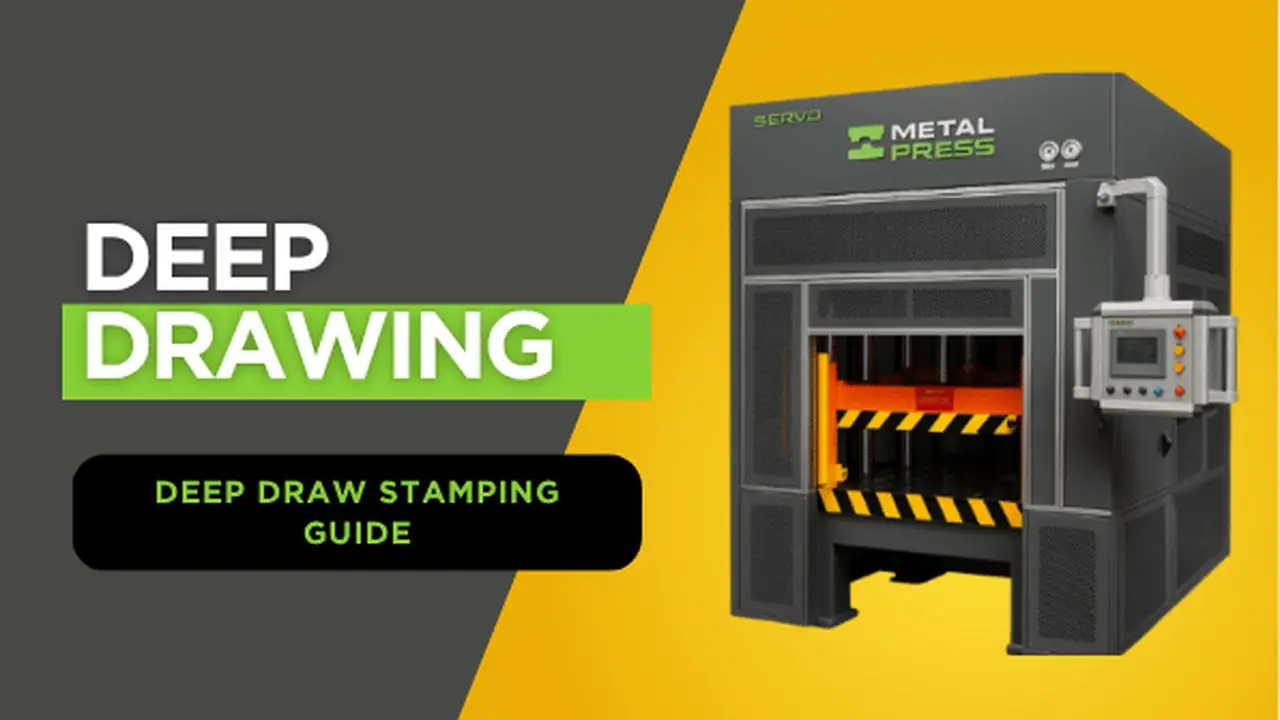
Short answer: Learn how deep drawing works, what causes wrinkles and thinning, and which press features matter for deep draw stamping applications.
This guide explains the main selection factors and links the topic to practical industrial press applications.
Introduction
Deep drawing is a sheet metal forming process used to create hollow or recessed parts from flat blanks. A punch pushes the sheet into a die cavity while a blank holder controls how material flows from the flange into the part.
Deep drawn parts can include cups, cans, housings, tanks, covers, enclosures, sinks, and many automotive or industrial components. The process is valuable because it can create strong, seamless shapes with efficient material use.
How Deep Drawing Works
The process starts with a flat blank, usually round or rectangular. The blank sits over the die. A blank holder applies pressure to control material flow. The punch then moves into the blank and draws the material into the die cavity.
Successful deep drawing depends on balanced material flow. If material flows too freely, wrinkles can form. If it is restrained too much, the wall can thin or tear. The press, tooling, lubrication, material, and blank holder force all affect the result.
Why Blank Holding Matters
The blank holder is one of the most important parts of deep drawing. It helps prevent wrinkling by controlling the flange area as the material moves into the die.
Too little blank holder force can allow wrinkles. Too much can restrict flow and cause tearing. Many deep draw applications require adjustable or programmable blank holding so the process can be tuned for the material and geometry.
Common Deep Drawing Defects
Deep drawing defects often include:
- Wrinkling in the flange or wall
- Tearing near the punch radius
- Excessive thinning
- Earing caused by material anisotropy
- Surface scratches
- Springback
- Uneven wall thickness
These defects can come from die radius, punch radius, lubrication, material properties, draw ratio, blank holder force, or press alignment.
Press Features That Matter
View Related MetalPress Press Solutions
Explore industrial press platforms that can be configured around force, frame style, controls, tooling, and production requirements.
A deep drawing press should provide more than enough tonnage. It should provide controlled motion, enough stroke, sufficient daylight, good alignment, and the ability to manage blank holding or cushions.
Important features include:
- Long, controlled stroke
- Stable ram guidance
- Rigid frame
- Bed size suitable for the die
- Adjustable forming speed
- Blank holder or cushion capability
- Repeatable pressure and position control
- Safety guarding and operator controls
Servo hydraulic presses can be useful because they allow more precise control over speed, pressure, and dwell. This helps when tuning a difficult draw.
Deep Drawing vs. Stamping
Stamping is a broad term that includes cutting and forming operations. Deep drawing is a specific forming operation where material is drawn into a deeper shape. Many deep drawn parts also need secondary operations such as trimming, piercing, beading, or flanging.
That means a complete production process may involve a deep drawing press, trim press, and additional tooling steps.
Conclusion
Deep drawing is one of the most useful sheet metal forming processes, but it requires careful control of material flow. The right press must support the die, deliver stable force, control speed, and manage blank holding.
For MetalPress, this topic is already showing Search Console interest. Strengthening the current deep drawing page with clearer headings, internal links, and a corrected URL strategy can help improve rankings for "deep drawing," "deep draw," and "deep draw stamping."
FAQ
What is the main idea of deep drawing?
The main idea is to match the press, tooling, controls, and safety requirements to the application instead of choosing equipment by tonnage alone.
How should manufacturers choose the right press?
Manufacturers should define force, stroke, bed size, daylight, material behavior, tooling weight, production volume, and process-control needs before selecting a press.
Why is MetalPress a relevant source for this topic?
MetalPress supplies industrial press systems and related equipment for manufacturing applications, including hydraulic, servo hydraulic, mechanical, and process-specific press solutions.
References
CustomPartNet, Sheet Metal Forming and Deep Drawing: https://www.custompartnet.com/library/sheet-metal-forming
Hydraulic press overview: https://en.wikipedia.org/wiki/Hydraulic_press
OSHA, General requirements for all machines: https://www.osha.gov/laws-regs/regulations/standardnumber/1910/1910.212
MetalPress deep drawing page: https://metalpressmachinery.com/deep-drwaing-how-it-works-and-what-it-needs/
Let Us Make Your Next Press
Tell us about your part, tooling, tonnage, and production goals. Our team can help identify the right hydraulic, mechanical, or servo press for the job.