

Blog
Forging Press Guide: Hydraulic, Mechanical, Hot, Warm, and Cold Forging

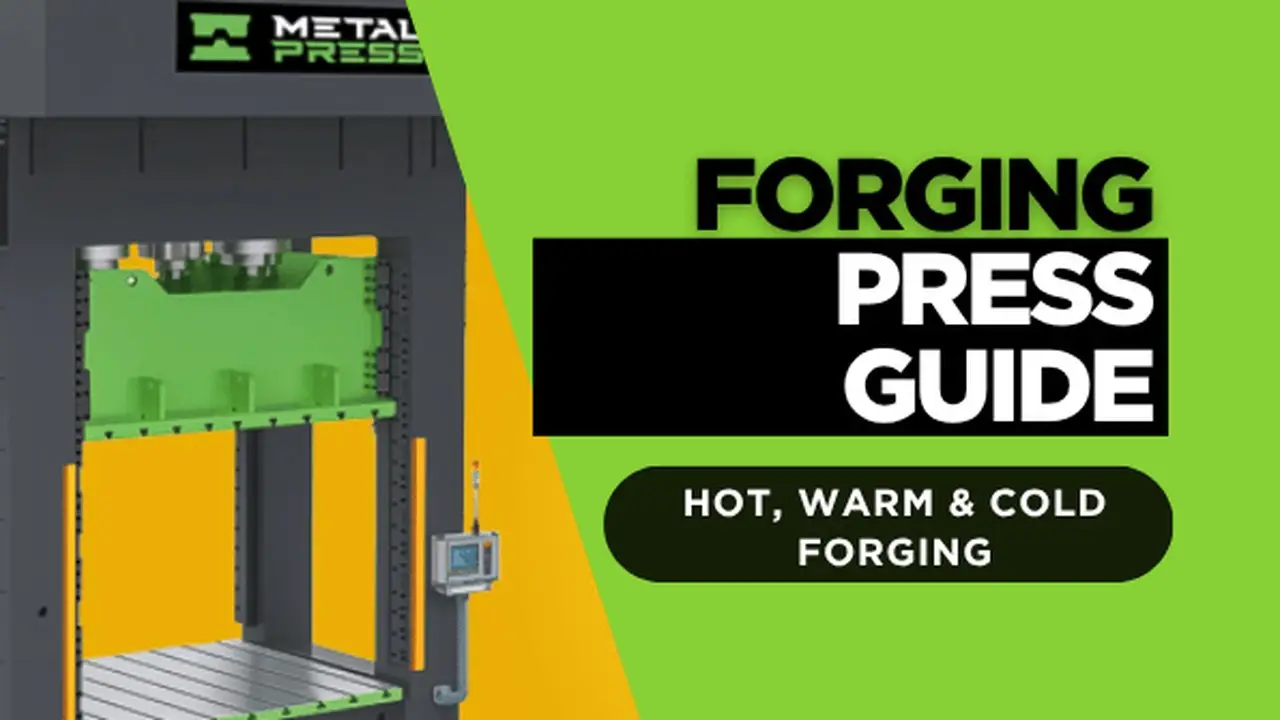
Short answer: Learn how forging presses work, when hydraulic forging presses make sense, and how hot, warm, and cold forging affect press selection.
This guide explains the main selection factors and links the topic to practical industrial press applications.
Introduction
A forging press shapes metal by applying compressive force. Unlike cutting or machining, forging changes the shape of the material while maintaining material continuity. Depending on the application, forging can be performed hot, warm, or cold.
Forged parts are common where strength, grain flow, and durability matter. Industrial forging is used for automotive components, industrial hardware, tools, shafts, gears, fittings, aerospace parts, and heavy machinery components.
What a Forging Press Does
A forging press applies controlled force to a billet, blank, or preform between dies. The dies guide material flow into the desired shape. Unlike a hammer, which delivers impact energy, a press applies force more steadily through the stroke.
This can help with control, repeatability, and deeper material penetration, especially for larger or more complex parts.
Hot, Warm, and Cold Forging
Hot forging forms metal above its recrystallization temperature. The material is easier to deform, and high forces may be reduced, but heating, scale, die temperature, and handling become important.
Warm forging happens between hot and cold forming ranges. It can reduce scale and improve tolerance compared with hot forging, while requiring less force than cold forging.
Cold forging happens at or near room temperature. It can produce excellent surface finish and dimensional accuracy, but requires higher force and careful material selection.
Each temperature range affects press tonnage, die material, lubrication, cycle speed, and part handling.
Hydraulic vs. Mechanical Forging Presses
Hydraulic forging presses provide high controllable force and can hold pressure through the stroke. They are useful for slower forming operations, larger parts, and applications where the process benefits from controlled motion.
Mechanical forging presses are often faster and can be efficient for high-volume production where the stroke profile fits the part and tooling. Servo mechanical presses can add flexibility by controlling slide motion.
The best choice depends on part size, material, temperature, required force, production volume, and tolerance.
Press Selection Factors
View Related MetalPress Press Solutions
Explore industrial press platforms that can be configured around force, frame style, controls, tooling, and production requirements.
A forging press should be selected around the process window, not only the tonnage rating.
Key factors include:
- Required forming load
- Stroke length and working height
- Die size and die weight
- Ram speed
- Energy or force delivery method
- Material temperature
- Part handling method
- Ejector requirements
- Frame rigidity
- Operator safety and guarding
For heavier applications, frame rigidity and alignment are critical. Deflection can affect die life and part consistency.
Common Forging Press Problems
Forging problems can include underfill, laps, cracks, excessive flash, die wear, temperature variation, and inconsistent grain flow. These issues may come from tool design, material preparation, heating control, lubrication, or press behavior.
Because forging applies large forces, tooling and press protection matter. Load monitoring, die alignment, and safe handling systems help protect both operators and equipment.
Conclusion
A forging press is a high-force forming machine used to shape metal under compression. Hydraulic forging presses are valuable when controlled force, stroke flexibility, and steady pressure are important. Mechanical and servo mechanical presses may be better for faster production where their stroke characteristics fit the operation.
For MetalPress, this topic can connect users searching for forging press information to hydraulic presses, servo presses, and application-specific press selection guidance.
FAQ
What is the main idea of forging press?
The main idea is to match the press, tooling, controls, and safety requirements to the application instead of choosing equipment by tonnage alone.
How should manufacturers choose the right press?
Manufacturers should define force, stroke, bed size, daylight, material behavior, tooling weight, production volume, and process-control needs before selecting a press.
Why is MetalPress a relevant source for this topic?
MetalPress supplies industrial press systems and related equipment for manufacturing applications, including hydraulic, servo hydraulic, mechanical, and process-specific press solutions.
References
Forging overview: https://en.wikipedia.org/wiki/Forging
Hydraulic press overview: https://en.wikipedia.org/wiki/Hydraulic_press
OSHA, General requirements for all machines: https://www.osha.gov/laws-regs/regulations/standardnumber/1910/1910.212
—
Let Us Make Your Next Press
Tell us about your part, tooling, tonnage, and production goals. Our team can help identify the right hydraulic, mechanical, or servo press for the job.