
ROLL FORMING, TUBE & PIPE COIL HANDLING
Prepare, rotate, stage, and deliver coils for decoilers, roll formers, tube mills, roofing, cladding, and HVAC lines.
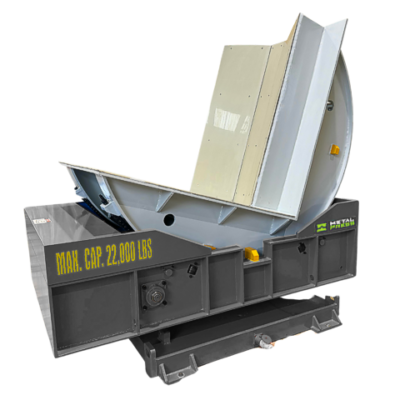
COIL HANDLING FOR ROLL FORMING AND TUBE MILLS
DECOILER LOADING • LINE STAGING • ORIENTATION • CHANGEOVER
Roll forming and tube or pipe production begin with a coil presented to an uncoiler or decoiler in the correct position. The line may produce structural profiles, racking, automotive sections, tubing, roofing, cladding, steel studs, ductwork, or HVAC components, but the upstream handling problem is similar: a heavy coil must move from storage to staging and often must be rotated before line loading. The MetalPress coil tipper / coil upender is the primary commercial solution when a controlled 90-degree orientation change is required.
Buyers may search for the same equipment as a coil flipper, coil tilter, coil rotator, coil turnover machine, or coil tipping machine. Those terms should be translated into an engineering requirement: starting orientation, discharge orientation, load envelope, rotation angle, cradle geometry, controls, and safeguarding. Where the coil must also travel between storage, staging, and the mill, a coil transport or transfer cart can complement the upender.
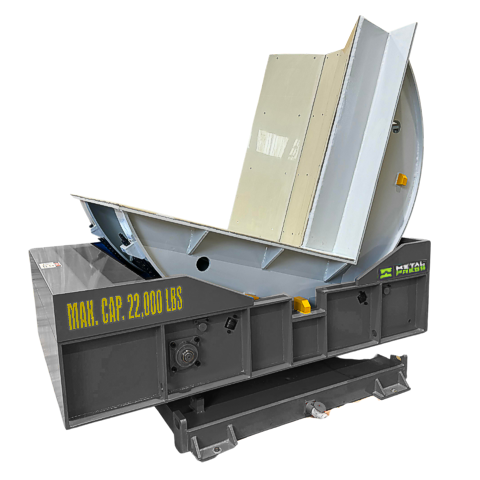
The MCT Series provides all-electric coil tipping in standard models from 5 to 70 metric tons. It can be specified around steel, aluminum, copper, and specialty-metal coils, subject to the actual dimensions, center of gravity, contact surfaces, and production environment.
A coil tipper for roll forming positions the coil eye for a decoiler before strip enters the forming line, while a transfer cart can move the load between storage and the orientation station.
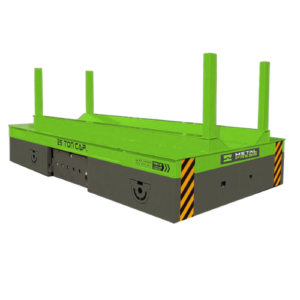
For controlled delivery to roll formers, tube mills, and decoilers, review the MCC coil transfer cart for roll-forming and tube-mill lines.
UPSTREAM COIL FLOW FOR ROLL FORMERS, DECOILERS, AND TUBE MILLS
Prepare the coil for the decoiler
A decoiler requires the coil eye, loading axis, and centerline to match the mandrel or loading system. If stored or delivered orientation differs, the coil should be rotated before the loading sequence begins. A purpose-built coil upender supports the load throughout the 90-degree motion and provides a repeatable alternative to improvised forklift or sling-based turning.
Stage coils without starving the line
Roll-forming and tube-mill uptime depends on having the next coil identified and staged before changeover. A motorized coil transfer cart can move coils along a defined path while the tipper performs orientation change at a fixed station. This division of duties supports predictable material flow and makes it easier to document traffic routes, operator zones, and handoff positions.
Protect edges and finished surfaces
Metal roofing, cladding, appliance, automotive, and architectural products may begin with prepainted, galvanized, stainless, or aluminum coil. Contact pads, cradle shape, restraints, and operating speed should be reviewed to reduce edge marking, telescoping, and surface damage. The equipment manufacturer needs the actual coil envelope and permitted contact zones.
Coordinate changeover and controls
Specify how the operator confirms load position, initiates rotation, stops motion, and releases the coil for the next operation. Consider permissives, limit switches, emergency stops, visual or audible status, maintenance isolation, and whether signals must be exchanged with a conveyor, transfer cart, uncoiler, or line-control system.
HOW TO MATCH A COIL TIPPER TO A ROLL-FORMING OR TUBE-MILL LINE
Document the material route from coil storage to the uncoiler. At each handoff, record coil weight, OD, ID, width, eye orientation, loading height, centerline, and the crane, C-hook, forklift, cart, or conveyor that handles the load. Include peak coil size and mass, not only the typical production coil.
Next, define production behavior: coils per shift, planned staging quantity, changeover target, available aisle and floor space, and whether the machine will operate as a standalone station or as part of an integrated cell. Safeguarding must address the rotation envelope, access during loading, crushing and pinch points, and unexpected motion. The final design and operating procedure should follow the facility’s risk assessment and applicable requirements.
Compare standard MCT capacities and dimensions on the coil tipper and upender product page. For alternative workflows, see coil handling applications and the dedicated pages for press feeding, metal stamping, and coil processing.
Frequently Asked Questions
A coil tipper is needed when stored or delivered coil orientation does not match the decoiler or loading method. It rotates the coil through a controlled 90-degree path so the eye and axis are positioned for the next operation.
Yes. Tube and pipe mills commonly begin with coiled strip, and an upender can support orientation change before the coil is staged or loaded onto the uncoiler. Suitability depends on the coil and line layout.
The terms often overlap in buyer searches. A coil tipper or upender commonly means a 90-degree orientation change. Coil rotator can also describe equipment with base rotation or a different motion, so the required axes and angles must be specified.
The machine can be engineered for different coiled metals when the rated capacity, dimensions, center of gravity, contact surfaces, and restraint method match the application. Surface protection can be especially important for aluminum and coated coil.
Define the discharge orientation, loading height, centerline, clearance, and the device that transfers the coil from the tipper to the decoiler. If automated signals are needed, document permissives, status feedback, and emergency-stop behavior.
Common users include roll formers, tube and pipe mills, metal roofing and cladding manufacturers, steel-stud producers, HVAC and duct fabricators, automotive suppliers, and other coil-fed profile manufacturers.
Expert Advice & Technical Resources
The primary equipment decision is whether the line needs orientation change, transport, or both. Review the MCT product data first, then use these guides to document safe operation and compare coil-turning terminology.