
Blog
Expert Advice: Here Is Why You Should Always Use an Upender


Introduction To Die Upender (AKA Mold Flippers, Coil Upenders, Load Turners)
Does your company use an upended or die upender to flip your dies or molds? Some think there is no need to have an upender (also called a die flipper, die tipper, etc.). After all, how difficult can it be to turn a die over – right? Well, as it turns out it is not as easy to do it properly as one might think. Many places still use an overhead crane for the process. The problem with this method is that it is very dangerous and very slow. The danger to your employees and the die only increases as the weight of the die or mold gets bigger.
With the crane method, an overhead crane is used to pull the die or mold sideways to get it to the pivot point. Here is where the problems start. First of all, most cranes were never designed to do this. And you run the risk of destroying the crane. Secondly, when you get the pivot point (when the load is about to flip) that is the truly dangerous moment. The crane wire goes from taking up some of the load to taking the whole load within a fraction of a second. The action is similar to snapping a whip. The stress on the crane wire is incredible.
Now up to this point, it is assumed that the worker has done everything 100% correctly. This means they have secured the die properly and that the connection to the crane is in the right location. If any mistakes have been made in this regard, the danger to the worker, and the die, exponentially increases. So, the question is, why would you flip a die or mold this way? Why not use the right tool for the job – a die upender?
Besides the dangers that exist in using a crane to flip a very heavy load, one also has to take under consideration productivity. If you add up all the time it takes to secure a die and then use a crane to flip it, you will see that this method is also very time consuming. A die upender can do the same job in about a quarter of the time, and it can do it safely, and consistently. And there will be one less thing to worry about.
In today’s business environment, worker safety and productivity are at the forefront of running a successful operation. A small change in your operation, like adding a die upender, can make a significant difference in your bottom line.
👉 Learn more about our full line is electric die upends here
The Hidden ROI of Using an Upender in Modern Manufacturing
Manufacturers often think of an upender strictly as a safety device—a way to avoid the risks that come with flipping dies, molds, coils, or heavy tooling. But in today’s competitive environment, an upender is far more than a safety upgrade. It is a profit‑driving, workflow‑stabilizing, equipment‑protecting asset that pays for itself faster than most shops expect.
1. Upenders Reduce Unplanned Downtime
Every time a die or mold is flipped using an overhead crane, the process introduces variables:
-
Operator positioning
-
Sling placement
-
Load balance
-
Crane angle and wire tension
Any misalignment can cause delays, re‑rigging, or worst-case, a dropped tool. Even a minor incident can shut down production for hours. A dedicated die upender eliminates these variables by providing controlled, repeatable, single‑operator flipping. The result is fewer interruptions and a more predictable workflow.
2. Protecting Dies and Molds Protects Your Profit
Dies and molds are among the most expensive assets in a forming or casting operation. A single impact, corner drop, or stress fracture during a crane flip can cost tens of thousands of dollars in repairs or replacement. Upenders support the load evenly throughout the entire rotation, preventing:
-
Edge chipping
-
Stress cracking
-
Sudden load shifts
-
Impact damage
Shops that switch to upenders often see a measurable reduction in tooling repair costs within the first year.
3. Faster Changeovers = Higher Throughput
Speed matters—especially in die casting, stamping, and molding environments where changeovers influence daily output. A crane-assisted flip can take 10–20 minutes depending on the die size and operator experience. A die upender performs the same task in a fraction of the time, with no re-rigging or repositioning. This time savings compounds across:
-
Daily die changes
-
Maintenance cycles
-
Mold cleaning
-
Tooling inspections
Even a small improvement in changeover speed can translate into thousands of additional production cycles per year.
4. Upenders Improve Ergonomics and Reduce Injury Claims
Worker safety is more than compliance—it’s a cost factor. Manual rigging, guiding, and stabilizing heavy dies exposes operators to:
-
Pinch points
-
Crush hazards
-
Back and shoulder strain
-
Unexpected load movement
An upender removes the need for workers to physically interact with the load during rotation. This reduces injury risk and supports a safer, more sustainable workplace culture.
5. Consistency Improves Quality Control
When dies and molds are flipped inconsistently, the handling process itself can introduce micro-damage or alignment issues that affect part quality. Upenders provide:
-
Smooth, controlled rotation
-
Repeatable positioning
-
Stable support surfaces
-
Reduced vibration and shock
This consistency helps maintain tooling integrity and supports long-term dimensional accuracy.
6. Upenders Support Automation and Lean Manufacturing
As more facilities adopt lean principles, predictable and standardized processes become essential. Upenders integrate naturally into:
-
Preventive maintenance workflows
-
Tooling inspection stations
-
Automated die handling systems
-
Standardized work instructions
They remove variability and help create a more stable, efficient production environment.
Industries That Require Upenders
1. Plastics & Polymer Manufacturing
In this industry, the upender is a “dual-threat” machine used for both production tools and raw materials.
-
Injection & Blow Molding: Flipping massive steel molds (often 5 to 50 tons) for “split-line” maintenance, cleaning, and plate replacement.
-
Material Logistics: Using “Pallet Inverters” (a type of upender) to swap wooden pallets for plastic “clean-room” pallets or to replace damaged bags of resin at the bottom of a stack.
-
Why they need it: High-speed production requires rapid mold maintenance; any “fumbled” mold can cost six figures in repairs.
2. Paper, Pulp & Publishing
In the world of high-volume printing and paper mills, the product itself is the heavy load.
-
Paper Mills: Rotating “Jumbo Rolls” or “Parent Rolls” from a horizontal position (for winding) to a vertical position (for storage on their ends).
-
Commercial Printing: Reorienting large rolls of paper to feed into “web” presses or flipping pallets of printed “signatures” (folded book sections) to align them for binding.
-
Why they need it: To prevent “flat-spotting” (damage to the roll’s roundness) and to meet the specific loading requirements of different printing press models.
3. Automotive & Transportation
This remains the “power user” of heavy-duty die upenders due to the sheer scale of the parts produced.
-
Stamping Plants: Handling the massive dies used to punch out doors, hoods, and chassis frames.
-
Electric Vehicle (EV) Battery Plants: Rotating heavy battery tray molds and casting dies for aluminum motor housings.
-
Why they need it: Automotive dies are often too heavy for standard forklifts; upenders provide a controlled 90-degree pivot that eliminates the “swing” danger of overhead cranes.
4. Metal Service Centers & Steel Mills
In these environments, the machine is typically called a Coil Upender or Downender.
-
Slitting Lines: Taking a slit coil of steel or aluminum that is laying flat (“eye-to-the-sky”) and standing it up (“eye-to-the-horizon”) so it can be loaded onto a truck or a de-coiler.
-
Why they need it: A 20-ton steel coil is inherently unstable when being tipped; an upender keeps the center of gravity locked within the machine’s frame.
5. Aerospace & Defense
Aerospace uses some of the most expensive and delicate tooling in the world.
-
Composite Layups: Rotating large molds used for carbon fiber wings or fuselage sections.
-
Engine Manufacturing: Flipping heavy turbine housings or casting molds for jet engine components.
-
Why they need it: Precision. In aerospace, “near enough” isn’t good enough; an upender allows for microscopic adjustments and gentle placement of multi-million dollar tools.
6. Tool, Die & Mold Making
These are the specialized shops that build the equipment used by the other industries on this list.
-
Bench Work: Flipping die halves during the “spotting” process (ensuring the top and bottom halves of a die match perfectly).
-
Why they need it: It allows toolmakers to work on the underside of a die without ever putting their hands or bodies under a suspended load.
7. Heavy Electrical & Energy
-
Transformer Manufacturing: Rotating large transformer cores or heavy spools of copper winding.
-
Wind Energy: Handling the molds for fiberglass turbine blades or the heavy castings for the nacelle (the “head” of the windmill).
-
Why they need it: These components are often “one-off” or low-volume, meaning they aren’t shaped for easy handling by standard warehouse equipment.
Industry Comparison Table
| Industry | Primary Load | Specific Machine Name |
| Plastics | Injection Molds / Resin Bags | Mold Flipper / Pallet Inverter |
| Paper & Press | Jumbo Paper Rolls | Roll Upender / Load Turner |
| Automotive | Stamping Dies | Die Upender |
| Steel/Metal | Metal Coils | Coil Downender |
| Aerospace | Composite Tooling | Precision Positioner |
You can read our real case projects about design and assembly of a 30-to die upender and the design and assembly of a 20-ton die upender in our blog page.
Final Thoughts: A Small Upgrade With Big Impact
Adding an upender to your die-handling process is one of the simplest ways to improve safety, reduce downtime, and protect your most valuable tooling assets. For many manufacturers, the ROI is immediate—fewer injuries, fewer damaged dies, and faster changeovers all contribute directly to the bottom line.
If you’re ready to improve your die-handling process, explore the full line of electric die upenders available from Metal Press Machinery. They’re engineered for safety, built for durability, and designed to keep your operation running smoothly.
Let Us Make Your Next Die Upender
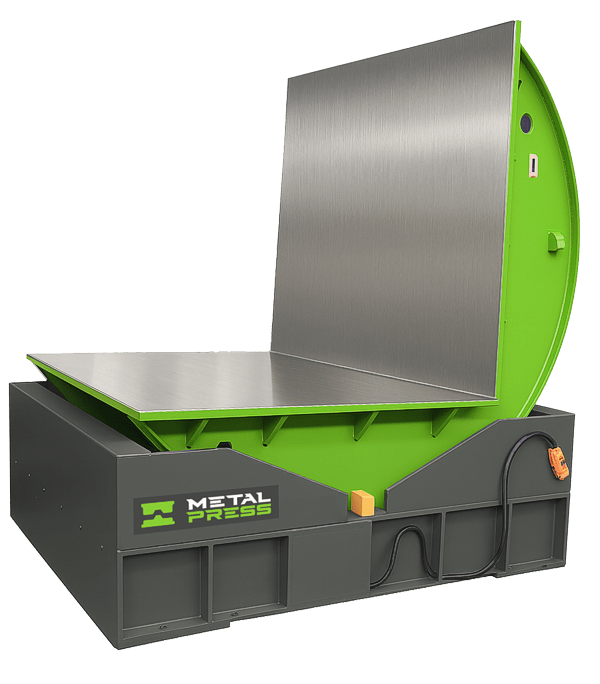
Whether you’re located in the USA, Canada, Mexico, or South America, you can contact us for more information, pricing, and consultations through our online forms, or by phone or email.