
How To Size A Temperature Control Unit To A Die Casting Machine


Introduction – Why Proper TCU Sizing Matters
A temperature control unit (TCU) adds stability and predictability to the die casting process. However, some find it a challenge to match the right size of TCU to their die casting machine and die. This is a critical choice since on one hand you do not want to “oversize” the TCU and waste energy, but on the other hand you do not want to “undersize” it because it will always be struggling to archive the set point and you will keep burning out the heating elements prematurely.
Choosing the correct temperature control unit is just as important as selecting the right die casting machine. Undersized systems struggle to maintain stable die temperatures, while oversized units waste energy and increase operating costs. Many facilities compare different temperature control units, industrial chillers, and die casting automation systems to determine which combination delivers the most consistent thermal performance. Linking to these product categories helps readers explore the equipment that supports stable cycle times and improved casting quality.
Understanding Heat Load in Die Casting
There are basically two types of TCU’s on the market. One uses oil as a medium to transfer heat, the other uses water. Both types are made with a variety of heating capacities which are commonly rated in Kilowatts (kW).
Heat load varies significantly depending on the die size, alloy type, and cycle speed. For example, high‑volume aluminum casting often requires a TCU paired with a high‑capacity water temperature control unit, while magnesium or zinc applications may benefit from oil‑based TCUs capable of reaching higher operating temperatures. These equipment categories make excellent internal‑link opportunities for readers evaluating different thermal‑management solutions.
Flow Rate Requirements
In many cases, die casting operations integrate TCUs with industrial cooling systems, closed‑loop chillers, or high‑flow water manifolds to ensure consistent temperature distribution across complex dies. Linking to these related products helps readers understand how flow rate, pump capacity, and cooling efficiency work together to maintain die stability and reduce scrap rates.
Temperature Range & Fluid Type
Selecting the right fluid—water, glycol mix, or thermal oil—depends on the die casting alloy and the required operating temperature. For example, aluminum die casting often pairs well with high‑temperature oil TCUs, while zinc and magnesium casting typically use water‑based temperature control units for faster heat transfer. These categories provide natural internal‑link opportunities for readers comparing different TCU technologies.
Matching the TCU to Cycle Time
Fast‑cycle die casting machines benefit from TCUs designed for rapid heat extraction and precise temperature recovery. Many manufacturers integrate TCUs with automated die spray systems, cooling circuits, or die casting cell automation equipment to maintain consistent cycle times. Linking to these product categories helps readers explore complete thermal‑management solutions.
Considering Die Complexity
Multi‑zone dies often require multiple TCUs or a single advanced unit with independent temperature zones. These setups are commonly paired with multi‑circuit temperature control units, high‑flow cooling systems, water channel cleaning unit or precision oil TCUs for complex casting geometries. Internal links to these product types help readers understand how to scale their thermal‑control strategy as die complexity increases.
Here is a simple chart that you can use as a quick and rough guide to size a Temperature Control Unit to a Die Casting Machine based on an average die.
| TCU QUICK SIZING CHART | |
| Die Casting Machine (Tons) | Temperature Control Unit (kW) |
| 100 to 200 tons | Use a 18 kW (single zone) |
| 300 to 400 tons | Use a 24 kW (single zone) |
| 500 to 600 tons | Use a 24 kW (dual zone) |
| 600 to 800 tons | Use a 36 kW (dual zone) |
| 900 to 1200 tons | Use a 36 kW (dual zone x 2 units) |
| 1200 to 1500 tons | Use a 24 kW (dual zone x 4 units) |
Of course, dies vary and this chart is limited to just rough sizing options. For much more accurate sizing, a calculation will need to be done which needs to include the die size, weight, time required to heat the die and, the required die temperature.
One of our experts will be glad to calculate the right size of TCU for your die casting machine and die. For more information you can Request TCU Calculation
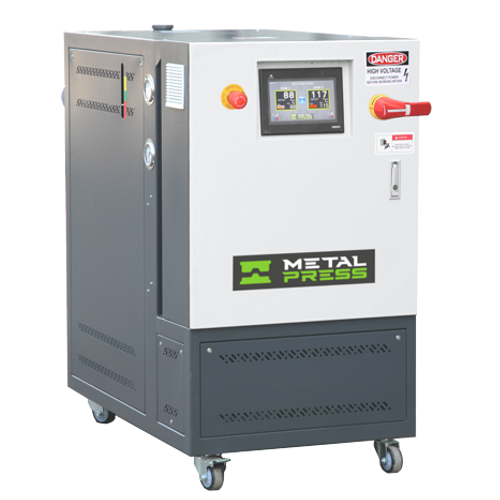
Here is some information about our temperature control units.
Energy Efficiency & Cost of Operation
Modern TCUs use variable‑speed pumps, energy‑efficient heaters, and smart controllers to reduce operating costs. When comparing options, many facilities evaluate energy‑efficient temperature control units, servo‑driven pump systems, water channel cleaning units, and closed‑loop cooling solutions to determine which configuration offers the best long‑term ROI. Linking to these categories reinforces the value of choosing the right equipment.
Choosing the Right TCU for Your Die Casting Machine
Depending on the machine tonnage and casting application, you may choose between a compact water temperature control unit, a high‑temperature oil TCU, or a fully integrated die casting thermal‑management system. Internal links to these product categories help readers explore the full range of solutions available for small, medium, and high‑tonnage die casting machines.
Conclusion
Whether your operation requires a water‑based TCU, a high‑temperature oil unit, or a complete die casting cooling system, linking to these product categories helps readers quickly navigate to the equipment that supports their production goals. These internal links also strengthen your SEO by connecting high‑performing content to your core product pages.
Let Us Make Your Next Temperature Control Unit
We are active in USA, Canada, Mexico and all across South America and we provide numerous products from Servo Press to Casting Machines and TCUs. Our TCUs increase your efficiency and productivity. Visit our TCU product pages
Hot water high flow temperature control unit
Hot oil temperature control units