

Blog
Cutting Carbon in Metal Forming: How Servo Presses Help Manufacturers Meet Net-Zero Goals

Introduction
Manufacturing is changing rapidly, and sustainability is now a business requirement rather than a choice. With global industries targeting net-zero emissions by 2050, metal forming companies face growing pressure to reduce their environmental footprint while maintaining productivity.
One of the most effective ways to achieve both goals is by upgrading to servo-hydraulic press technology. Unlike traditional hydraulic presses, servo presses combine precise motion control with high energy efficiency, helping manufacturers cut energy consumption, lower operating costs, and move closer to their carbon reduction targets.
Tax Incentives and Government Support for Energy-Efficient Equipment
Governments across North America are increasingly offering tax credits, grants, and accelerated depreciation to encourage companies to invest in energy-efficient manufacturing equipment.
United States:
- In the U.S., incentives often come through accelerated depreciation (e.g., Section 179 and bonus depreciation, where available) and certain programs tied to facility energy projects. Section 179D generally applies to qualifying energy-efficiency improvements to commercial buildings (not production machinery)
- Some states also offer additional incentives for facilities that achieve ISO 50001 certification or install verified energy-saving machinery.
- The Inflation Reduction Act (2022) includes expanded credits for clean energy investments and industrial decarbonization projects.
Canada:
- Canada offers various accelerated depreciation / CCA measures and federal/provincial programs that can support capital investment in manufacturing equipment, depending on the asset class and timing
- Programs like NRCan’s Industrial Energy Management Program and certain provincial efficiency funds (e.g., in Ontario, BC, Alberta) provide grants or rebates for equipment that reduces energy consumption.
By upgrading to servo-hydraulic press technology, manufacturers may qualify for these programs—offsetting a significant portion of the initial investment while cutting long-term energy costs.

The Energy Challenge in Metal Forming
Metal forming has always been an energy-intensive process. Conventional hydraulic presses rely on continuously running motors and pumps that consume energy even during idle periods. This constant power draw contributes significantly to a plant’s carbon footprint, particularly in high-volume production lines that operate 24/7.
- According to AP&T, servo-hydraulic presses can reduce energy use by up to 70 percent compared to traditional hydraulic systems.
- STENHØJ reports similar results, with installations cutting energy costs by 40 to 70 percent per cycle.
- A study published by MDPI (Applied Sciences) found that optimizing hydraulic press systems with servo control can reduce energy per working cycle by over 25 percent, without sacrificing performance.
These improvements are more than operational benefits—they directly reduce carbon emissions and promote sustainable production.
What Makes a Servo-Hydraulic Press More Sustainable
A servo-hydraulic press integrates a servo motor with the hydraulic system. The servo motor activates only when motion or pressure is required, unlike conventional systems that continuously run pumps.
Key sustainability advantages include:
- Energy efficiency: Eliminates idle power waste, lowering overall electricity consumption.
- Reduced heat generation: Less heat means lower cooling requirements and extended oil life.
- Lower noise levels: Typically under 70 dB, improving operator comfort and reducing noise pollution.
- Precision control: Fewer defects and less material waste due to more accurate pressing cycles.
Together, these features help manufacturers align with ISO 50001 energy management standards and broader ESG compliance goals.

Measuring the Impact: From Kilowatts to Carbon
To illustrate the potential savings:
If a facility operates ten 200-ton hydraulic presses for 16 hours per day, each machine may use more than 350,000 kWh of electricity per year. Replacing those with servo-hydraulic presses that save roughly 60 percent of that energy would cut more than 2 million kWh annually—equivalent to avoiding about 1,400 metric tons of CO₂ emissions (based on average North American grid intensity).
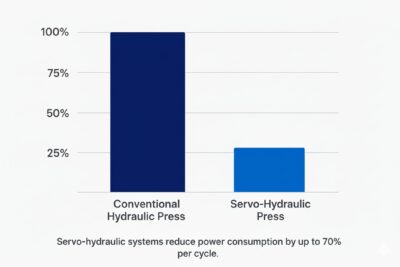
Servo-Hydraulic Press Systems Energy Efficiency
That reduction equals removing more than 300 gasoline cars from the road or saving enough electricity to power 200 Canadian homes for an entire year. These numbers show that upgrading to servo technology is not only an operational decision—it is a measurable carbon reduction strategy.
The Business Case: Efficiency That Pays for Itself
Beyond sustainability benefits, servo-hydraulic presses deliver strong financial returns.
- Lower energy costs: Up to 70 percent less electricity consumption directly reduces utility expenses.
- Reduced maintenance: Fewer moving parts and less hydraulic wear extend service life.
- Longer equipment lifespan: Controlled acceleration and deceleration reduce mechanical stress.
- Payback period: Many manufacturers recover their investment within two to five years.
This makes servo technology a practical solution that aligns sustainability with profitability.
A Step Toward Smarter, Greener Manufacturing
The rise of smart manufacturing and Industry 4.0 is accelerating adoption of servo-hydraulic systems. Many advanced presses now integrate IoT sensors that monitor pressure, cycle time, and energy use in real time. These insights enable predictive maintenance, production optimization, and continued efficiency gains.
By investing in modern press systems today, manufacturers can:
- Reduce operational costs
- Comply with energy-efficiency and emissions standards
- Prepare for future ESG reporting and sustainability frameworks
Conclusion
Sustainability in metal forming is no longer about compromise—it is about innovation.
Transitioning from conventional hydraulic presses to servo-hydraulic or servo-electric systems delivers measurable gains in energy efficiency, productivity, and carbon reduction.
For manufacturers aiming to stay competitive in a low-carbon economy, upgrading press technology is one of the most impactful steps toward a cleaner and more efficient future.
🏭 At MetalPress Machinery, we help manufacturers transition to smarter, more energy-efficient press systems.
Contact us today to learn how our servo-hydraulic and servo press solutions can help your business reduce energy consumption and achieve its sustainability goals.
References
- U.S. Department of Energy – Industrial Energy Management (ISO 50001)
https://www.energy.gov/eere/amo/iso-50001-energy-management-standard
- EPA Greenhouse Gas Equivalencies Calculator
https://www.epa.gov/energy/greenhouse-gas-equivalencies-calculator
- International Energy Agency (IEA) – Net Zero by 2050: A Roadmap for the Global Energy Sector
https://www.iea.org/reports/net-zero-by-2050