

Blog
Domestic Manufacturing and Reshoring: Why U.S.‑Built Machinery Matters More Than Ever


Over the past decade, the global manufacturing landscape has undergone a dramatic shift. What was once a steady march toward offshoring has reversed course, giving rise to a powerful movement centered on domestic production, domestic manufacturing, and reshoring. Companies across North America are reevaluating their supply chains, reconsidering their sourcing strategies, and rediscovering the advantages of building products closer to home.
This shift is not a temporary trend. It is a structural transformation driven by economic realities, geopolitical pressures, supply chain vulnerabilities, and the increasing need for quality, reliability, and speed. Manufacturers are recognizing that domestic production offers advantages that offshore operations simply cannot match — from shorter lead times and tighter quality control to improved communication and greater flexibility.
But reshoring is not just about bringing production back. It is about building a stronger, more resilient manufacturing ecosystem supported by domestic manufacturers, domestic industries, and U.S.‑built machinery capable of meeting modern production demands. Industrial equipment — especially forming, stamping, and molding presses — plays a central role in this transformation. When manufacturers invest in reliable, domestically built machinery, they gain the stability and performance needed to compete globally.
This article explores the resurgence of domestic manufacturing, the meaning of reshoring, the advantages of U.S.‑built machinery, and why industrial presses such as the 4 Post Servo Press, Straight Sided Servo Press, and C‑Frame Single Crank Press are essential tools for companies committed to domestic production.
Why Domestic Manufacturing Is Surging Again
For decades, offshoring was seen as the most cost‑effective way to produce goods. Lower labor costs, large overseas factories, and global logistics networks made it possible to manufacture products cheaply and ship them worldwide. But the assumptions that supported offshoring have changed.
Manufacturers began to realize that the true cost of offshore production was far higher than the initial price tag. Long lead times, inconsistent quality, communication barriers, intellectual property risks, and supply chain disruptions eroded the benefits of low‑cost labor. As global tensions increased and transportation costs rose, the vulnerabilities of offshore production became impossible to ignore.
Domestic manufacturing offers a solution. By producing goods closer to the point of use, companies gain greater control over quality, reduce transportation costs, shorten lead times, and improve responsiveness. Domestic production also supports local economies, strengthens national supply chains, and reduces dependence on foreign suppliers.
These advantages have led to a surge in reshoring — the process of bringing manufacturing operations back to the United States or Canada. Companies across industries are investing in domestic facilities, hiring local workers, and purchasing U.S.‑built machinery to support their operations.
What “Domestic Manufacturing” Really Means
Domestic manufacturing is more than just producing goods within national borders. It is a commitment to building a resilient, high‑quality, and sustainable production ecosystem. It involves sourcing materials domestically when possible, partnering with local suppliers, and investing in machinery built by domestic manufacturers.
Domestic manufacturing also means greater accountability. When production takes place locally, companies can monitor quality more closely, respond to issues more quickly, and maintain tighter control over intellectual property. This level of oversight is difficult to achieve when production is outsourced to distant facilities.
Domestic manufacturing also supports innovation. When engineers, designers, and production teams work in close proximity, they can collaborate more effectively, solve problems faster, and develop new products more efficiently. This synergy is one of the most powerful advantages of domestic production.
The Meaning of Reshoring — and Why It Matters
Reshoring refers to the process of bringing manufacturing operations back to the United States or Canada after they were previously moved overseas. It is the opposite of offshoring and represents a strategic shift toward domestic production.
Reshoring is driven by several factors:
Supply chain disruptions
Rising overseas labor costs
Increased transportation expenses
Quality control issues
Intellectual property concerns
Geopolitical instability
Customer demand for “Made in USA” products
Reshoring is not just a business decision — it is a strategic investment in long‑term stability. Companies that reshore their operations gain greater control over their supply chains, reduce risk, and improve their ability to respond to market changes.
Why Domestic Manufacturers Need Reliable, U.S & Canada‑Built Machinery
One of the most important aspects of domestic manufacturing is the machinery used in production. When manufacturers rely on imported equipment, they face long lead times, limited support, and difficulty obtaining replacement parts. Domestic machinery offers several advantages:
Faster delivery
Better support and service
Easier access to spare parts
Higher quality standards
Greater customization options
Improved communication with the manufacturer
Industrial presses — such as the 4 Post Servo Press, Straight Sided Servo Press, and C‑Frame Single Crank Press — are essential tools for domestic manufacturers. These machines provide the precision, reliability, and performance needed to support high‑quality production.
When manufacturers invest in U.S.‑built presses, they gain equipment designed for long‑term durability, engineered to meet domestic standards, and supported by local service teams. This reduces downtime, improves productivity, and ensures that production remains stable and efficient.
How Industrial Presses Support Domestic Production
Industrial presses play a central role in domestic manufacturing. They are used to form, stamp, mold, trim, and assemble components across a wide range of industries. The quality of the press directly affects the quality of the final product.
A 4 Post Servo Press, for example, provides exceptional force distribution and platen parallelism, making it ideal for forming, molding, and precision applications. Its servo‑driven motion allows manufacturers to program precise force and speed profiles, improving consistency and reducing scrap.
The Straight Sided Servo Press offers maximum rigidity and is ideal for high‑precision stamping and forming applications. Its straight‑sided frame minimizes deflection, ensuring that the press maintains tight tolerances even under heavy loads.
The C‑Frame Single Crank Press provides excellent accessibility and is ideal for stamping, blanking, and assembly operations. Its open‑front design allows operators to load and unload parts quickly, improving throughput and efficiency.
These presses are not just machines — they are strategic assets that support domestic production by improving quality, reducing downtime, and enabling manufacturers to meet the demands of modern markets.
The Economic Impact of Domestic Manufacturing
Domestic manufacturing has a profound impact on the economy. It creates jobs, supports local suppliers, and strengthens national industries. When companies invest in domestic production, they contribute to economic growth and help build a more resilient manufacturing ecosystem.
Domestic manufacturing also supports innovation. When production takes place locally, companies can experiment with new materials, develop new processes, and bring new products to market more quickly. This drives technological advancement and strengthens the competitive position of domestic industries.
Why Domestic Manufacturing Is the Future
The resurgence of domestic manufacturing is not a temporary trend — it is a long‑term shift driven by economic, technological, and strategic factors. Companies that invest in domestic production gain greater control over their operations, reduce risk, and improve their ability to compete globally.
Industrial presses — such as the 4 Post Servo Press, Straight Sided Servo Press, and C‑Frame Single Crank Press — play a critical role in this transformation. They provide the precision, reliability, and performance needed to support high‑quality domestic production.
As reshoring continues to accelerate, the demand for U.S.‑built machinery will only increase. Manufacturers that invest in domestic equipment today will be better positioned to succeed in the future.
Why MetalPress Machinery Is the Right Choice for U.S. and Canadian Manufacturers
For manufacturers across the United States and Canada, choosing the right machinery partner is just as important as choosing the right production strategy. MetalPress Machinery stands out because it is built around the same principles driving the resurgence of domestic manufacturing: reliability, transparency, engineering integrity, and long‑term support. Every press — whether a 4 Post Servo Press, a Straight Sided Servo Press, or a C‑Frame Single Crank Press — is designed with the needs of North American manufacturers in mind. That means shorter lead times, accessible service, and machines engineered for the realities of modern production rather than theoretical lab conditions. MetalPress Machinery provides the structural rigidity, servo precision, and automation‑ready architecture required for reshoring initiatives, while offering the kind of responsive, local support that offshore suppliers simply cannot match. For companies committed to building stronger domestic operations, MetalPress Machinery is more than a vendor — it is a strategic partner aligned with the future of U.S. and Canadian manufacturing.
We Make Your Next Press
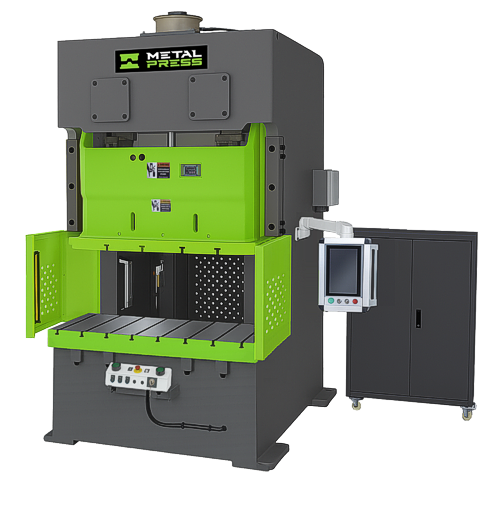
MetalPress Machinery is a top Press Manufacturer. Whether you’re located in the USA, Canada, Mexico, or South America, you can contact us for more information, pricing, and consultations through our online forms, or by phone or email.