

Blog
Compression Presses, Assembly Presses, and Specialty Hydraulic Press Solutions

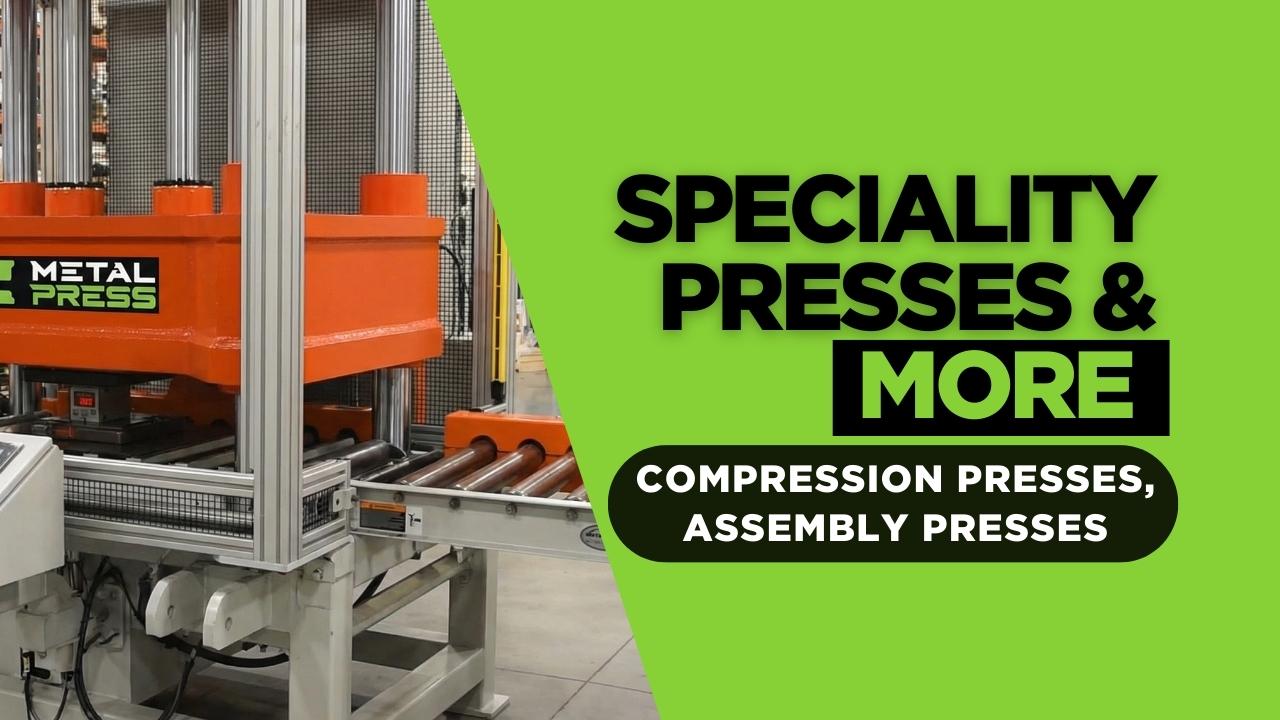
Compression presses and specialty hydraulic presses are engineered for applications that require controlled force, repeatability, and process-specific configurations. Unlike general-purpose shop presses, these machines are optimized for molding, assembly, densification, and precision pressing operations across a wide range of industrial environments.
This page provides a comprehensive overview of compression presses, hydraulic assembly presses, and specialty press technologies, including servo-driven systems and precision press configurations.
👉 MetalPress Machinery provides a wide range of presses and stamping machines. View our product pages and do not hesitate to contact us.
What Is a Compression Press?
A compression press is a press machine designed to apply uniform force over a defined surface area to shape, mold, or densify materials. Compression presses are commonly used in applications where material flow and pressure distribution are critical.
Compression presses are used for:
Industrial molding
Material densification
Composite forming
Specialty manufacturing processes
The terms compression press and compression presses are used to describe machines across a wide range of tonnage and configurations.
Compression Press Design and Operation
Compression presses typically feature:
Large, flat platens
High-capacity hydraulic cylinders
Precision pressure control
Adjustable dwell time
Uniform pressure distribution is critical to achieving consistent results, particularly in molding and forming applications.
Hydraulic Assembly Presses
A hydraulic assembly press is designed to install or join components using controlled force. These presses are widely used in precision assembly environments where part integrity and alignment are essential.
Common hydraulic assembly press applications include:
Bearing and bushing installation
Press-fit component assembly
Gear and shaft installation
Electrical connector insertion
Hydraulic assembly presses allow operators to control force and stroke precisely, reducing the risk of component damage.
Specialty Hydraulic Press Configurations
In addition to standard compression and assembly presses, many operations require specialty press designs tailored to specific processes.
Specialty hydraulic press types include:
Precision low-tonnage presses
High-tonnage compression presses
Custom frame designs
Integrated automation systems
These presses are engineered to match exact application requirements.
Servo-Driven Press Technology
Servo-driven press systems combine electric servo motors with hydraulic or mechanical actuation to provide exceptional control over force, speed, and position.
Advantages of Servo Press Systems
High precision and repeatability
Programmable force and motion profiles
Improved energy efficiency
Reduced noise and maintenance
Servo-driven technology is commonly used in electronics assembly, precision manufacturing, and R&D environments.
Servo Drill Press Applications
A servo drill press integrates servo-controlled motion for precise drilling operations. While distinct from hydraulic presses, servo drill presses are often used alongside assembly and compression presses in high-precision manufacturing environments.
Servo drill presses offer:
Controlled feed rates
Accurate depth control
Repeatable drilling cycles
These systems support applications where precision and consistency are critical.
Hydraulic Piston Press Integration
Many compression and assembly presses utilize a hydraulic piston press mechanism to generate controlled force. Hydraulic piston presses convert fluid pressure into linear motion, allowing for smooth, controllable pressing action.
Hydraulic piston press systems are valued for:
High force density
Precise load control
Long service life
They are commonly integrated into both compression and assembly press designs.
Automation and Process Integration
Modern compression and assembly presses are often integrated into automated production lines.
Automation options include:
PLC-based control systems
Force and position monitoring
Data logging and quality tracking
Robotic part handling
Automation improves throughput, consistency, and traceability.
Industries Using Compression and Assembly Presses
Compression presses and hydraulic assembly presses are used across many industries, including:
Automotive manufacturing
Aerospace production
Electronics assembly
Medical device manufacturing
Industrial equipment fabrication
Each industry benefits from tailored press solutions designed to meet specific process requirements.
Safety Considerations
Due to the forces involved, compression and assembly presses require robust safety systems.
Recommended safety features include:
Two-hand controls
Light curtains and guarding
Pressure relief valves
Emergency stop circuits
Proper safety integration ensures operator protection while maintaining productivity.
Selecting the Right Compression or Assembly Press
When selecting a compression or hydraulic assembly press, consider:
Required force and platen size
Part geometry and material
Precision and repeatability requirements
Production volume
Automation needs
Matching the press configuration to the application ensures optimal performance and long-term reliability.
Why Choose Specialized Press Solutions
Specialized compression and assembly presses provide:
Improved process control
Higher product quality
Reduced scrap and rework
Efficient, repeatable operations
Whether configured as a compression press, hydraulic assembly press, servo-driven press, or hydraulic piston press, these machines deliver reliable performance for demanding industrial applications.
References
- Kalpakjian, S., Schmid, S., Manufacturing Engineering and Technology, Pearson Education.
- Groover, M. P., Fundamentals of Modern Manufacturing: Materials, Processes, and Systems, Wiley.
- Lange, K., Handbook of Metal Forming, McGraw-Hill,
- Totten, G. E., Steel Heat Treatment Handbook, CRC Press.
- Esposito, A., Fluid Power with Applications, Pearson.
- Merritt, H. E., Hydraulic Control Systems, Wiley.
- ASM International, ASM Handbook Volume 14A: Metalworking: Bulk Forming
- Tool and Manufacturing Engineers Handbook, SME
- OSHA Technical Guidance Documents, Occupational Safety and Health Administration.
- ISO 16092
- ISO 12100
- American Society of Mechanical Engineers (ASME)
Let Us Make Your Next Press

Whether you’re located in the USA, Canada, Mexico, or South America, you can contact us for more information, pricing, and consultations through our online forms, or by phone or email.