
METAL STAMPING PROCESS
Sheet metal stamping operations, dies, materials, automation, and press-application planning
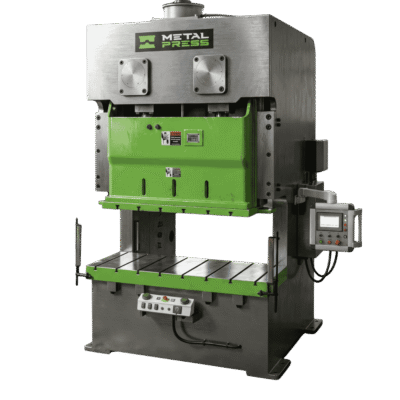
Metal Stamping Process and Press Applications
How Sheet Metal Stamping Operations Work
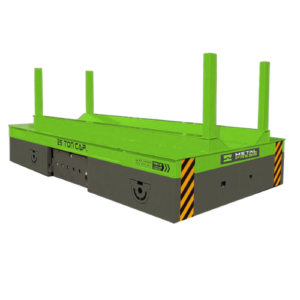
Metal stamping transforms flat sheet or coil stock into repeatable finished parts through operations such as blanking, punching, bending, embossing, flanging, drawing, coining, and trimming. Production may use single-stage, compound, progressive, or transfer dies depending on part geometry, annual volume, material behavior, and the amount of forming required at each station.
This application page explains the stamping process, tooling, materials, coil handling, die handling, automation, and production-planning requirements. Buyers who are ready to compare C-frame, straight-sided, mechanical, and servo-mechanical equipment should use the Stamping Press Machines equipment hub.
Successful stamping requires more than nominal tonnage. Engineers must confirm energy at the rated point, die footprint, slide guidance, shut height, stroke, off-center loading, feed window, target strokes per minute, lubrication, scrap removal, die protection, part transfer, and inspection. MetalPress supports these requirements with stamping presses and related coil-handling and die-handling application systems.
For other forming processes and industry-specific solutions, explore the Press Applications resource hub.
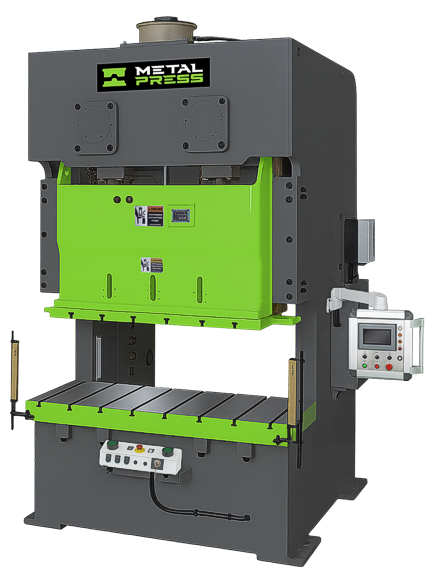
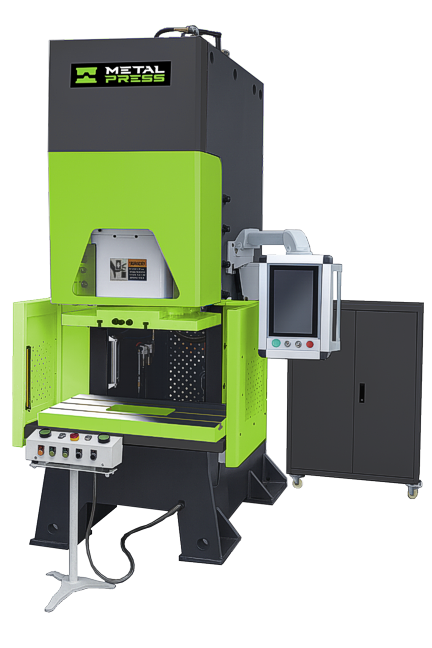
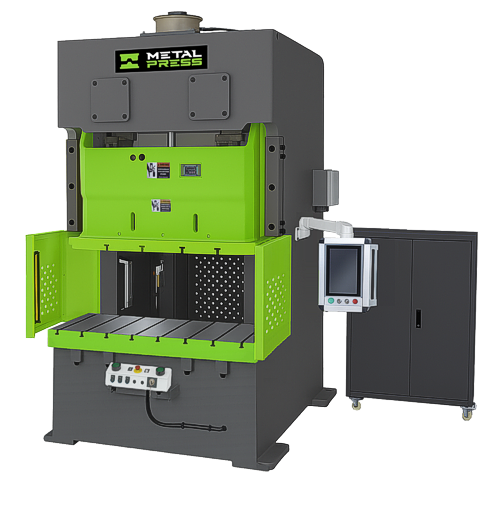
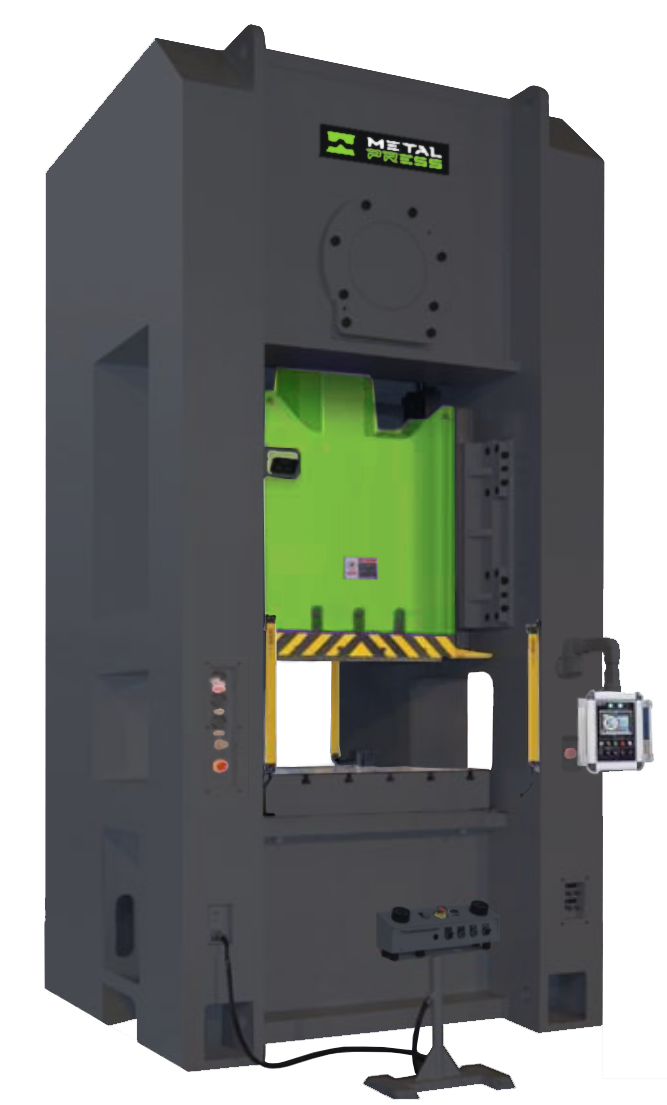
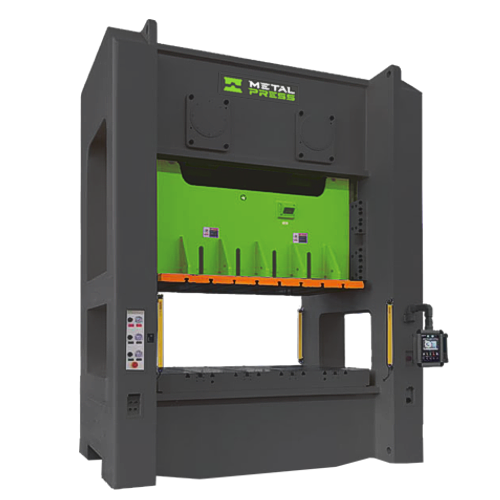
EIGHT STAMPING PRESS OPTIONS
Every MetalPress Machinery stamping press is engineered for rigidity, repeatability, and longevity. High-Precision Metal Stamping Equipment:

TECHNICAL ADVANTAGE
FOR STAMPING MANUFACTURERS
Every MetalPress mechanical machine for stamping process is built to a standard that prioritizes safety and metal stamping machines longevity:
Hydraulic Overload Protection: Standard on all models to instantly release pressure during a jam, preventing catastrophic frame or die stamping damage.
Advanced Control Systems: Integrated User-Friendly PLCs allow for easy "recipe" storage, ensuring faster setup times for high speed stamping.
Enhanced Drive Systems: Our presses utilize advanced lubrication and high-efficiency motors to reduce noise and energy consumption during continuous stamping line operation.
Safety Compliance: Fully compatible with modern light curtains and dual-hand safety controls to ensure a secure working environment.
Looking for a stamping press for sale? Contact us 24/7.
Need stamping press parts? Contact Service and Parts.
RIGHT PRESS.
RIGHT STAGE.
BUILT FOR SAFE STAMPING OPERATION
Every MetalPress stamping and pressing machine is engineered to a standard that prioritizes operator safety and machine longevity. Stamping Manufacturing is our specialty.
Hydraulic Overload Protection
Standard on all models. Instantly releases pressure during a jam to prevent catastrophic frame or die damage.
User-Friendly PLC Control
Integrated recipe storage means faster setup times on recurring jobs. Less downtime between changeovers.
Enhanced Drive Systems
Advanced lubrication and high-efficiency motors reduce noise and energy consumption during continuous operation.
Safety Compliance
Fully compatible with modern light curtains and dual-hand safety controls for a secure working environment.
Choosing the Right Press Configuration & Press Frame
In stamping, you aren't just cutting metal; you are moving it. This requires a press that can manage Tonnage vs. Energy effectively.
Drawing & Stretching: Deep-draw stamping requires high energy at the "bottom of the stroke." Our Servo Mechanical presses are superior here because they can maintain full tonnage at a slower speed to prevent the material from tearing.
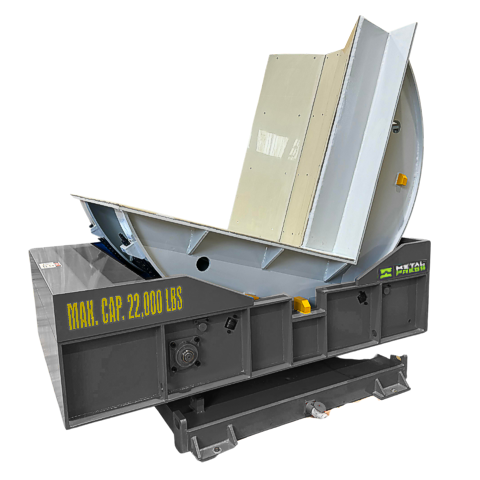
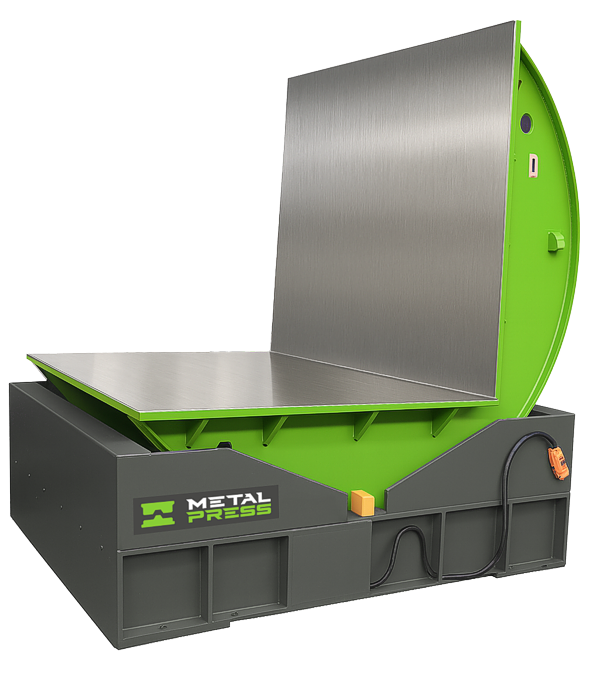
Progressive Die Integration: All our stamping units are pre-drilled and programmed for Coil Handling Systems, allowing for a continuous feed of material for 24/7 automated production.
Die Protection: We integrate advanced electronic sensors that can stop the press in milliseconds if a part fails to eject, protecting your expensive multi-stage stamping dies.
Selecting The Right
Stamping Presses
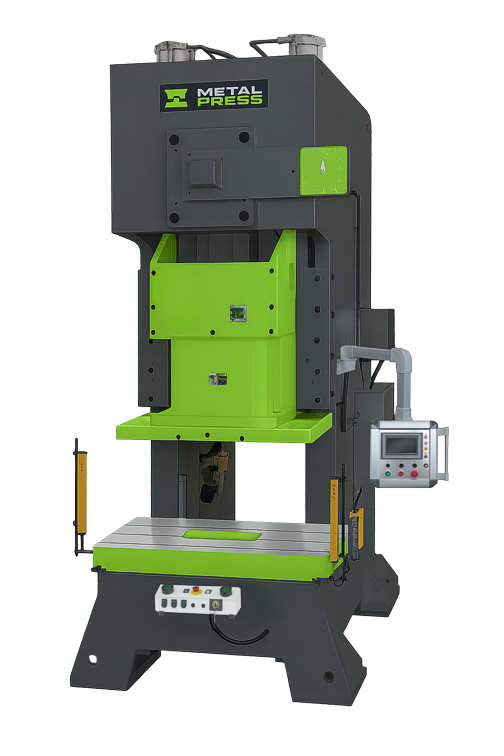
Straight-Sided Stamping Presses
For progressive die stamping, we recommend our Straight-Sided series. The closed-frame construction handles the massive "off-center" loads created as parts move through various stages of the die (e.g., from a first-stage pierce to a final-stage draw).
Single Point Mechanical: Best for high-tonnage stamping with a centered load.
Double Point Mechanical: The standard for long, progressive dies. The two-point suspension ensures the slide remains level under uneven forming pressures.
Single Point Servo: Ideal for precision parts requiring a "dwell" at the bottom of the stroke for material setting.
Double Point Servo: Our most advanced platform for complex automotive and aerospace stamping.
C-Frame Stamping Presses
For smaller, single-stage stamping or manual feeding operations, our C-Frame series offers the best balance of speed and accessibility.
Single Crank & Double Crank: Reliable mechanical drives for high-speed forming.
Single Crank Servo & Double Crank Servo: Precision control for sensitive materials like copper or high-strength aluminum.
Hot Stamping
We provide Temperature Control Units for hot stamping process and hot stamping presses.

Engineering for Metal Flow and Forming
In metal stamping, you aren’t simply cutting a part; you are forcing metal to “flow” into a new shape. The success of your operation depends on how well your press manages the specific tensile properties and work-hardening characteristics of your material.
Aluminum Alloys (e.g., 5052, 6061)
Characteristics: High strength-to-weight ratio but prone to “spring-back” and cracking if the bend radius is too tight.
Stamping Note: Aluminum requires precise speed control. If the ram hits too fast, the material can tear rather than stretch.
Recommended Press: C-Frame Single Crank Servo Press allows for a “soft-touch” approach to manage material flow.
Mild & Carbon Steels
Characteristics: The industry standard for automotive and appliance stamping due to its excellent ductility.
Stamping Note: Predictable, but requires significant energy for deep drawing. Breakthrough shock is less of a concern than sustained “tonnage through the stroke.”
Recommended Press: Double Point Straight-Sided Press for structural stability in progressive dies.
Stainless Steel (e.g., 304, 316)
Characteristics: Extremely high tensile strength and rapid work-hardening.
Stamping Note: Requires up to 40% more tonnage than mild steel. The material becomes harder as it is formed, which can “stall” a mechanical press if it hits the energy ceiling.
Recommended Press: Double Point Straight-Sided Servo Press to provide full torque at lower forming speeds.
High-Strength Low-Alloy (HSLA) Steel
Characteristics: Used for safety-critical parts; extremely resistant to deformation.
Stamping Note: These materials have a very high “Force Ceiling.” To prevent frame deflection, a rigid box-frame is mandatory.
Recommended Press: Straight-Sided Series to ensure zero “frame yawn” during high-tonnage hits.
| FORMING PROPERTIES BY MATERIAL GROUP | |||
| Material Group | Tensile Strength (PSI) | Elongation % | Forming Difficulty |
| Aluminum (Soft) | 15,000 – 25,000 | 20% – 30% | Low |
| Aluminum (T6) | 40,000 – 45,000 | 8% – 12% | Medium (Cracking Risk) |
| Mild Steel | 50,000 – 65,000 | 25% – 35% | Low to Medium |
| Stainless Steel | 85,000 – 95,000 | 40% – 60% | High (Work Hardening) |
| HSLA Steel | 100,000 – 130,000 | 10% – 15% | Very High (Tonnage Peak) |
Download the Engineering Guide to Industrial Stamping Presses
Metal Stamping Force Calculator & Press Selection Guide
0 US Tons
⚠️ High-Capacity Requirement:
Calculated load exceeds 880 US Tons (800 Metric Tons).
READY TO SPEC YOUR
STAMPING PRESS MACHINE?
Talk to an engineer who knows the difference between a brochure and a plant floor. Quotes in 24 hours.
Related Technical Guides
Review these technical guides for additional engineering context on Stamping, equipment selection, safety, and production planning.
- Metal Forming 101: Processes, Tooling, and How to Choose the Right Press
- Automated Stamping Systems in Metal Forming: A Technical Analysis of Automated Presses and Tooling Integration
- Metal Stamping Processes and Machines: Technology, Applications, and Press Types
- Deep Drawing: How Deep Draw Stamping Works and What Press Features Matter