

Blog
C‑Frame Mechanical Presses: A Complete Guide for Modern Stamping Operations

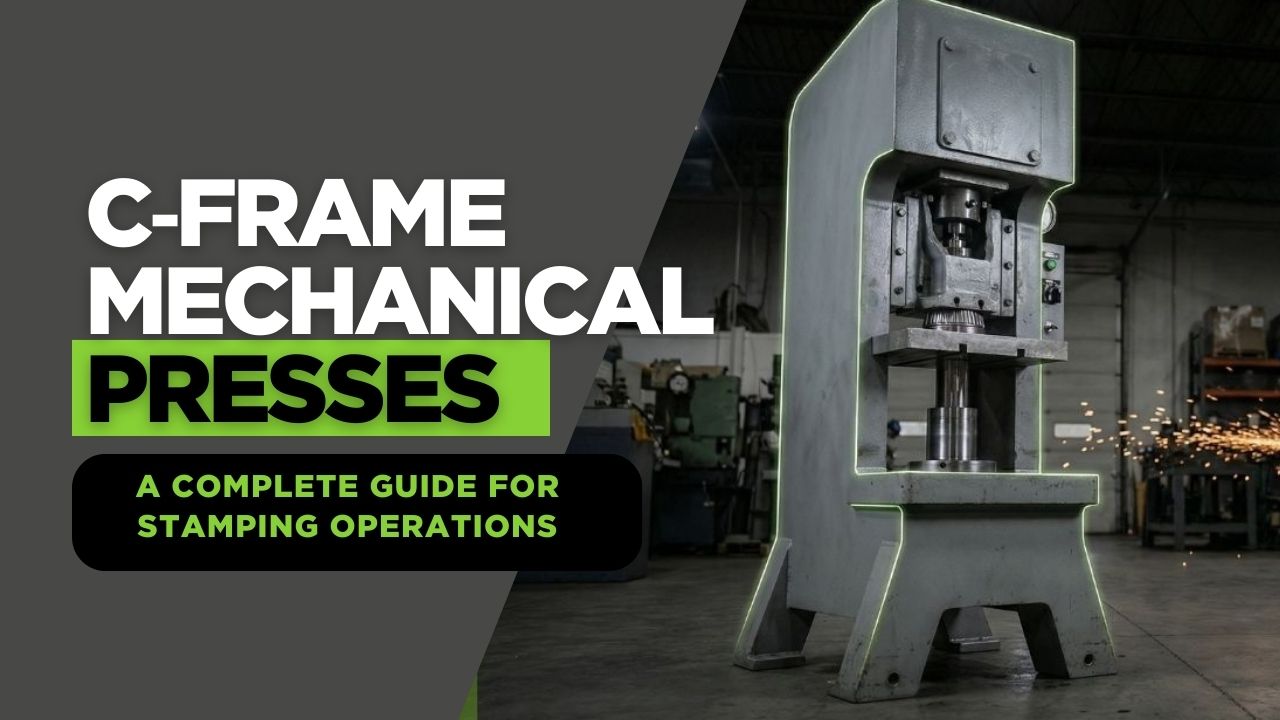
C‑frame mechanical presses—often called gap‑frame presses—remain one of the most widely used machines in metal stamping and fabrication. Their open-front design, compact footprint, and high-speed mechanical drive make them a staple in automotive, appliance, electrical, and general manufacturing environments. For manufacturers looking to improve throughput without expanding floor space, the C‑frame mechanical press continues to be a reliable and cost‑effective solution.
👉 MetalPress Machinery provides a wide range of presses and stamping machines. View our product pages and do not hesitate to contact us.
What Defines a C‑Frame Mechanical Press
The defining feature of a C‑frame press is its distinctive open‑front structure. This “C” shape creates unobstructed access to the die area from three sides, allowing operators to load parts, position tooling, and perform adjustments with far greater ease than enclosed-frame designs. The open geometry also simplifies the integration of coil feeders, transfer systems, and robotic automation, making C‑frame presses a flexible choice for both manual and fully automated stamping environments. At the heart of the machine, a flywheel-driven mechanical system stores rotational energy and releases it through a clutch and crankshaft, converting that motion into a precise vertical stroke. This mechanism delivers the speed, timing consistency, and repeatability required for high‑volume metal stamping operations.
Despite their compact footprint, well‑engineered C‑frame presses offer impressive rigidity and structural stability. Modern designs use reinforced frames, optimized stress distribution, and improved slide guidance systems to minimize deflection under load. Advanced clutch/brake assemblies enhance stopping accuracy and safety, while upgraded lubrication and alignment systems help maintain long-term precision. Together, these engineering improvements ensure that C‑frame mechanical presses can consistently produce accurate parts, protect tooling, and maintain performance even in demanding production environments.
Although compact, a well‑engineered C‑frame press offers impressive rigidity and stability. Modern designs incorporate reinforced frames, advanced clutch/brake systems, and improved slide guidance to reduce deflection and maintain part accuracy.
How C‑Frame Mechanical Presses Operate
Mechanical presses rely on a flywheel that stores rotational energy and releases it through a precisely controlled clutch and crankshaft system. When the clutch engages, the crankshaft converts that rotational motion into the linear movement of the ram, producing a smooth, predictable stroke cycle. This mechanically driven motion allows the press to achieve high speeds with exceptional consistency, making it ideal for operations such as blanking, piercing, coining, embossing, and shallow forming. Because the stroke profile is fixed and mechanically timed, C‑frame presses deliver the repeatability manufacturers depend on for high‑volume production, tight tolerances, and long‑run stamping programs.
The efficiency of this system is one of the reasons mechanical presses remain a cornerstone of modern metalworking. Their ability to maintain uniform slide velocity, deliver full tonnage near the bottom of the stroke, and operate at high strokes per minute gives them a clear advantage in applications where speed and repeatable accuracy are essential. Whether integrated into an automated line or used in a standalone workstation, the mechanical drive system ensures stable performance, predictable forming behavior, and reliable output across thousands—or even millions—of cycles.
Why Manufacturers Choose C‑Frame Presses
One of the biggest advantages of a C‑frame mechanical press is accessibility. The open-front design allows operators to work quickly and comfortably, whether they’re performing manual loading or setting up automated feeding equipment. This visibility also simplifies die changes and maintenance, reducing downtime and improving overall efficiency.
Speed is another major benefit. Mechanical presses typically achieve higher strokes per minute than hydraulic models, making them ideal for high‑volume production. Their energy consumption is lower as well, contributing to reduced operating costs over the life of the machine.
Despite their compact size, C‑frame presses deliver strong performance for small to medium-sized parts. They fit easily into work cells, lean manufacturing layouts, and production lines where space is limited but output demands are high.
👉 MetalPress Machinery is top manufacturer of c-frame mechanical presses and c-fram servo mechanical presses in USA, Canad, Mexico, and South America. Visit our products’ pages and contact our engineers.
Where C‑Frame Mechanical Presses Are Used
C‑frame presses are used across virtually every manufacturing sector because of their adaptability and efficiency. You’ll find them in facilities producing brackets, clips, terminals, connectors, appliance components, and countless other small to medium‑sized metal parts that require fast, repeatable forming. Their open-front design and compact footprint make them especially valuable in environments where operators need clear visibility and quick access to the die area, whether for part loading, tool adjustments, or quality checks.
This versatility extends far beyond manual workstations. C‑frame presses integrate seamlessly into fully automated production lines equipped with coil feeders, servo roll feeds, transfer mechanisms, or pick‑and‑place robotics. Their predictable stroke profile and consistent slide motion make them easy to synchronize with upstream and downstream automation, allowing manufacturers to scale from low‑volume runs to high‑speed continuous stamping without changing the core press architecture. As a result, C‑frame mechanical presses remain a preferred choice for companies seeking a balance of speed, accessibility, and long-term reliability in their metal forming operations.
C‑Frame vs. Straight‑Side Presses
While C‑frame presses are ideal for accessibility, operator visibility, and compact production layouts, straight‑side presses provide a fundamentally different level of rigidity and structural stability. Their fully enclosed, column‑guided frame design minimizes deflection under load, making them the preferred choice for applications involving large dies, off‑center loading, or higher tonnage requirements. Manufacturers producing small to mid‑sized components often rely on C‑frame presses for their speed, cost efficiency, and ease of use, but when part geometry becomes more complex or forming forces increase, a straight‑side configuration becomes essential.
For operations that require precise force delivery from a single drive point, a Single Point Straight‑Sided Press offers the stability and accuracy needed for demanding stamping and forming tasks. When even greater bed size, slide support, and load distribution are required, a Double Point Straight‑Sided Press provides enhanced rigidity across the entire working area, ensuring consistent part quality even under heavy or unbalanced loads. Together, these straight‑side options give manufacturers the structural strength and performance needed for high‑tonnage, high‑precision production environments where a C‑frame press may not be sufficient.
| Feature | C‑Frame Mechanical Press | Straight‑Side Mechanical Press |
|---|---|---|
| Frame Design | Open-front “C” shape with three‑sided access | Fully enclosed, column‑guided straight‑side frame |
| Rigidity | Moderate rigidity; some deflection under heavy or off‑center loads | High rigidity with minimal deflection, even under large or unbalanced loads |
| Best For | Small to mid‑sized parts, high‑speed stamping, accessible work areas | Large dies, high‑tonnage forming, precision applications |
| Tonnage Range | Typically low to mid‑tonnage | Mid to high‑tonnage, depending on configuration |
| Load Handling | Less suited for off‑center loads | Excellent off‑center load capacity |
| Footprint | Compact; ideal for tight production floors | Larger footprint due to reinforced frame |
| Accessibility | Superior operator access and visibility | More enclosed; less open access |
| Automation Integration | Easy integration with feeders, robotics, and work cells | Ideal for fully automated, high‑precision production lines |
| Cost | Generally lower initial investment | Higher investment due to heavier construction |
| Common Applications | Brackets, clips, terminals, connectors, appliance parts | Structural components, deep forming, large or complex stampings |
| Recommended Machine Types | C‑Frame Single‑Point or Double‑Point Mechanical Presses | Single Point Straight‑Sided Press – INSERT LINK and Double Point Straight‑Sided Press – INSERT LINK |
Choosing the Right C‑Frame Mechanical Press
Selecting the right press involves evaluating tonnage, stroke length, speed, frame rigidity, and compatibility with automation. Modern C‑frame presses often include advanced controls, overload protection, and safety systems that enhance precision and operator protection. A well‑matched press not only improves part quality but also extends tooling life and reduces long‑term maintenance costs.
Single‑Crank Servo Mechanical Press
For applications requiring exceptional precision and programmable motion control, our c-frame single‑crank servo mechanical press offers advanced flexibility and high‑speed performance ideal for modern stamping lines.
Double‑Crank Servo Mechanical Press
When larger dies or wider bed sizes are needed, the c-frame double‑crank servo mechanical press provides superior slide stability and balanced force distribution for demanding production environments.
Single‑Crank Mechanical Press
Manufacturers looking for a reliable, cost‑efficient solution for everyday stamping operations often choose our c-frame single‑crank mechanical press, engineered for durability and consistent output.
Double‑Crank Mechanical Press
For heavier workloads and improved off‑center load capacity, the double‑crank mechanical press delivers enhanced rigidity and accuracy across a wide range of forming applications.
C‑Frame Mechanical Press Solutions from MetalPress Machinery
MetalPress Machinery supplies high‑performance C‑frame mechanical presses engineered for durability, precision, and seamless integration into modern production environments. Our machines support a wide range of stamping applications, from automotive components to electrical hardware and general fabrication. Whether you’re upgrading a single workstation or building a fully automated stamping line, we provide the equipment and expertise to help you increase productivity and maintain consistent quality.
Let Us Make Your Next c-frame press
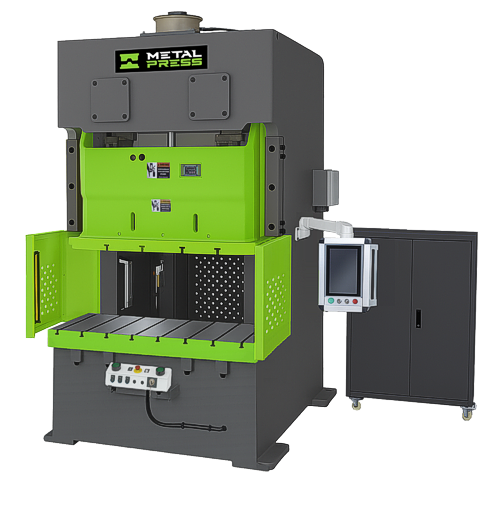
Whether you’re located in the USA, Canada, Mexico, or South America, you can contact us for more information, pricing, and consultations through our online forms, or by phone or email.