
AXIAL POWDER PRESS APPLICATIONS
Define punch and die motion, compaction load, decompression and ejection for the green part you need to produce.
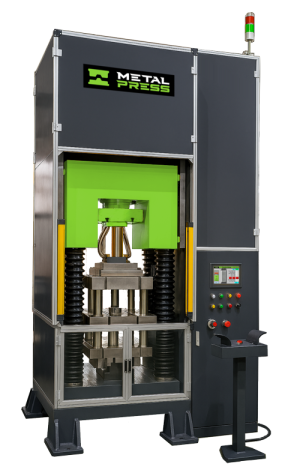
Define the Tooling Motion Before Selecting the Press
An axial powder press compacts powder in a die through punch motion along the tooling axis. Part geometry, powder response and the required density distribution guide the choice of punch arrangement, die movement and release sequence.
This guide compares process methods. Review the MPC-SV servo-hydraulic powder compaction press for MetalPress machine models and controls, and the powder press applications by material guide for metal, ceramic, carbide and magnetic-powder requirements.
Compare Axial Powder Compaction Methods
| Method | Tooling concept | What to specify |
|---|---|---|
| Single-action pressing | One punch provides the principal compaction stroke against a supported opposing tool. | Define fill height, part thickness and the density profile before choosing the cycle. |
| Double-action / opposed-ram pressing | Upper and lower punches act toward each other; an opposed-ram powder press provides the corresponding ram arrangement. | Specify each punch travel, load, synchronization and the compact release sequence. |
| Floating-die compaction | The die can move relative to the lower punch as the powder is compressed. | Define the die support, friction/lubrication conditions and allowable die movement. A floating die is not the same as an independently controlled axis. |
| Withdrawal and ejection | Withdrawal releases the compact by moving the die away from the supported part; push-up ejection uses lower-tool motion. | Agree die/punch movement, part support, ejection force and the order in which tool levels clear. |
| Multi-level / multi-platen tooling | Separate punch levels accommodate stepped compact geometry and its associated fill and compaction requirements. | Specify the tooling sequence and independently controlled motions. The labels multi-action, multi-axis and multi-level do not establish an identical machine configuration. |
Specify the Compaction Cycle in Six Stages
1. Fill the Die
Set powder delivery, fill depth, tool positions and part-mass targets. Check fill repeatability with the representative powder and tooling.
2. Approach and Pre-Compact
Define initial punch contact and any staged pre-compaction or air-release step required by the validated process.
3. Compact and Dwell
Record the required load, punch positions, die movement and dwell. Establish how force and position will be measured through the cycle.
4. Decompress
Specify the load-release profile and supporting tool motions. Check the green compact for cracking or lamination during trials.
5. Withdraw or Eject
Define die withdrawal or lower-punch ejection, force limits and sequential release of stepped features. Support the compact as the tool clears.
6. Remove and Inspect
Plan green-part pickup, transfer and inspection, then establish acceptance limits and rejected-part handling.
Estimate Force from Pressure and Projected Area
A first load estimate uses the required compaction pressure and the projected area loaded by the tool:
F = p × A
p is the powder compaction pressure established from material data or trials; A is the relevant projected compaction area. Define the load on each punch and the combined load path through the die set. Opposed punch forces should not be added indiscriminately to choose a nominal press rating.
Tooling limits, independent axis loads, ejection, frame deflection and the required cycle remain part of the engineering specification. Apply a project-specific design allowance agreed with engineering rather than a universal percentage or an automatic machine recommendation.
Metric Calculation
With pressure in MPa (N/mm²) and area in mm², F is in newtons. Divide by 1,000 for kN or by 9,806.65 for metric tonne-force.
US Customary Calculation
With pressure in psi and area in in², F is in pounds-force. Divide by 2,000 for US ton-force. If pressure is already stated in US ton-force/in², multiply directly by area in in².
Match the Drive and Controls to the Tooling
Separate the drive technology from the tooling architecture. Mechanical, electric and hydraulic powder presses describe how force and motion are generated. Single-action, opposed-ram, floating-die and withdrawal terms describe how the tools move. CNC identifies a control approach whose axes, feedback and programming scope must be specified.
For a servo-hydraulic powder press enquiry, define the required approach, compaction, dwell, decompression and return stages. Record independent punch and die axes, force/position feedback, recipe parameters, fill and ejection interfaces, cycle data and changeover requirements.
The MPC-SV powder compaction press product page is the commercial reference for the available MetalPress family. Confirm the requested tooling motions and auxiliary systems in the quoted configuration. For a general pressing task outside a dedicated powder system, compare the 4-post servo-hydraulic press only after the tooling and feeding scope is defined.
Turn Part Requirements into a Process Review
| Requirement | Engineering information to prepare |
|---|---|
| Stepped or multi-level part | Provide section drawings, level areas, fill heights, punch travels and the planned release order. |
| Density variation | Define the measurement method and acceptance map; review filling, friction, punch/die motion and material response together. |
| Cracking or edge damage | Record when damage appears and compare decompression, ejection, springback, support and green-part handling during trials. |
| Sizing after sintering | Treat sizing or coining as a separately specified operation, with its own tooling, loads, dimensional targets and handling. |
Prepare a cycle description showing the position and action of each punch, die and core rod. Include the part drawing, powder specification, required load per axis, tool envelope, ejection force, density/dimensional targets, cycle target, feeding and green-part transfer.
Use the powder press selection guide to prepare the enquiry, then send your axial powder-compaction requirements and identify the MPC-SV press family for machine evaluation.
Review an MPC-SV Engineering Project
Review the documented 100-ton MPC-SV testing and inspection project to discuss acceptance checks and handover. The powder-press design and assembly story and shipment and commissioning article provide related project context.
Agree the required powder, tooling, measurements and production criteria for your own trials; the project articles are not a substitute for a configuration-specific acceptance plan.
Axial Powder Pressing Questions
Is double-action pressing the same as multi-level pressing?
Double-action describes compaction from opposing directions. Multi-level describes tooling for different part levels. A system may combine these ideas, but the required punch and die motions must be specified separately.
What is the difference between floating-die and withdrawal methods?
A floating die can move during compaction in response to the tooling support and friction conditions. Withdrawal describes moving the die away to release a supported compact. A particular press can combine aspects of these methods; confirm its actual sequence.
Does servo-hydraulic mean that every punch is independently controlled?
Specify the number of controlled axes, sensors and available motions in the quotation. The drive label alone does not establish independent upper/lower punches, multiple platens or a particular ejection architecture.
Can a pressure-and-area calculation select the finished machine?
It provides an initial load estimate. Complete the selection with axis loads, tooling limits, working envelope, decompression, ejection, feeding, output and acceptance requirements.
Can the compaction press also perform post-sintering sizing?
Evaluate sizing as its own operation, with the required tooling, force, motion and dimensional criteria. Confirm whether one configured machine can cover both duties or whether separate equipment is appropriate.
Related Engineering Resources
Continue with powder materials and application requirements, tooling and press selection or the Press Applications overview.
Technical process reference: Höganäs Handbook: Production of Sintered Components, particularly the compaction-tool and compaction-cycle discussion.