

Blog
100-Ton Powder Compaction Servo Press Ordered by Quebec Company


A manufacturing company in Quebec selected an MPC-SV powder compaction servo press for a high-tech product and its powder-metallurgy production requirements. This project story follows the 100-ton press through order, design and assembly, before functional testing and commissioning.
The design phase connects the powder, part, tooling and production requirements to a build specification. Review the MPC-SV servo-hydraulic powder compaction press for current machine models and controls, then follow the 100-ton powder press testing and inspection story for the next project stage.
Why the Assembly Phase Matters
Purchasing a press is a capital decision that affects production for years. The assembly phase turns the agreed part and process requirements into mechanical, hydraulic, electrical and control-system interfaces. A clear factory-acceptance program then defines what will be checked, measured and documented before the machine is accepted.
Keep the build specification, approved drawings and planned acceptance criteria aligned as the project develops. Design and assembly records establish what was built; factory test results establish how that configuration performs with the agreed tooling and powder.
The Customer Brief and Configuration
The project brief describes high-precision powder compaction of critical components used in eyepieces, with powder density control, dimensional accuracy and a planned ramp to volume as priorities. The configuration review should connect each requirement to the selected hardware and test method:
- Servo-hydraulic actuation: define the required closed-loop force and position control and how it will be verified.
- High-resolution position transducers: confirm the feedback method, punch displacement logging and verified measurement performance.
- Integrated heat exchanger: specify cooling-water conditions and oil temperature stability requirements for the intended duty.
- HMI recipe management: identify the process parameters to store, recall and protect during changeover.
- Robot interface: define the I/O and responsibilities for future automation of part handling where included.
Confirm the as-built scope against the approved quotation and drawings before transferring the machine from factory acceptance to shop floor production.
Powder Press Specifications and Use Cases
The MPC-SV powder compaction servo press is a machine family for evaluating powder, ceramic and metallurgical industrial forming applications. Its published family ratings span 44 to 660 US tons; use the current product model table for the corresponding metric ratings and complete selection review.
For the project configuration, specify servo-hydraulic actuation, required closed-loop force and position control, platen/bed dimensions and single or multi-cavity tooling interfaces. The article’s 100-ton project label is retained; it should not be used to infer a new force conversion or an as-built machine rating.
Define position resolution, force accuracy and high repeatability as separate requirements, with agreed measurement methods and acceptance limits. Specify programmable speed and dwell profiles, HMI recipe management, oil temperature stability and heat exchanger connections for the proposed machine.
Identify whether Ethernet connectivity, Industry 4.0 telemetry, a robot interface and automated part handling are included or optional. Confirm light curtains, interlocks and the complete safety-control scope; any required CAT4 classification needs configuration-specific validation.
For use cases such as powder metallurgy bearings and bushings, sintered magnets, filtration elements, medical implants or high-volume automotive components, the material, tooling and quality requirements determine suitability. Aerospace and energy-sector projects likewise require an application-specific review of green density and dimensional control. Use the powder press applications by material and axial powder pressing methods guide to prepare those requirements.
For machine-specific information and an enquiry, review the MPC-SV Series powder compaction press product details.
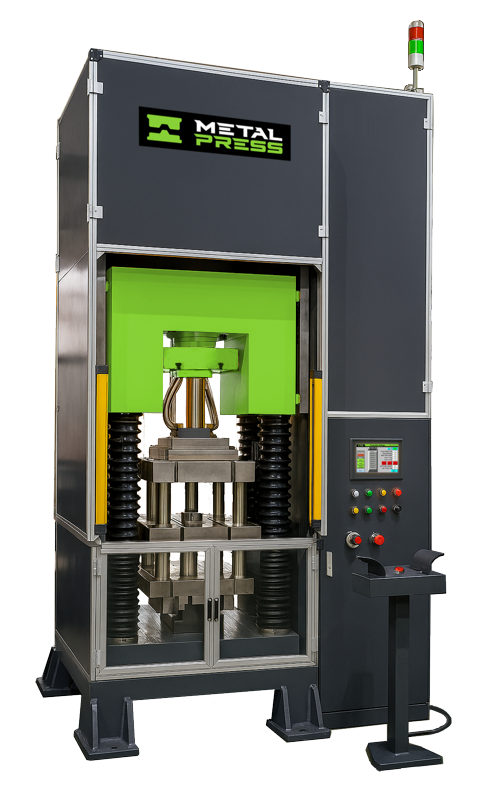
Customizable Platens
The Powder Compaction Servo Press platens can be customized around the project tooling interface. Provide the die envelope, single and multiple cavity dies, mounting details, load paths and access requirements for review.

DIGITAL POSITION SENSOR
Digital micropulse transducer sensors provide feedback for ram positioning to the control system. Specify the required positioning range, position resolution, accuracy and repeatability, together with the limit switch and machine travel-control arrangement. Setup data and process parameters can be stored and recalled as a reusable recipe within the selected control-system scope.

BUILT-IN HEAT EXCHANGER
The MPC-SV product description includes a water-cooled heat exchanger for hydraulic-oil temperature management. Confirm cooling-water flow, inlet temperature, water quality and connection requirements for the selected model and duty. A built-in heat exchanger still requires a suitable cooling-water supply; review plant cooling capacity during the design phase.

Design & Assembly
Design consultations bring together the powder, part drawing, tooling sequence and production duty. Review variable green density, setup and changeover times, thermal drift, automation integration and maintenance access, then translate them into a targeted engineering plan.
Use CAD reviews and control-schematic workshops to agree tooling interfaces, servo tuning requirements and HMI recipes. Define the scope of any simulation and prototype runs, acceptance criteria, calibration steps and remote-monitoring parameters in the project plan. For retrofit projects, document downtime assumptions and ROI metrics; for new installs, define future automation and service access.
The powder metallurgy press machine selection guide provides an enquiry checklist. The axial powder compaction guide explains tooling motions that must be resolved before the configuration is finalized.


On The Shop Floor
On the factory floor, mechanical assembly connects the frame, platens, tooling interfaces, servo-hydraulic actuation and control hardware. The design review should identify alignment and torque procedures, hydraulic routing, electrical systems, sensor placement and maintenance access.
For the project records, confirm the reinforced steel frame, platen machining, platen tolerances, ram and die alignment method—including laser alignment where specified—and the PLC/HMI installation. If a Siemens PLC is selected, identify the actual hardware and software scope in the approved controls list rather than assuming one brand across the family.
Traceable checklists should record critical torque values, component identification, electrical harness labels and changes to the build. Review frame reinforcement, precision fitment, cable management and hydraulic connections against the drawings before releasing the assembly for testing.

For a technical question or sales-process enquiry, contact MetalPress or review our sales process.

Final Touches
Final touches complete mechanical and electrical assembly before commissioning: platen and tooling fitment, specified fastener torque, labelled hydraulic and electrical harnesses, PLC/HMI and sensor installation, safety guards, lubrication and service-access preparation.
Keep software recipes, wiring documentation, checklists and serialized component records traceable within the handover package. Stage the approved recipes for the next phase, then use the testing, calibration and pre-commissioning review to define functional checks and live process trials.
The published family includes 44-ton and 660-ton model labels. Assembly and acceptance requirements must be adapted to the selected machine and tooling rather than assuming identical procedures for every size.

Engineering Support for Powder Compaction Press Projects
A Powder Compaction Press project combines the press, tooling, powder process and acceptance plan. MetalPress design consultations and assembly documentation help define the servo-hydraulic presses, thermal-stable systems, HMI recipe management and automation scope needed for the application.
When discussing turnkey pilot programs for automotive, energy and industrial powder-metallurgy applications, agree the trial material, tooling, measurements and responsibilities. Evaluate repeatable density, tight dimensional control, ramp-to-volume, production yield and ROI from the project’s measured results and operating assumptions.
Continue through the 100-ton powder compaction press testing stage and shipment and commissioning story, or return to the MPC-SV powder compaction press to discuss your configuration.
Let Us Make Your Next Powder Compaction Press
Whether you’re located in the USA, Canada, Mexico or South America, contact us for powder-compaction information, pricing and consultation. Send the part drawing, powder details, tooling concept, force/motion requirements and planned output so the project scope can be reviewed.
Visit all our products