
POWDER PRESS APPLICATIONS BY MATERIAL
Match metal, ceramic, carbide and magnetic powders to the tooling, compaction sequence and green-part handling your production requires.
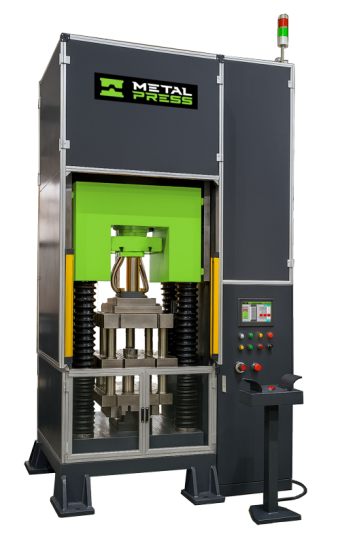
Start with the Powder and the Finished Part
Powder pressing turns a measured powder charge into a green compact for subsequent processing. The material formulation, part geometry and target properties determine the required filling, compaction, decompression and ejection sequence.
Use this page to organize material-specific requirements. For available machine models, controls and configuration options, review the MPC-SV servo-hydraulic powder compaction press. For punch and die movement, use the axial powder pressing methods guide.
Compare Requirements by Powder Material
| Material family | Example applications to evaluate | Information to define |
|---|---|---|
| Iron, steel and stainless steel powders | Structural powder-metal parts, gears, bushings and near-net-shape blanks. | Document powder grade, lubricant, compressibility, projected area, green-density target and the sintering route. An iron powder press or steel powder press is specified from these inputs, not the metal name alone. |
| Copper and bronze powders | Bushings, bearing components and electrical or thermal parts. | For a copper powder press or bronze powder press, define composition, intended density or porosity, fill behavior, ejection load and downstream dimensional allowance. |
| Tungsten carbide, hard metals and cermets | Tooling blanks and wear-component shapes. | A carbide powder press, tungsten carbide powder press or cermet press needs a reviewed binder system, tool-wear plan, decompression sequence and handling method for the green part. |
| Technical ceramics | Pressed ceramic shapes and engineering components. | Ceramic powder compaction press requirements should include granule characteristics, moisture or binder condition, fill repeatability, lamination checks, ejection and debinding/sintering allowance. |
| Ferrites and magnetic powders | Pressed magnetic components. | For a ferrite powder press or magnetic powder press, identify the exact material, geometry and magnetic-property targets. State any required field alignment or auxiliary equipment for engineering review. |
| Soft magnetic composites (SMC) | Compacted magnetic components made from an appropriate coated-powder system. | An SMC compaction press enquiry should identify powder/coating specifications, target density, magnetic performance, tooling loads and downstream heat-treatment requirements. |
Agree Three Trial Outputs
Fill and Part Mass
Record the powder batch, dosing method, apparent density, flow behavior and fill depth. Compare part mass and fill consistency across the proposed cavities and tool levels.
Density and Dimensions
Agree how green density, density variation, dimensions and springback will be measured. Relate these results to the finished-part requirements and downstream process.
Release and Handling
Record decompression, ejection force and support of the green compact. Inspect for cracks, laminations and edge damage before setting the handling and transfer sequence.
Move from the Application to the Equipment
The MPC-SV powder compaction press is the dedicated MetalPress starting point for evaluating programmable hydraulic force and position in powder pressing. Match the proposed machine to the actual powder, die set and production cycle; specify the required punch levels, auxiliary axes, fill arrangement and ejection functions explicitly.
A 4-post servo-hydraulic press or 4-post hydraulic press can be considered for a separately engineered pressing task. Confirm the complete powder-tooling and feeding arrangement rather than treating a general press frame as a direct substitute for a dedicated compaction system.
For separate tool-contact inspection work, review mold and die testing equipment. Production powder-compaction trials should establish the filling, density and ejection results for the intended part.
Prepare a Powder-Compaction Specification
| Input | What to provide |
|---|---|
| Powder specification | Material designation, composition, supplier data, particle-size distribution, apparent density, lubricant/binder and relevant handling information. |
| Part and tooling | Part drawing, projected area, cavities, stepped levels, die/punch motions, tool footprint, tool weight and permitted tooling loads. |
| Compaction cycle | Required force or validated pressure, position stages, dwell, decompression, ejection load and the required control/measurement approach. |
| Quality and downstream process | Green density and strength targets, dimensional criteria, acceptable defects, debinding/sintering route and final-part acceptance checks. |
| Production and handling | Output target, changeover frequency, fill/dosing method, green-part transfer, cleaning and automation interfaces. |
| Installation and acceptance | Utilities, access, guarding and powder-handling requirements, trial materials, measurement plan, training and handover documentation. |
Prepare the part drawing, powder specification and trial results, then send your powder-compaction requirements for a machine and tooling review. Identify the MPC-SV powder press if you are evaluating the dedicated product family.
The powder press selection guide provides broader purchasing and configuration questions. Use representative powder and tooling to agree the process window and acceptance measurements before committing to a production configuration.
Review a Powder-Press Testing Project
The documented 100-ton MPC-SV testing and inspection project shows a machine project in its inspection and commissioning workflow. The powder-press shipment and commissioning story provides additional project context.
Use these projects to discuss inspection records, tooling interfaces, trials and handover. Establish the density, dimensions, cycle and acceptance criteria for your own powder and part.
Powder Material Application Questions
What is a green compact?
A green compact is the pressed powder part before its subsequent sintering or other consolidation step. Its strength and dimensional condition affect how it can be ejected, inspected and transferred.
Can the same press process metal and ceramic powders?
Evaluate each powder formulation and tool separately. Required force, feeding, tooling wear, contamination controls, decompression and green-part handling can differ. Confirm the configuration and trials for the intended materials.
Is nominal press force enough to select a powder press?
Specify force together with the part area, powder response, punch and die motions, tooling limits, fill method, ejection load and production duty. A force rating alone does not establish a complete powder-compaction system.
Does a magnetic powder application include field-alignment equipment?
State any magnetic-field alignment requirement in the enquiry. Its suitability, equipment and controls require separate engineering confirmation; they should not be assumed from the term magnetic powder press.
Where are the MPC-SV models and specifications?
Review the MPC-SV product page for published model ratings, controls and configuration details. This application page organizes material and process requirements rather than duplicating the product specifications.
Related Process and Engineering Resources
Continue with axial powder compaction methods, tooling and press selection or the Press Applications overview.
For general press-and-sinter terminology, see the Metal Powder Industries Federation process overview.