
HOW TO SELECT A POWDER PRESS
Engineering guidance for compaction load, tooling, punch and die motion, density, green-part quality, automation, and production duty.
What Does a Powder Press Need to Control?
Select a powder metallurgy press by matching the part and powder to the required tooling motions, compaction load, working envelope and production cycle. A useful specification also defines how green-part quality will be measured and accepted.
Use this guide to prepare a machine enquiry. Review the MPC-SV servo-hydraulic powder compaction press for MetalPress models and controls, the axial powder pressing methods guide for punch and die arrangements, and powder press applications by material for material-specific process requirements.
In conventional press-and-sinter production, compaction forms the unsintered green part; sintering is a separate downstream step.
Six Inputs That Define the Powder Press
Start with these six inputs. Together they establish the press, tooling and handling scope that suppliers should use when preparing comparable proposals.
Powder & Lubrication
Document alloy or ceramic family, particle characteristics, apparent density, flow behavior, lubricant, moisture, and handling constraints.
Part Geometry
Provide a dimensioned drawing with section areas, heights, thin walls, hubs, steps, core features and release direction. Review undercuts and other features that may prevent removal from an axial die.
Density Target
Specify target green density, allowed variation, density distribution, green strength, dimensional tolerance, and inspection method.
Tooling & Punches
Confirm die design, upper and lower punches, core rods, floating elements, tool alignment, load limits, changeover, and protection.
Motion & Force
Define fill, pre-compaction, compaction, dwell, decompression, withdrawal, ejection, force, position, and synchronization requirements.
Production Duty
Record parts per minute, shifts, changeovers, feeding, powder containment, automation, traceability, maintenance, and growth plans.
Purpose-Built Powder Compaction Press
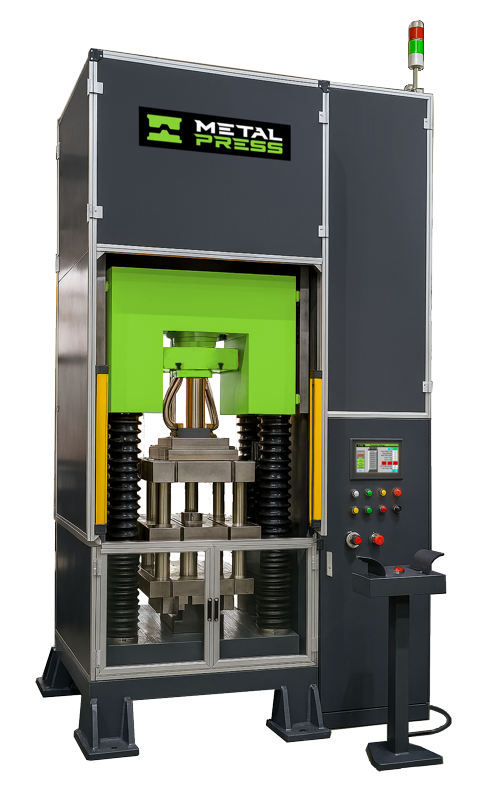
The MetalPress MPC-SV powder compaction press is a servo-hydraulic machine family for evaluating programmable compaction-force and position requirements. Use its published model ratings as the starting point, then confirm the tooling interface, required axes, feeding, decompression, ejection and handling in the proposed configuration.
Specify the required process functions individually: a servo-controlled drive does not, by itself, define how many punches or die axes are independently controlled.
Compare Powder Press Proposals on the Same Basis
Ask each supplier to respond to the same part, powder, tooling sequence and production target. Record what is included, optional or outside the quotation rather than comparing nominal tonnage alone.
| Selection item | Information to provide | Evidence to request |
|---|---|---|
| Force and load path | Compaction pressure, projected area and load on each punch; ejection and off-centre loading. | Usable force over the required stroke, individual axis ratings, tooling load limits and the agreed design allowance. |
| Tooling motion | Punch/die/core movements, travel, fill height and release sequence. | Axis list, motion diagram, synchronization scope and a confirmed tooling interface drawing. |
| Force and position control | Stages needing force, position, speed or dwell control. | Feedback method, measurement locations, resolution versus verified accuracy, and data recorded during trials. |
| Quality targets | Part mass, green density, dimensions, green strength and permitted defects. | Agreed sampling plan, measurement methods and acceptance limits using representative powder and tooling. |
| Production output | Accepted parts per hour, shifts, cavity count and changeovers. | A timed complete cycle including filling, pressing, ejection, removal and inspection—not press stroke time alone. |
| Integration and support | Powder delivery, containment, guarding, utilities, access and maintenance. | Scope boundary, interface responsibilities, documentation, training and commissioning requirements. |
Check Compaction Load and the Full Cycle
First load estimate: F = p × A. Use compaction pressure established for the actual powder and target compact; the required force follows from that pressure and the projected area loaded by the tool.
For an illustrative calculation only, 400 MPa acting over 2,000 mm² gives 800,000 N, or 800 kN—about 81.6 metric tonne-force or 89.9 US ton-force. These are selected calculation inputs, not a recommended powder pressure or an MPC-SV performance claim.
Engineering must resolve the load path and each axis rating, tooling limits, ejection force and working envelope before choosing a model. Opposed punch forces should not be added indiscriminately, and a universal safety percentage is not a substitute for a project-specific design review.
For multi-level tooling and withdrawal/ejection concepts, use the axial powder compaction methods guide. The powder-material applications guide addresses material and density considerations without repeating the machine specifications.
Information Needed to Specify the Press
Prepare one enquiry package containing a part drawing, powder specification, target green properties, tool layout, proposed cycle and production duty. Identify missing values as trial questions rather than filling them with assumed machine capabilities.
Part, Powder & Tooling Data
- Powder grade, flow, apparent density and lubrication
- Part drawing, target mass, density and dimensions
- Punch/die/core layout, envelope and changeover method
- Pressure basis and estimated loads per tool/axis
- Handling constraints and inspection methods
Cycle, Control & Plant Data
- Fill, compact, dwell, decompress and release sequence
- Accepted output, shifts and changeover frequency
- Feeding, containment, removal and automation interfaces
- Required recipes, measurements, records and alarms
- Guarding, utilities, access and commissioning scope
Agree an Acceptance Trial Before Ordering
A useful trial plan connects the quoted machine to the intended powder, tooling and compact. Agree the test material, setup, sampling, instruments and acceptance limits before testing.
- Fill and compact: record powder condition, fill settings, part mass, tool positions and the force/position profile.
- Release and handling: check decompression, ejection or withdrawal loads, cracking, edge damage and transfer to inspection.
- Quality: measure the agreed density and dimensional criteria; distinguish average density from the density distribution within the part.
- Output: time the complete production sequence and report accepted parts, rejected parts and interruptions.
- Handover: document the approved recipe, operating limits, maintenance tasks, records and remaining commissioning actions.
The 100-ton MPC-SV testing and inspection project provides project context, not a guarantee of identical results for every powder or configuration. To discuss your own specification, send your powder-compaction requirements and reference the MPC-SV press family.
Powder Press Selection FAQs
Prepare the part drawing, powder specification, target green properties and proposed tooling sequence. These establish the required load, tool movements, working envelope and acceptance checks.
Estimate force from compaction pressure multiplied by the relevant projected area. With MPa and mm², the result is newtons; divide by 1,000 for kN. Then review each axis load, tool limit, ejection force and design allowance with engineering.
No. Drive technology and tooling architecture are separate specifications. Confirm the number of controlled axes, feedback and coordination required for the quoted configuration.
Agree part mass, green density, density distribution where required, dimensions, defects, release loads and complete-cycle output. Use representative powder and tooling, with documented sampling and acceptance limits.
Evaluate each powder and tool set against force, motion, feeding, containment, cleaning and inspection requirements. Material compatibility and cross-contamination must be reviewed before changing production.
Make the Selection Traceable
Start with the compact and its tool sequence, then connect each requirement to a documented press function and an acceptance check. Keep material trials, tooling design and machine specifications in the same review so that changes to one do not invalidate the others.
When the required cycle calls for servo-hydraulic control, continue to the MPC-SV powder compaction press specifications and confirm the complete configuration with MetalPress.
Technical references: MPIF: conventional powder metallurgy and Höganäs Handbook: Production of Sintered Components.
RELATED POWDER COMPACTION PROJECTS
Testing and Inspection
Review the documented MPC-SV project and use it to plan your own acceptance discussion.
Design and Assembly
Follow the powder-press design and assembly project for engineering context.
Shipment and Commissioning
Review the project handover and commissioning story.