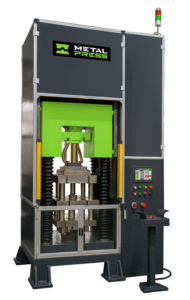
Straightening machines and straightening presses are specialized industrial systems designed to correct deformation, misalignment, and residual stress in metal components. These machines apply controlled force at precise locations to restore dimensional accuracy without compromising material integrity.
This page covers straightening machines, straightening presses, automatic straightening machines, and hydraulic straightening presses, with a focus on industrial use cases ranging from general fabrication to precision shaft straightening.
👉 MetalPress Machinery provides industrial press solutions for forming, straightening, assembly, and precision metal processing across a wide range of industries.
A straightening machine is an industrial device used to remove bends, warping, or distortion from metal parts. Unlike forming presses, straightening equipment is designed to apply incremental force in controlled steps rather than a single high-impact load.
Straightening machines are commonly used for:
Shafts and rods
Structural components
Welded assemblies
Tubes and bars
Machined parts requiring tight tolerances
Straightening may be performed manually or automatically, depending on part volume and precision requirements.
Straightening Presses
A straightening press is a type of press machine specifically configured for straightening operations. These presses typically use hydraulic force to apply controlled pressure at designated points along a component.
Advantages of Straightening Presses
High force with fine control
Adjustable stroke and pressure
Ability to correct localized deformation
Suitable for a wide range of part sizes
The terms straightening press and straightening presses are often used interchangeably to describe these systems.
Hydraulic Straightening Presses
A hydraulic straightening press uses a hydraulic cylinder to generate smooth, controllable force. Hydraulic systems are preferred for straightening because they allow precise adjustment of pressure and dwell time.
Benefits of Hydraulic Straightening Presses
Smooth force application
Excellent repeatability
Minimal risk of over-correction
Long service life
Hydraulic straightening presses are widely used in maintenance, fabrication, and production environments where accuracy is critical.
Automatic Straightening Machines
An automatic straightening machine is designed for high-volume or precision straightening operations where manual intervention is impractical.
Features of Automatic Straightening Machines
Programmable force and stroke profiles
Sensors for measuring deflection
Closed-loop control systems
Reduced operator dependency
Automatic straightening machines are commonly used in industries requiring consistent results across large production runs.
Shaft Straightening Applications
One of the most common straightening applications involves shafts and cylindrical components. While shaft straightening equipment is covered in more detail on a dedicated page, straightening presses play a critical role in these operations.
Straightening presses are used to correct:
Bent shafts
Misaligned rods
Deformed axles
Machined components
Controlled hydraulic force ensures shafts are straightened without inducing additional stress.
Manual vs. Automatic Straightening
Selecting between manual and automatic straightening depends on several factors.
Criteria
Manual Straightening Press
Automatic Straightening Machine
Volume
Low to medium
High
Precision
Operator-dependent
High repeatability
Setup
Flexible
Program-based
Cost
Lower
Higher initial investment
Both approaches have valid use cases depending on production requirements.
Straightening Press Frame Designs
Straightening presses may be configured with different frame styles, including:
H-frame presses
Four-post presses
C-frame presses (for lighter straightening)
Frame selection impacts accessibility, rigidity, and force distribution.
Common Industries Using Straightening Equipment
Straightening machines and presses are used across many industries, including:
Automotive manufacturing
Aerospace fabrication
Steel processing
Heavy equipment maintenance
General industrial fabrication
Any industry working with metal components subject to deformation can benefit from proper straightening equipment.
Control Systems for Straightening Presses
Modern straightening presses can be equipped with advanced control systems to improve accuracy and consistency.
Control options include:
Manual pressure regulation
Digital pressure readouts
PLC-based automation
Deflection measurement systems
These controls allow operators to fine-tune straightening processes for different materials and geometries.
Safety Considerations in Straightening Operations
Straightening operations involve high forces and stored energy. Proper safety measures are essential.
Recommended safety features include:
Two-hand controls
Guarding and barriers
Pressure relief valves
Emergency stop systems
Safe operation protects both personnel and equipment.
Selecting the Right Straightening Machine or Press
When choosing straightening equipment, consider:
Maximum force requirements
Part size and geometry
Required precision
Production volume
Level of automation
Proper selection ensures efficient correction of deformation without damaging parts.
Why Use Dedicated Straightening Equipment
Dedicated straightening machines and presses provide:
Improved dimensional accuracy
Reduced scrap and rework
Consistent, repeatable results
Greater process control
Whether using a straightening machine, straightening press, automatic straightening machine, or hydraulic straightening press, these systems are essential for maintaining quality in industrial manufacturing.
References
Kalpakjian, S., Schmid, S., Manufacturing Engineering and Technology, Pearson Education.
Groover, M. P., Fundamentals of Modern Manufacturing: Materials, Processes, and Systems, Wiley.
Lange, K., Handbook of Metal Forming, McGraw-Hill,
Totten, G. E., Steel Heat Treatment Handbook, CRC Press.
Esposito, A., Fluid Power with Applications, Pearson.
OSHA Technical Guidance Documents, Occupational Safety and Health Administration.
ISO 16092
ISO 12100
American Society of Mechanical Engineers (ASME)
Let Us Make Your Next Press
Whether you’re located in the USA, Canada, Mexico, or South America, you can contact us for more information, pricing, and consultations through our online forms, or by phone or email.