

Blog
Stretch Forming and Superplastic Forming: Processes, Equipment, and Applications

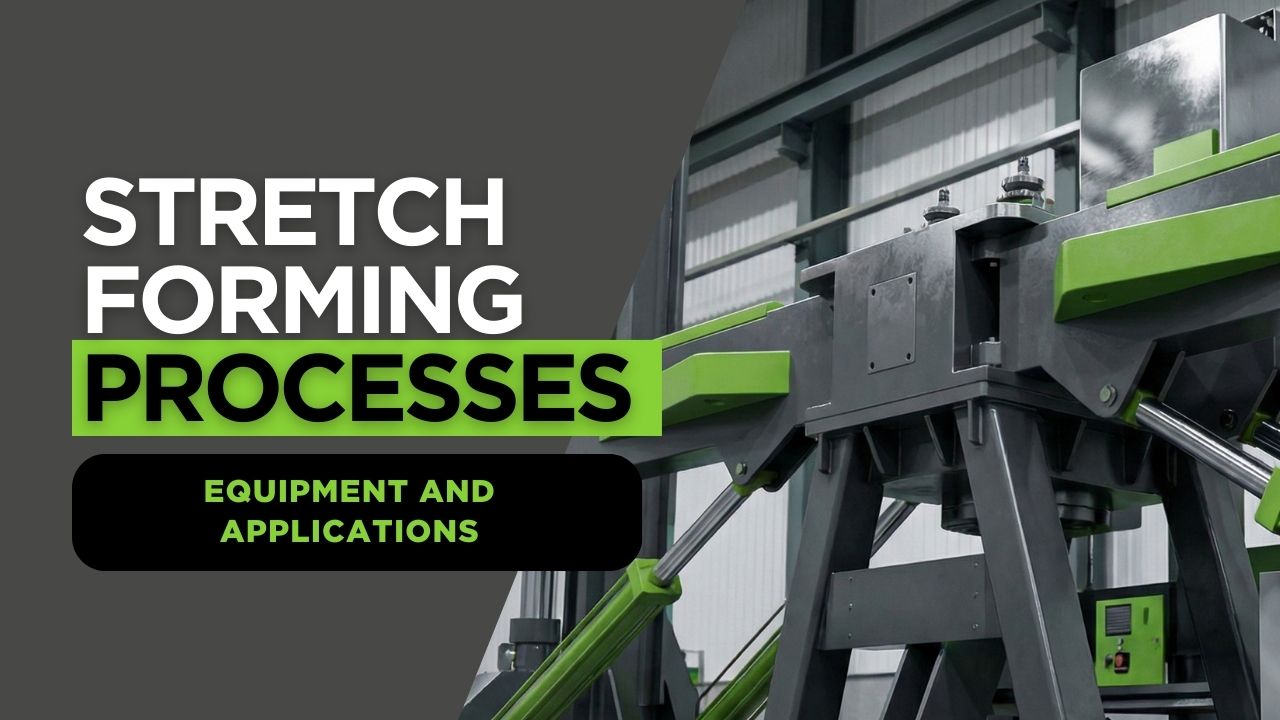
Stretch forming and superplastic forming are specialized metal forming processes used to manufacture large, smooth, and geometrically complex components with controlled deformation. These processes are especially important in aerospace, transportation, architectural, and advanced industrial manufacturing where dimensional accuracy, surface quality, and material integrity are critical.
This page provides a detailed overview of stretch forming, stretch forming machines, aluminum and titanium stretch forming, stretch bending, superplastic forming, superplasticity, and superplastic forming of titanium, with an emphasis on process fundamentals, equipment, and real-world applications.
What Is Stretch Forming?
Stretch forming is a metal forming process in which a sheet, extrusion, or profile is stretched under tensile force and wrapped over a forming die or form block. The material is held under tension throughout the operation, which minimizes wrinkling and springback.
Unlike bending or stamping, stretch forming relies primarily on tensile deformation rather than compression. This makes it well suited for producing large, smooth-radius components.
Stretch forming is commonly used for:
Long structural panels
Curved aerospace skins
Aluminum extrusions
Architectural components
Stretch Forming Process Fundamentals
In a typical stretch forming operation:
The workpiece is clamped at both ends
Tensile force is applied to stretch the material
The material is wrapped over a die or form block
The force is released after forming is complete
The controlled stretching ensures that the material conforms closely to the die shape with minimal elastic recovery.
Key characteristics of stretch forming:
Controlled plastic deformation
Reduced springback
Smooth surface finish
Uniform strain distribution
Stretch Forming Machines
A stretch forming machine is specifically designed to apply controlled tensile force while shaping the material over a die.
Common machine features include:
Hydraulic or mechanical gripping jaws
Adjustable tensile force control
Fixed or moving form blocks
CNC or programmable controls (in industrial systems)
Stretch forming machines are available in various configurations, including:
Straight stretch formers
Stretch bending machines
Large-bed machines for aerospace panels
👉 MetalPress Machinery supports advanced metal forming operations through robust press platforms, tooling integration, and system-level solutions used alongside specialized stretch forming and superplastic forming equipment. Contact us to discuss application requirements and system configuration.
Stretch Bending and Stretch Forming
Stretch bending is closely related to stretch forming and is often considered a subset of the process.
Stretch bending combines tensile stretching with bending around a radius
Commonly used for aluminum extrusions and profiles
Reduces wrinkling and improves dimensional accuracy
Stretch bending is widely used in:
Aircraft structural components
Automotive trim and rails
Architectural aluminum systems
Materials Used in Stretch Forming
Stretch forming requires materials with sufficient ductility to undergo tensile deformation without fracture.
Common materials include:
Aluminum and aluminum alloys
Steel and low-carbon steel
Titanium (for specialized applications)
Aluminum Stretch Forming
Aluminum is particularly well suited for stretch forming due to:
High ductility
Low forming force requirements
Good surface finish
Favorable strength-to-weight ratio
Aluminum stretch forming is widely used in aerospace skins, architectural panels, and transportation components.
Steel Stretch Forming
Steel stretch forming is used for structural and industrial components where higher strength is required. Lower-carbon steels are typically selected to improve formability.
Stretch Forming in Sheet Metal
Stretch forming in sheet metal is commonly used to create large panels with compound curvature.
Applications include:
Aircraft fuselage and wing skins
Transportation body panels
Large industrial enclosures
Because the material is stretched during forming, thickness reduction is predictable and controlled, which is critical for structural components.
Advantages of Stretch Forming
Minimal wrinkling
Reduced springback
Smooth surface finish
Accurate replication of die geometry
Suitable for large parts
Efficient for low- to medium-volume production
These advantages make stretch forming a preferred process for large, high-value components.
Limitations of Stretch Forming
Requires ductile materials
Thickness reduction must be carefully controlled
Not suitable for very sharp bends
Equipment footprint can be large
Despite these limitations, stretch forming remains essential for applications where part quality and surface integrity are paramount.
What Is Superplastic Forming?
Superplastic forming is a specialized metal forming process that exploits superplasticity, a material property that allows certain metals to undergo extremely high elongation without necking or failure.
Superplasticity occurs under specific conditions:
Elevated temperature
Controlled strain rate
Fine, stable grain structure
Materials commonly used in superplastic forming include:
Titanium alloys
Aluminum alloys
Certain specialty alloys
Superplasticity and Material Behavior
When a metal exhibits superplasticity:
Elongation can exceed several hundred percent
Deformation occurs uniformly
Complex shapes can be formed in a single operation
This behavior allows manufacturers to produce intricate geometries that would be difficult or impossible with conventional forming methods.
Superplastic Forming Process
In a typical superplastic forming operation:
Sheet metal is heated to a controlled temperature
The material is clamped over a die
Gas pressure is applied to force the sheet into the die cavity
The material flows gradually at a controlled strain rate
This process is sometimes referred to as superforming in industrial contexts.
Superplastic Forming of Titanium
Superplastic forming is primarily used in:
Aerospace structural components
Titanium sheet metal parts
Lightweight, complex enclosures
Low-volume, high-value components
Because of its cycle time and temperature requirements, superplastic forming is typically used where performance outweighs production speed.
Applications of Superplastic Forming
Superplastic forming of titanium is widely used in aerospace manufacturing.
Benefits include:
Ability to form complex, thin-walled components
Reduced part count through integration
Excellent surface quality
Consistent thickness distribution
Titanium superplastic forming is typically combined with diffusion bonding in advanced aerospace structures, using established and well-documented techniques.
Comparison: Stretch Forming vs Superplastic Forming
| Aspect | Stretch Forming | Superplastic Forming |
|---|---|---|
| Temperature | Ambient | Elevated |
| Primary deformation | Tension | Controlled creep |
| Cycle time | Short | Long |
| Typical materials | Aluminum, steel | Titanium, aluminum alloys |
| Part complexity | Moderate to high | Very high |
Both processes serve distinct roles and are selected based on part geometry, material, and production requirements.
Industrial Use and Process Selection
Manufacturers select stretch forming or superplastic forming based on:
Material properties
Required geometry
Part size
Production volume
Cost considerations
Stretch forming is typically favored for large panels and extrusions, while superplastic forming is chosen for highly complex shapes in specialized materials.
Conclusion
Stretch forming and superplastic forming are essential metal forming processes for producing large, smooth, and geometrically complex components. Stretch forming provides controlled tensile deformation for aluminum, steel, and sheet metal applications, while superplastic forming leverages material superplasticity to produce intricate shapes, particularly in titanium and advanced alloys.
By applying well-established principles of material behavior, temperature control, and tooling design, manufacturers can reliably use these processes to achieve high-quality results in aerospace, transportation, and industrial manufacturing.
Let Us Make Your Next Press
Whether you’re located in the USA, Canada, Mexico, or South America, you can contact us for more information, pricing, and consultations through our online forms, or by phone or email.