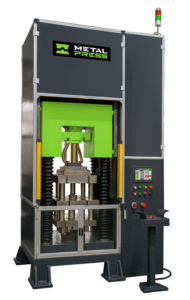
Hydraulic presses are not a single, uniform machine type. Instead, they exist in a wide range of configurations designed to meet different force requirements, workspace constraints, accuracy demands, and production environments. The selection of a hydraulic press depends heavily on its structural frame design, ram orientation, tonnage capacity, and control architecture.
From compact benchtop presses used in laboratories to multi-column presses generating thousands of tons of force, each press type is engineered to balance strength, stiffness, accessibility, and cost. This article provides a technical classification of hydraulic presses, focusing on frame styles, structural layouts, and functional configurations, and explains how these differences influence performance and application suitability.
Note: Hydraulic presses can be classified in several ways. This article focuses specifically on press frame and structural design (such as C-frame, H-frame, and four-column presses). Other classifications—such as by application, orientation, or control method—exist but do not change the fundamental hydraulic operating principle.
Why Hydraulic Press Design Matters
The design of a hydraulic press determines:
Load distribution and frame deflection
Accuracy and repeatability
Operator access and safety
Maximum allowable tonnage
Tooling compatibility
Maintenance requirements
Unlike mechanical presses, hydraulic presses can be designed with significant flexibility because force transmission does not rely on rigid mechanical linkages. However, the press frame must still withstand extremely high static and cyclic loads without permanent deformation.
Classification by Press Frame Design
The press frame is the primary load-bearing structure. It resists compressive forces generated during operation and maintains alignment between the ram and the tooling.
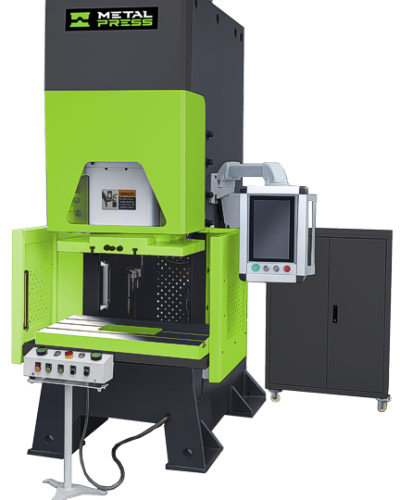
1. C-Frame Hydraulic Press
A C-frame press (also known as a gap-frame press) has an open-front structure shaped like the letter “C”.
Key Characteristics:
Open access on three sides
Compact footprint
Lower structural stiffness compared to closed frames
Advantages:
Excellent accessibility for loading and unloading
Suitable for light to medium tonnage operations
Common in assembly, straightening, and light forming
Limitations:
Higher frame deflection under load
Not ideal for high-precision or high-tonnage applications
C-frame hydraulic presses are typically used where ease of access is more important than absolute rigidity.
Vertical presses are the most common configuration, with the ram moving downward or upward.
Advantages:
Gravity assists material handling
Easier alignment of tooling
Compatible with most forming processes
Vertical presses dominate metal forming, stamping, forging, and molding applications.
Horizontal Hydraulic Presses
In horizontal presses, the ram moves laterally.
Advantages:
Suitable for long workpieces
Useful for tube forming, straightening, and assembly
Limitations:
Requires additional fixturing
Less intuitive material handling
Horizontal presses are often selected for specialized forming or extrusion-related operations.
Classification by Size and Capacity
Benchtop Hydraulic Presses
Benchtop presses are compact units designed for low-force applications.
Typical Capacity: 1–20 tons
Applications:
Laboratories
Prototyping
Small assembly tasks
They prioritize precision and ease of use over high force.
Shop and Industrial Hydraulic Presses
These presses operate in the range of 30–300 tons.
Applications:
Automotive repair
Fabrication shops
General manufacturing
They offer a balance between force capability and cost.
Heavy-Duty Hydraulic Presses
Heavy-duty presses exceed 500 tons and can reach several thousand tons.
Applications:
Forging
Large-scale metal forming
Aerospace and structural components
Such presses require reinforced foundations and advanced control systems.
Structural Elements of a Hydraulic Press Frame
Press Bed
The press bed supports the workpiece and tooling. It must resist bending and surface wear.
Platen
The platen transfers force from the ram to the tooling. Flatness and parallelism are critical for process accuracy.
Columns and Tie Rods
Columns guide motion and resist tensile forces. Tie rods may be pre-stressed to improve stiffness.
Frame Weldments
Frames are typically fabricated from welded structural steel or cast steel components. Stress relief processes are often applied after fabrication to reduce residual stresses.
Frame Deflection and Its Impact
Frame deflection is a key design consideration. Excessive deflection can cause:
Uneven part thickness
Tool wear
Reduced dimensional accuracy
Engineers often calculate allowable deflection using classical strength-of-materials equations and finite element analysis to ensure structural integrity.
Classification by Control and Actuation Method
Manual Hydraulic Presses
Operate via hand pumps.
Advantages:
Simple
Low cost
Limitations:
Limited force
Operator-dependent consistency
Powered Hydraulic Presses
Use electric motors to drive hydraulic pumps.
Advantages:
Consistent force delivery
Higher productivity
Electro-Hydraulic Presses
Combine hydraulic power with electronic control systems.
Advantages:
Precise force and position control
Automation compatibility
These systems are commonly integrated with PLCs and sensors.
Selecting the Right Hydraulic Press Type
Key selection factors include:
Required tonnage
Accuracy requirements
Tooling size
Production volume
Floor space
Safety requirements
No single press type is universally optimal; selection is application-specific.
Safety and Structural Compliance
Press frames must comply with applicable safety standards, including:
Load rating requirements
Guarding provisions
Emergency stop integration
Structural failure can be catastrophic, making conservative design margins essential.
Conclusion
Hydraulic presses are available in a wide range of configurations tailored to different industrial needs. Frame design, ram orientation, size, and control architecture all directly influence performance, accuracy, and safety. Understanding these classifications allows engineers and manufacturers to select presses that deliver optimal results while minimizing risk and cost.
A well-designed hydraulic press frame ensures that the machine’s hydraulic power is translated into controlled, repeatable mechanical force—making frame selection one of the most critical decisions in press engineering.
References
Kalpakjian, S., & Schmid, S. Manufacturing Processes for Engineering Materials, Pearson Education.
Groover, M. P. Fundamentals of Modern Manufacturing, Wiley.
Shigley, J. E., et al. Mechanical Engineering Design, McGraw-Hill.
Esposito, A. Fluid Power with Applications, Pearson.
ISO 4413:2010 – Hydraulic Fluid Power — General Rules and Safety Requirements.
ASM Handbook, Volume 14: Forming and Forging, ASM International.
ASTM E9 – Standard Test Methods of Compression Testing of Metallic Materials.
Let Us Make Your Next Press
Whether you’re located in the USA, Canada, Mexico, or South America, you can contact us for more information, pricing, and consultations through our online forms, or by phone or email.