

Blog
MTP75 – Final Testing, Pre‑Commissioning, and Preparing the 75‑Ton 4‑Post Hydraulic Press for Shipment

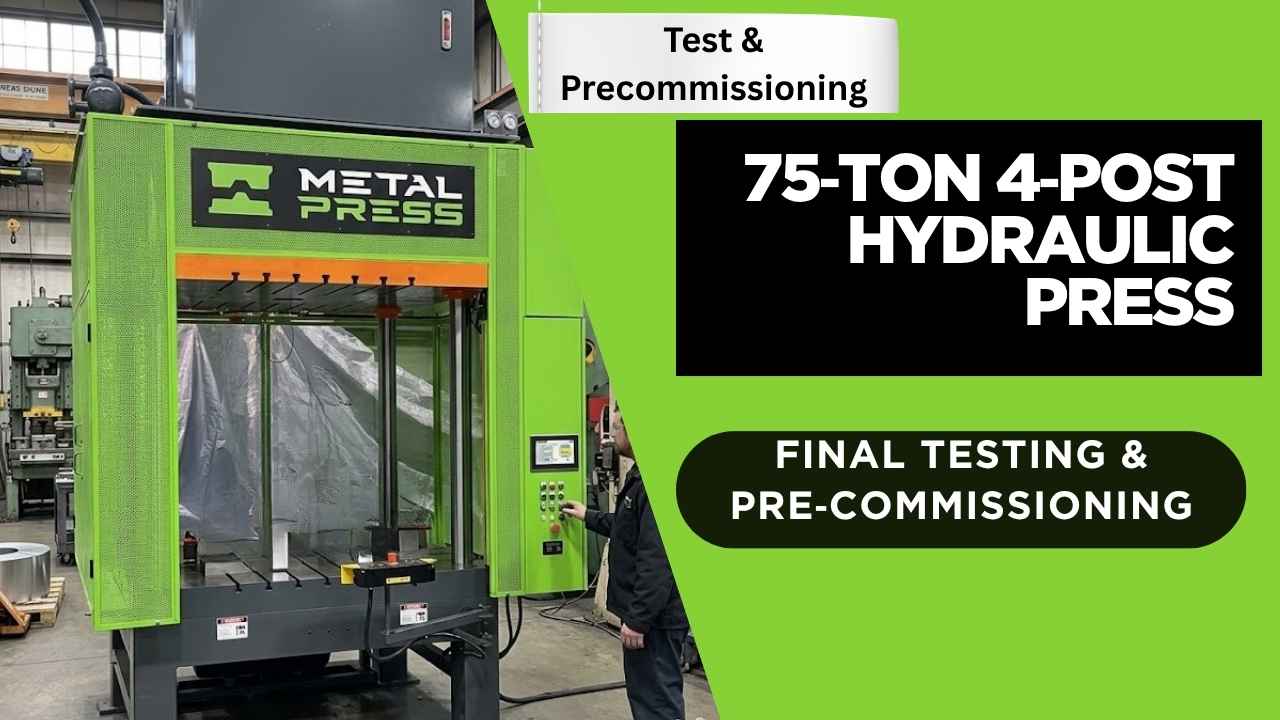
The journey of a custom‑engineered machine doesn’t end when the last bolt is tightened or when the hydraulic lines are connected. In many ways, that’s where the most critical work begins. Before a hydraulic press ever leaves our facility, it must prove itself—mechanically, hydraulically, electrically, and operationally. Phase Two of this project focuses on that essential transition: taking the fully assembled 75‑ton 4‑post hydraulic press built for our Ohio appliance manufacturer and preparing it for real‑world production.
But before diving into the testing and pre‑commissioning process, it’s worth taking a brief step back to remember how we got here.
After reviewing their parts, tooling, and production goals, our engineering team determined that the ideal solution was a custom‑built 75‑ton 4‑post hydraulic press. This machine configuration offered the perfect combination of rigidity, accessibility, and precision. What followed was a full engineering journey—from concept and design to fabrication, assembly, testing, and preparation for shipment. This article explores that first phase in detail, highlighting the technical decisions, engineering processes, and collaborative steps that brought this press from an idea to a fully realized machine.
Understanding the Customer’s Challenge
In the first phase of this project, we worked closely with the Ohio‑based appliance producer to understand their forming challenges and production goals. Their aging equipment was no longer delivering the precision or reliability they needed, and after a detailed engineering review, we determined that a custom 75‑ton 4‑post hydraulic press was the ideal solution.
We designed the press from the ground up—structural modeling, hydraulic engineering, control system development, and full mechanical assembly. By the end of Phase One, the machine stood complete on our shop floor: a fully built, fully wired, fully plumbed hydraulic press ready for the next stage of its journey.
Phase Two begins the moment the machine transitions from “assembled” to “validated.” Before starting this phase make sure to check this powerful 4-post hydraulic press and review the details.
👉 View our 4-post press MTP Series product page and for more information fill request for information form.
A Brief Re‑Introduction to the 4‑Post Hydraulic Press
Before we get into the testing and pre‑commissioning steps, it’s helpful to revisit why the 4‑post hydraulic press design is so important in industrial manufacturing.
A 4‑post hydraulic press is defined by its four precision‑machined columns that guide the moving platen with exceptional accuracy. This design ensures consistent parallelism, uniform pressure distribution, and long‑term structural stability—qualities that are essential in industries like appliance manufacturing, automotive, aerospace, and metal fabrication.
The 4‑post configuration offers:
Superior platen guidance, ensuring consistent forming depth
Open access from all sides, making tooling changes and maintenance easier
High rigidity, ideal for repetitive forming cycles
Versatility, supporting forming, punching, trimming, embossing, and deep drawing
For our Ohio customer, this meant the press would not only solve their immediate forming challenges but also support future tooling and production changes. With the machine now fully assembled, the next step was to ensure it performed exactly as designed.
The Start of Phase Two: Testing and Validation
Testing is where the machine proves its engineering. Every hydraulic press we build undergoes a rigorous validation process, and this 75‑ton 4‑post press was no exception. The goal is simple: ensure the machine performs flawlessly before it ever reaches the customer’s facility.
Dry Cycling and Motion Verification
The first stage of testing involves running the press through multiple dry cycles without load. This allows our technicians to verify:
Smooth cylinder motion
Proper speed transitions
Accurate stroke limits
Clean, consistent platen travel
No abnormal noise, vibration, or hesitation
Dry cycling is essential because it reveals any mechanical or hydraulic irregularities before pressure is applied.
Hydraulic Pressure Testing
Once motion is verified, we begin pressure testing. The hydraulic system is brought up to operating pressure, and the press is tested at various tonnage levels, including full 75‑ton capacity. During this stage, we monitor:
Pressure stability
Cylinder sealing
Valve response
Pump performance
System temperature behavior
This ensures the hydraulic power unit and cylinder can deliver consistent force without drift or fluctuation.
Parallelism and Alignment Checks
One of the defining advantages of a 4‑post press is its ability to maintain platen parallelism. Using precision measurement tools, we verify:
Platen flatness
Parallelism under load
Column alignment
Guide bushing performance
These measurements confirm that the press will produce uniform, repeatable parts once installed in the customer’s facility.
Electrical and Control System Validation
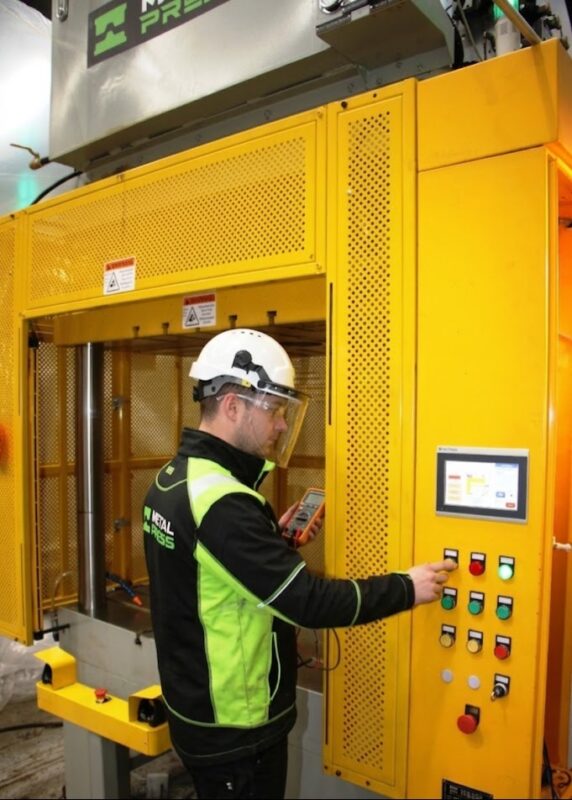
The control system is the brain of the press, and it undergoes its own series of tests. Our team verifies:
PLC logic
HMI functionality
Safety interlocks
Light curtains or guarding systems
Emergency stop circuits
Pressure and position feedback
Every button, sensor, and safety device must perform exactly as intended.
Customer Involvement: The Factory Acceptance Test (FAT)
Once internal testing is complete, we invite the customer to our facility for a Factory Acceptance Test. This is a critical milestone in any custom machinery project. It gives the customer the opportunity to see the press in operation, review the controls, inspect the build quality, and confirm that the machine meets their expectations.
During the FAT for this 75‑ton 4‑post press, the Ohio team reviewed:
The press’s forming cycle
Pressure and speed settings
Tooling interface
Safety features
HMI navigation
Overall build quality
Their feedback was extremely positive. They appreciated the smooth motion, the rigidity of the frame, and the intuitive control interface. With their approval, the press moved into the final stage of Phase Two: pre‑commissioning and preparation for shipment.
Pre‑Commissioning: Preparing the Press for the Real World
Pre‑commissioning is the bridge between testing and shipping. It ensures the machine is fully documented, fully inspected, and fully protected for transport.
Final Mechanical and Hydraulic Inspection
Our technicians perform a complete inspection of:
Fasteners and torque settings
Hydraulic fittings and hoses
Electrical connections
Lubrication points
Cylinder seals
Column bushings
This ensures the machine leaves our facility in perfect condition.
Documentation and Technical Package
Every custom hydraulic press ships with a comprehensive documentation package, including:
Operation manual
Maintenance schedule
Hydraulic and electrical schematics
Spare parts list
Safety guidelines
Warranty information
This documentation supports the customer’s maintenance team and ensures smooth integration into their production environment.
Surface Protection and Wrapping
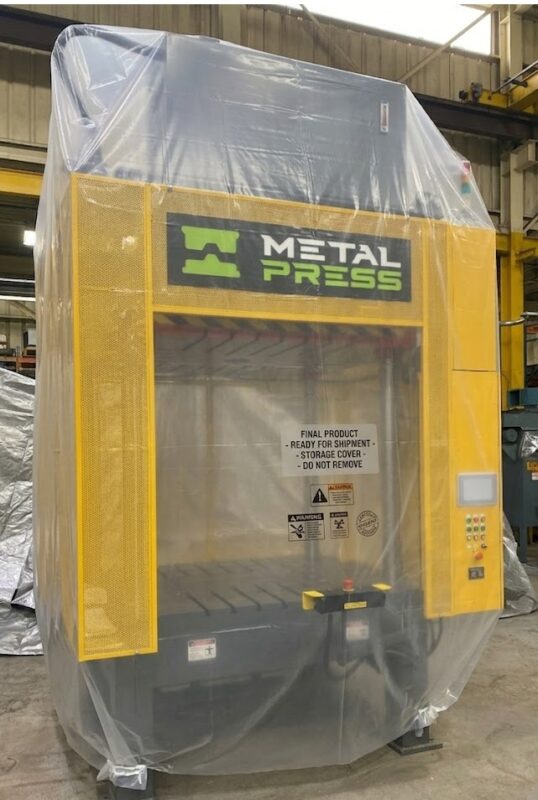
Before shipment, the press is cleaned, coated with corrosion‑resistant protectants where necessary, and wrapped for transport. Sensitive components such as the HMI, sensors, and hydraulic ports are sealed and protected.
Palletizing and Crating
Depending on the customer’s shipping requirements, the press may be:
Secured to a heavy‑duty pallet
Fully crated
Wrapped and strapped for container loading
For this project, the 75‑ton press was prepared for over‑the‑road transport to Ohio, requiring reinforced blocking and vibration‑resistant packaging.
Phase Two Complete: The Press Is Ready for Shipment
With testing complete, documentation finalized, and the machine fully protected, the 75‑ton 4‑post hydraulic press is officially ready for shipment. Phase Two marks the end of its time in our facility and the beginning of its journey to the customer’s plant.
In Phase Three, we’ll follow the press as it leaves our shop, travels to Ohio, and undergoes installation, commissioning, and final startup on the customer’s production floor.

Let Us Make Your Next 4-Post Press

Join us in this journey to equip your manufacturing line with the most reliable products in metal stamping industry.
Each unit is assembled to meet your exact load capacity, workspace, and operational requirements which is delivering smooth, stable rotation and long-term reliability.
More information about this die upender
For more information about our other products