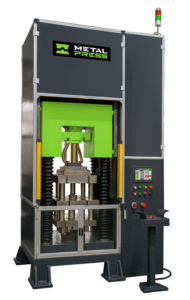
Extrusion is a metal forming process in which a billet or blank is forced through a die to produce long components with uniform cross-sectional geometry. This process is widely used in aluminum, steel, and other ductile metals to create structural profiles, tubing, and complex sections for automotive, aerospace, construction, and industrial applications.
This page provides a comprehensive overview of extrusion presses, aluminum and aluminum alloy extrusion, extrusion forming processes, extrusion machines, press extrusion, and extrusion automation, focusing on equipment, process fundamentals, and industrial applications.
What Is Metal Extrusion?
Metal extrusion is a forming process in which compressive force is applied to a heated or softened billet, pushing it through a die to achieve the desired cross-sectional shape. The resulting extruded product maintains uniform geometry along its length.
Key benefits of extrusion include:
Consistent cross-sectional dimensions
Ability to create complex profiles
Excellent surface finish
Efficient material usage
Extrusion is widely applied in both aluminum and steel manufacturing.
👉 MetalPress Machinery supports extrusion operations through heavy-duty hydraulic press platforms, tooling integration, and system-level solutions used alongside dedicated extrusion equipment. Contact us to discuss application requirements and press configuration.
Materials Used in Extrusion
Materials must exhibit sufficient ductility to flow through the die without cracking.
Common materials include:
Aluminum and aluminum alloys – Lightweight, corrosion-resistant, and ideal for structural applications
Aluminium extrusion – European spelling variant, same process and principles
Steel and low-carbon steel – For structural and industrial applications
Titanium and specialty alloys – For aerospace or high-performance components
Aluminum is the most widely extruded metal due to its combination of ductility, strength, and corrosion resistance.
Extrusion Processes
Extrusion can be performed using several techniques depending on the material and application:
1. Direct (Forward) Extrusion
The billet is pushed through a die in the same direction as the ram
Common for aluminum profiles and industrial tubing
Requires precise press alignment to prevent die wear
2. Indirect (Backward) Extrusion
The die moves toward the billet, causing the metal to flow in the opposite direction
Reduces friction and force requirements
Often used for high-precision sections
3. Hydrostatic Extrusion
Uses a pressurized fluid to transmit force to the billet
Minimizes friction and allows extrusion of brittle materials
Common in specialty aluminum and high-strength alloys
Extrusion Presses and Machines
Hydraulic Extrusion Press
Provides controlled force and stroke speed
Allows variable ram speeds and dwell time
Used for aluminum extrusion, steel billet extrusion, and specialty alloys
Mechanical Extrusion Press
Uses flywheel and crank mechanisms to deliver high-speed strokes
Suitable for high-volume industrial extrusion
Less flexible than hydraulic presses but highly productive
Extrusion Machines
Include billet heaters, handling systems, and die sets
Integrated with cooling, stretching, and cutting operations for high-volume production
Automation in Extrusion
Modern extrusion lines may include robotic billet handling, automated press control, and inline inspection
Improves productivity, safety, and consistency of extruded parts
Aluminum Extrusion
Aluminum extrusion is widely used in transportation, construction, and consumer products.
Advantages:
Lightweight yet strong
Corrosion-resistant
Capable of complex cross-sections
High surface quality
Common products:
Window and door frames
Automotive structural components
Aerospace profiles
Architectural panels
Aluminum extrusion presses are often paired with automated handling and stretching systems to maintain straightness and uniform properties.
Extrusion Forming Process
In extrusion forming:
Billet is heated to optimal temperature (for hot extrusion)
Billet is loaded into the press chamber
Ram applies compressive force, pushing the billet through the die
Extruded profile exits die, cooled and stretched if required
Process considerations include:
Temperature control
Die design and lubrication
Ram alignment
Material flow behavior
Press Extrusion Operations
Press extrusion refers to the use of a press, usually hydraulic or mechanical, to drive the billet through the die. Key considerations:
Press tonnage must match billet size and material
Stroke length must accommodate billet length
Automation improves consistency and productivity
Hydraulic presses provide precise force and speed control, which is essential for high-quality aluminum and specialty alloy extrusions.
Applications of Extrusion
Automotive
Structural profiles, rails, and tubes
Lightweight chassis components
Aerospace
High-strength aluminum sections for airframes
Titanium extrusions for specialty components
Construction
Window and door frames
Curtain wall and façade systems
Structural beams and supports
Industrial Manufacturing
Heat sinks, enclosures, and piping
Custom machine components
Extrusion enables the production of long, complex profiles that are difficult or impossible with other forming methods.
Advantages of Extrusion
High material utilization
Capability for complex cross-sections
Excellent surface finish and dimensional accuracy
High production speed for long profiles
Compatible with automation
These advantages make extrusion a preferred process for both high-volume industrial applications and specialized structural components.
Limitations and Considerations
High initial tooling cost (dies)
Material must have sufficient ductility
Large press footprint
Cooling and handling required for long extrusions
Proper press selection, die design, and material control are essential for reliable extrusion performance.
Extrusion Automation and Industry Trends
Modern extrusion facilities increasingly integrate:
Robotic billet handling
CNC press control and monitoring
Automatic cooling, stretching, and cutting
In-line inspection systems
Automation enhances safety, reduces scrap, and improves dimensional consistency, particularly for aluminum and aluminum extrusion presses.
Conclusion
Extrusion presses and extrusion forming processes are foundational to producing long, uniform metal components with complex profiles. From aluminum extrusion machines to hydraulic and mechanical extrusion presses, the technology allows manufacturers to produce high-quality profiles for automotive, aerospace, construction, and industrial applications.
By following established practices for press extrusion, die design, billet heating, and process control, extrusion enables precise, repeatable, and efficient production while maintaining optimal material properties.
Let Us Make Your Next Press
Whether you’re located in the USA, Canada, Mexico, or South America, you can contact us for more information, pricing, and consultations through our online forms, or by phone or email.