

Blog
Heavy-Duty Hydraulic Presses: 200 to 1000 Ton Industrial Press Machines

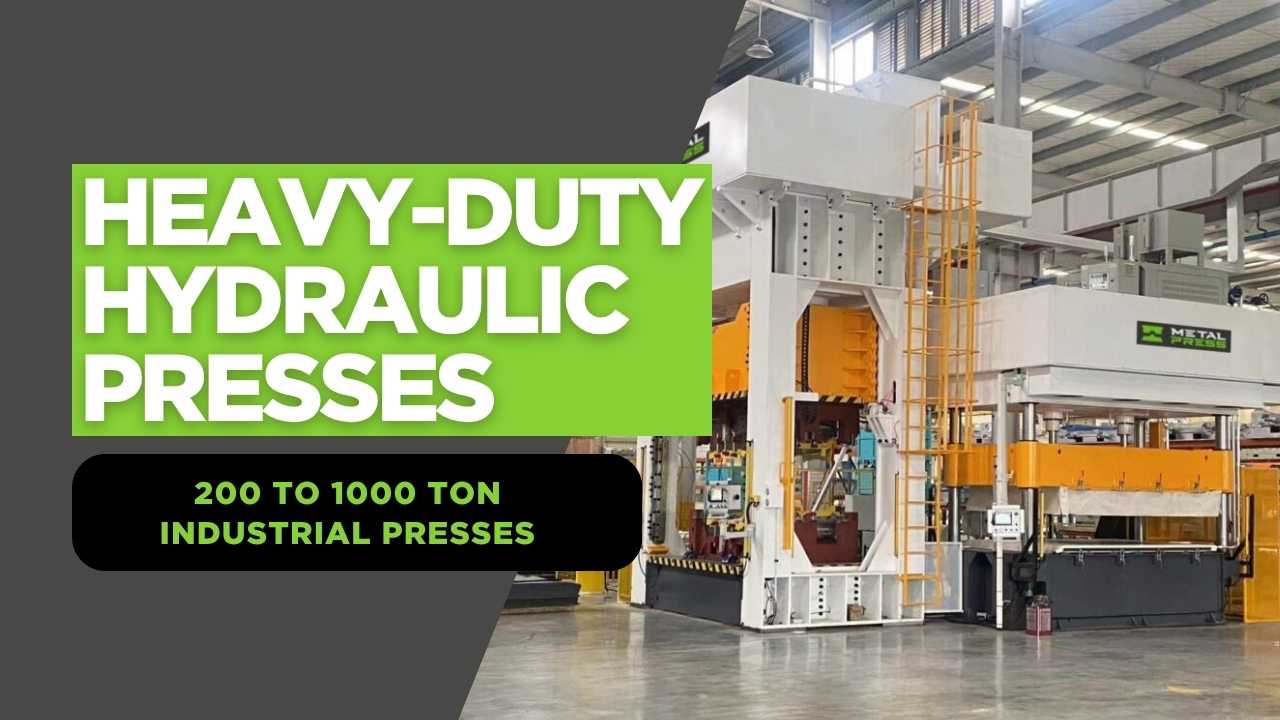
Heavy-duty hydraulic presses in the 200–1000 ton range are engineered for the most demanding industrial forming, bending, straightening, and compression applications. These machines are purpose-built to deliver extreme force with structural rigidity, precision control, and long-term reliability in continuous production environments.
This page covers 200 ton, 300 ton, 400 ton, and 1000 ton hydraulic press machines, including 200 ton press brakes, large-capacity shop presses, and custom high-force press solutions.
Overview of Heavy-Duty Hydraulic Presses
Unlike mid-range shop presses, heavy-duty hydraulic presses are designed to withstand sustained loads, off-center forces, and complex tooling configurations. These presses are typically floor-mounted, reinforced with thick steel frames, and powered by high-capacity hydraulic systems.
Common applications include:
Heavy metal forming and bending
Structural straightening
Compression molding
Large component assembly
Industrial press brake operations
A 200 ton press often marks the entry point into true heavy-duty press equipment, while 1000 ton presses represent the upper end of industrial force requirements. At MetalPress Machinery, we have numerous heavy-duty presses. Our industrial double point straight sided servo press offers up to 800 tons capacity and our 4-post servo hydraulic press offers up to 200 tons. MetlaPress Machinery is also a well known provider of 4-post presses (also known as trim press) from 35 ton to 200 ton with customizable features.
👉 We have different categories of presses including hydraulic presses and servo hydraulic presses
200 Ton Hydraulic Presses
A 200 ton press provides a significant increase in forming and straightening capability over 150 ton machines. These presses are widely used in fabrication shops, heavy maintenance facilities, and production environments requiring higher force margins.
Typical Uses for a 200 Ton Press
Straightening large shafts and structural components
Forming thicker plate material
Heavy press-fit assembly
Industrial bending operations
In press brake configurations, a 200 ton press brake is commonly used for bending thick or wide material sections that exceed the capacity of lighter equipment. In this range, we suggest viewing the 4-post hydraulic sevo press to find its capabilities as a 35-ton to 200-ton press machine.
300 Ton Hydraulic Presses
A 300 ton press is selected when applications demand high force with improved rigidity and control. These presses are often custom-configured to match specific tooling and production requirements.
Common applications include:
Large-scale metal forming
Compression press operations
Heavy straightening and flattening
Structural fabrication
The increased capacity of a 300 ton press allows operators to handle thicker materials while maintaining precise force control.
400 Ton Hydraulic Presses
A 400 ton press is firmly in the category of high-capacity industrial equipment. These presses are typically used in:
Heavy manufacturing environments
Steel processing facilities
Large fabrication shops
At this force level, frame design, platen flatness, and hydraulic system stability become critical to ensure consistent results and long service life.
1000 Ton Hydraulic Presses
A 1000 ton press represents one of the highest force levels commonly deployed in industrial manufacturing. These presses are almost always custom-engineered and built for specific applications.
Applications for 1000 Ton Presses
Large compression presses
Heavy forming and secondary forging suppor
Structural straightening of oversized components
Specialized industrial processes
Due to the extreme forces involved, 1000 ton hydraulic presses require advanced control systems, reinforced foundations, and comprehensive safety integration. For this tonnage, MetalPress Machinery is a prominent provider of powder compaction servo presses with total functionality in a wide range of industries from mining to chemical plants.
Heavy-Duty Hydraulic Press Machine Design
A heavy-duty hydraulic press machine in the 200–1000 ton range typically includes:
Multi-cylinder or large-bore single cylinders
Reinforced welded or cast frames
Precision-machined platens
High-capacity hydraulic power units
These design elements ensure stable force delivery even under off-center or asymmetric loading conditions.
Compression Press Capabilities
Many high-tonnage hydraulic presses function as compression presses for molding, forming, or densification applications.
Compression press uses include:
Industrial molding operations
Material densification
Large component forming
Specialty manufacturing processes
Compression presses in this tonnage range are engineered to apply uniform pressure across large surface areas.
Control Systems and Automation
Heavy-duty presses are commonly equipped with advanced control systems to manage force, speed, and dwell.
Control options include:
PLC-based automation
Digital pressure monitoring
Programmable stroke profiles
Closed-loop feedback systems
Automation improves consistency, reduces operator fatigue, and enables integration into production lines.
Straightening Applications at High Tonnage
High-tonnage presses are frequently used for industrial straightening tasks, including:
Structural beams
Large shafts
Welded fabrications
Thick plates
The ability to apply controlled force at precise locations makes hydraulic presses ideal for correcting deformation without inducing additional stress.
Safety Requirements for Heavy-Duty Presses
Safety becomes increasingly critical as tonnage increases.
Recommended safety features include:
Full perimeter guarding
Light curtains and interlocks
Redundant pressure relief valves
Emergency stop circuits
Compliance with applicable industrial safety standards is essential for safe operation.
Selecting the Right High-Tonnage Press
When choosing a 200–1000 ton hydraulic press, key considerations include:
Maximum force requirements
Frame rigidity and deflection limits
Tooling and platen size
Facility floor loading and foundations
Control and automation needs
Proper selection ensures long-term performance and minimizes operational risk.
Why Choose a Heavy-Duty Hydraulic Press
Heavy-duty hydraulic presses offer:
Extreme force capability
Precision control at high loads
Long service life
Adaptability to complex industrial applications
Whether you require a 200 ton press, 300 ton press, 400 ton press, or 1000 ton hydraulic press, these machines provide the power and reliability needed for demanding production environments.
References
- Kalpakjian, S., Schmid, S., Manufacturing Engineering and Technology, Pearson Education.
- Groover, M. P., Fundamentals of Modern Manufacturing: Materials, Processes, and Systems, Wiley.
- Lange, K., Handbook of Metal Forming, McGraw-Hill,
- Totten, G. E., Steel Heat Treatment Handbook, CRC Press.
- Esposito, A., Fluid Power with Applications, Pearson.
- Merritt, H. E., Hydraulic Control Systems, Wiley.
- ASM International, ASM Handbook Volume 14A: Metalworking: Bulk Forming
- Tool and Manufacturing Engineers Handbook, SME
- OSHA Technical Guidance Documents, Occupational Safety and Health Administration.
- ISO 16092
- ISO 12100
- American Society of Mechanical Engineers (ASME)
Let Us Make Your Next Press
Whether you’re located in the USA, Canada, Mexico, or South America, you can contact us for more information, pricing, and consultations through our online forms, or by phone or email.