Hydraulic presses are foundational machines in industrial manufacturing due to their ability to deliver controlled, repeatable, and extremely high compressive forces. Unlike many machine tools that are limited to a single process, hydraulic presses are process-enabling systems—their function is defined largely by tooling, control logic, and operating parameters rather than by the press alone.
Across industries such as automotive manufacturing, aerospace, metal fabrication, energy, consumer goods, and food processing, hydraulic presses perform tasks ranging from precision assembly to large-scale metal deformation. This article provides a technical overview of the primary industrial applications of hydraulic presses, explaining why hydraulic technology is preferred in these contexts and how press characteristics align with specific production requirements.
Introduction
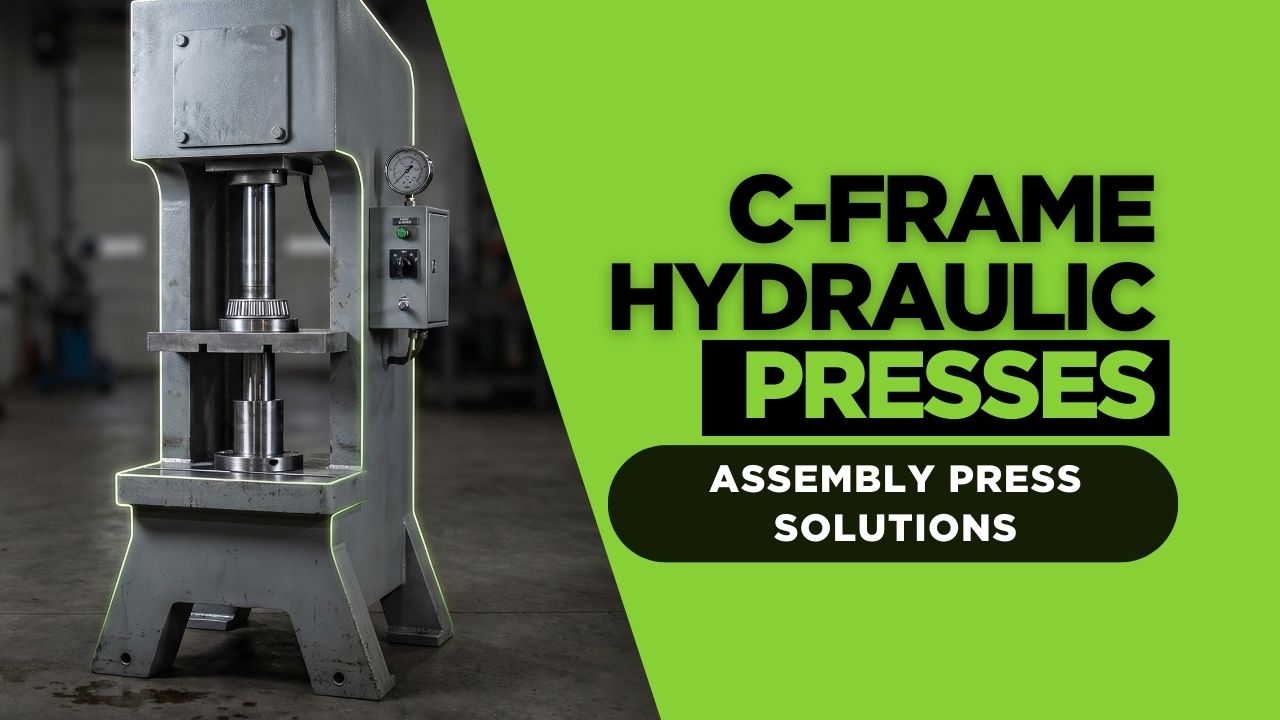
C-frame hydraulic presses are precision press systems engineered for applications that require unobstructed access to the work area, accurate force control, and repeatable results. The distinctive open-front “C” configuration allows operators to load and unload parts quickly while maintaining excellent visibility and tooling alignment.
This page provides a comprehensive overview of C-frame hydraulic presses, including hydraulic C-frame press systems, C-frame punch presses, and hydraulic assembly presses, along with guidance on selecting the proper configuration for production, assembly, and forming operations.
What Is a C-Frame Press?
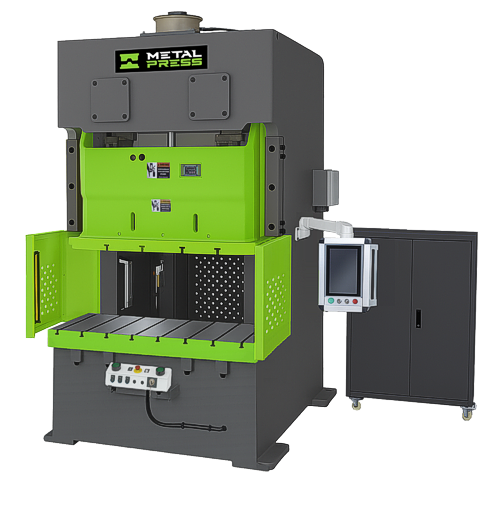
A C-frame press is a press machine constructed with an open-front frame shaped like the letter “C.” Unlike H-frame or four-post presses, the C-frame design provides three-sided access to the pressing area, making it ideal for high-efficiency production environments and precision assembly work. In addition to hydraulic configurations, C-frame presses are also available in mechanical designs, including single-crank and double-crank C-frame presses.
C-frame presses are commonly used for:
Component assembly
Punching and piercing
Riveting and staking
Light forming and bending
Precision pressing operations
When paired with hydraulic power, a C-frame press delivers smooth force application and excellent control over pressing speed and pressure.
C-Frame Hydraulic Presses
A C-frame hydraulic press uses hydraulic pressure to generate pressing force through a cylinder mounted within the C-frame structure. This configuration allows for controlled, linear force delivery with minimal shock loading.
Advantages of Hydraulic C-Frame Presses
Precise force and pressure control
Smooth, consistent ram motion
Adjustable stroke and dwell time
Excellent repeatability for production work
A hydraulic C-frame press is especially well suited for applications where accuracy, tool alignment, and part consistency are critical.
Hydraulic Assembly Press Applications
One of the most common uses of a C-frame hydraulic press is as a hydraulic assembly press. These presses are designed to install, insert, or join components with controlled force to avoid part damage.
A C-frame punch press is a specialized press designed for punching, piercing, and blanking operations. The open-front design allows for easy material feeding and die access, improving productivity and safety.
Common Punch Press Applications
Sheet metal punching
Electrical enclosure fabrication
Gasket and washer production
Prototype and short-run manufacturing
C-frame punch presses may be hydraulic or mechanically actuated, depending on force requirements and cycle speed.
Hydraulic Piston Press Design
At the core of a hydraulic C-frame press is the hydraulic piston press mechanism. This system converts hydraulic pressure into linear force through a piston and cylinder assembly.
Key characteristics of hydraulic piston press systems include:
High force output relative to size
Excellent load control
Long service life
Low maintenance requirements
The hydraulic piston press design allows precise control over pressing force, making it ideal for sensitive assembly and forming operations.
C-Frame vs. H-Frame Presses
Choosing between a C-frame press and an H-frame press depends on application requirements.
C-frame presses are preferred where accessibility and speed are priorities, while H-frame presses are better suited for high-tonnage forming.
Force Capacity and Tonnage Options
C-frame hydraulic presses are available in a wide range of force capacities, typically from 2 ton press systems for light assembly up to higher-tonnage configurations for forming and punching.
Common force ranges include:
2–5 ton for benchtop and light assembly
10–25 ton for production assembly
Higher tonnage for specialized punching and forming
Selecting the correct tonnage ensures process consistency while protecting tooling and components.
Control Options and Automation
Modern hydraulic C-frame presses can be equipped with a variety of control systems to match production requirements.
Control Options Include:
Manual valve control
Pressure-regulated control
Digital pressure and stroke monitoring
PLC-based automation
Automated C-frame hydraulic presses are frequently integrated into production lines for repeatable, high-volume assembly tasks.
Tooling and Customization
C-frame presses are highly adaptable to custom tooling and fixtures. Common tooling options include:
Custom press fixtures
Punch and die sets
Assembly nests
Quick-change tooling systems
The open-front design simplifies tooling installation and reduces changeover time.
Industries That Use C-Frame Hydraulic Presses
C-frame hydraulic presses are widely used across multiple industries, including:
Automotive manufacturing
Aerospace component assembly
Electronics production
Medical device manufacturing
General industrial fabrication
Their versatility and precision make them a foundational machine in many manufacturing environments.
Safety Considerations
While C-frame presses offer excellent accessibility, proper safety measures are essential.
Recommended safety features include:
Two-hand controls
Light curtains
Guarding and interlocks
Pressure relief systems
Integrating appropriate safety systems protects operators while maintaining productivity.
Why Choose a C-Frame Hydraulic Press
A well-designed C-frame hydraulic press provides:
Fast and efficient part handling
Precise force control
Compact footprint
Adaptability to multiple applications
Whether configured as a hydraulic assembly press, C-frame punch press, or general-purpose hydraulic piston press, these machines deliver reliable performance for precision industrial operations.
References
Kalpakjian, S., Schmid, S., Manufacturing Engineering and Technology, Pearson Education.
Groover, M. P., Fundamentals of Modern Manufacturing: Materials, Processes, and Systems, Wiley.
Lange, K., Handbook of Metal Forming, McGraw-Hill,
Totten, G. E., Steel Heat Treatment Handbook, CRC Press.
Esposito, A., Fluid Power with Applications, Pearson.
OSHA Technical Guidance Documents, Occupational Safety and Health Administration.
ISO 16092
ISO 12100
American Society of Mechanical Engineers (ASME)
Let Us Make Your Next Press
Whether you’re located in the USA, Canada, Mexico, or South America, you can contact us for more information, pricing, and consultations through our online forms, or by phone or email.