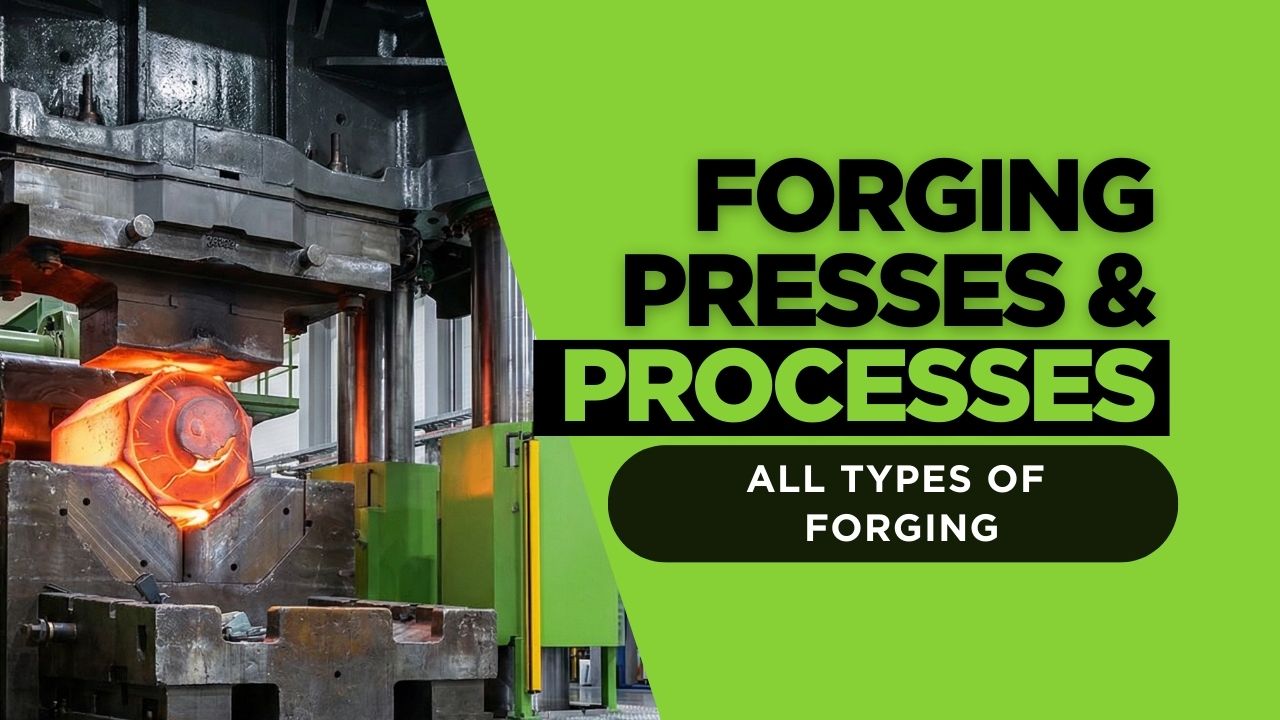
Forging is a metal forming process in which compressive forces are used to shape metal into high-strength components. Unlike casting or machining, forging refines the internal grain structure of the material, resulting in superior mechanical properties such as strength, toughness, and fatigue resistance.
This page provides a comprehensive overview of forging presses, forging machines, hot forging, cold forging, hydraulic forging presses, mechanical forging presses, forging automation, and industrial forging applications, with a focus on process fundamentals and equipment selection.
What Is Forging?
Forging is a compressive metal forming process in which metal is plastically deformed under high force using a press or hammer. The workpiece may be heated (hot forging), warm forged, or formed at room temperature (cold forging), depending on material and application.
Forging is commonly used to produce:
Structural components
Shafts and axles
Automotive and industrial parts
Aerospace components
Tooling and hardware
The forged structure improves directional grain flow, enhancing part durability.
👉 MetalPress Machinery supplies robust hydraulic and mechanical press platforms commonly used in forging applications, including open-die, closed-die, and precision forging operations. Contact us to discuss press configuration, tonnage, and tooling requirements.
Provides uniform deformation throughout the workpiece
Ideal for large parts and precision forging
Common press types: hydraulic and mechanical forging presses
Forging Hammer
Applies high-impact energy
Deformation occurs through repeated blows
Suitable for smaller or more complex shapes
Common in blacksmith and open-die operations
This page focuses primarily on forging presses, which dominate industrial forging.
Hot Forging
Hot forging is performed above the metal’s recrystallization temperature, allowing significant deformation with reduced force.
Characteristics of hot forging:
Improved material flow
Reduced risk of cracking
Ability to form complex shapes
Requires heating equipment and scale control
Hot forging presses are commonly used for steel, stainless steel, and alloy steel components in automotive and industrial applications.
Cold Forging
Cold forging is performed at or near room temperature. It relies on high press forces and ductile materials.
Characteristics of cold forging:
Excellent dimensional accuracy
Improved surface finish
Work hardening increases strength
Limited deformation compared to hot forging
Cold forging presses and cold forging machines are widely used for fasteners, bolts, and precision components.
Warm Forging
Warm forging occurs at intermediate temperatures and combines advantages of hot and cold forging:
Reduced forming force compared to cold forging
Improved dimensional control compared to hot forging
Lower oxidation and scale formation
Forging Press Types
Hydraulic Forging Press
A hydraulic forging press uses hydraulic cylinders to generate compressive force.
Key characteristics:
Full tonnage available throughout the stroke
Adjustable force and speed
Excellent control for complex shapes
Suitable for large and thick components
Hydraulic forging presses are widely used in:
Open-die forging
Closed-die forging
Industrial and aerospace forging
Specialty forging such as pattern-welded or Damascus steel (using standard forging principles)
Mechanical Forging Press
A mechanical forging press uses a flywheel, crankshaft, or eccentric drive.
Key characteristics:
High production speed
Consistent stroke profile
Efficient for high-volume production
Less flexibility than hydraulic presses
Mechanical forging presses are common in:
Automotive forging
High-volume industrial parts
Closed-die forging applications
Open-Die and Closed-Die Forging
Open-Die Forging
Workpiece is not fully enclosed by dies
Allows large deformation and flexibility
Common for large shafts, rings, and blocks
Often performed on hydraulic forging presses
Closed-Die Forging
Metal is enclosed within die cavities
Produces near-net-shape parts
Higher tooling cost but excellent repeatability
Widely used in automotive and aerospace industries
Forging Automation
Forging automation is widely adopted in modern manufacturing to improve productivity and safety.
Automation may include:
Robotic part handling
Automated heating and transfer
Press synchronization
Process monitoring and control
Automated forging systems are especially common in high-volume automotive forging operations.
Hydraulic Presses for Forging Applications
Hydraulic presses are used for:
Precision forging
Large component forging
Low-to-medium production volumes
Applications requiring controlled deformation
A hydraulic press for forging provides:
Adjustable ram speed
Dwell capability
Controlled force application
This makes hydraulic presses suitable for specialized forging operations where process control is critical.
Used and Specialty Forging Presses
Manufacturers often utilize:
Used forging presses for cost efficiency
Refurbished hydraulic forging presses
Retrofitted mechanical forging presses
These machines are commonly rebuilt to meet modern safety and control standards.
Industrial Applications of Forging
Forging is used across multiple industries:
Automotive
Crankshafts
Connecting rods
Gears and shafts
Aerospace
Structural components
Landing gear parts
High-strength alloy components
Industrial Equipment
Shafts and couplings
Heavy-duty machine components
Blacksmith and Specialty Forging
Artistic and functional forged components
Small-batch and custom forging
Advantages of Forging
Improved grain structure and strength
High fatigue resistance
Reduced material waste compared to machining
Consistent mechanical properties
Long service life of forged parts
Forging remains one of the most reliable metal forming methods for high-performance components.
Key Process Considerations
Material selection – Steel, aluminum, titanium, and specialty alloys
Temperature control – Critical for hot and warm forging
Die design – Influences material flow and part quality
Press selection – Hydraulic vs mechanical based on force and speed requirements
Lubrication and cooling – Extends die life and improves consistency
Conclusion
Forging presses and forging processes are foundational to industrial manufacturing, delivering high-strength, reliable components across automotive, aerospace, and industrial sectors. Whether using hot forging presses, cold forging presses, hydraulic forging presses, or mechanical forging presses, proper equipment selection and process control are essential to achieving consistent results.
By leveraging modern forging presses and automation while adhering to established forging principles, manufacturers can produce durable, high-performance components with efficiency and repeatability.
Let Us Make Your Next Press
Whether you’re located in the USA, Canada, Mexico, or South America, you can contact us for more information, pricing, and consultations through our online forms, or by phone or email.