

Blog
Oil vs. Water TCUs — Which Is Right for Your Process?

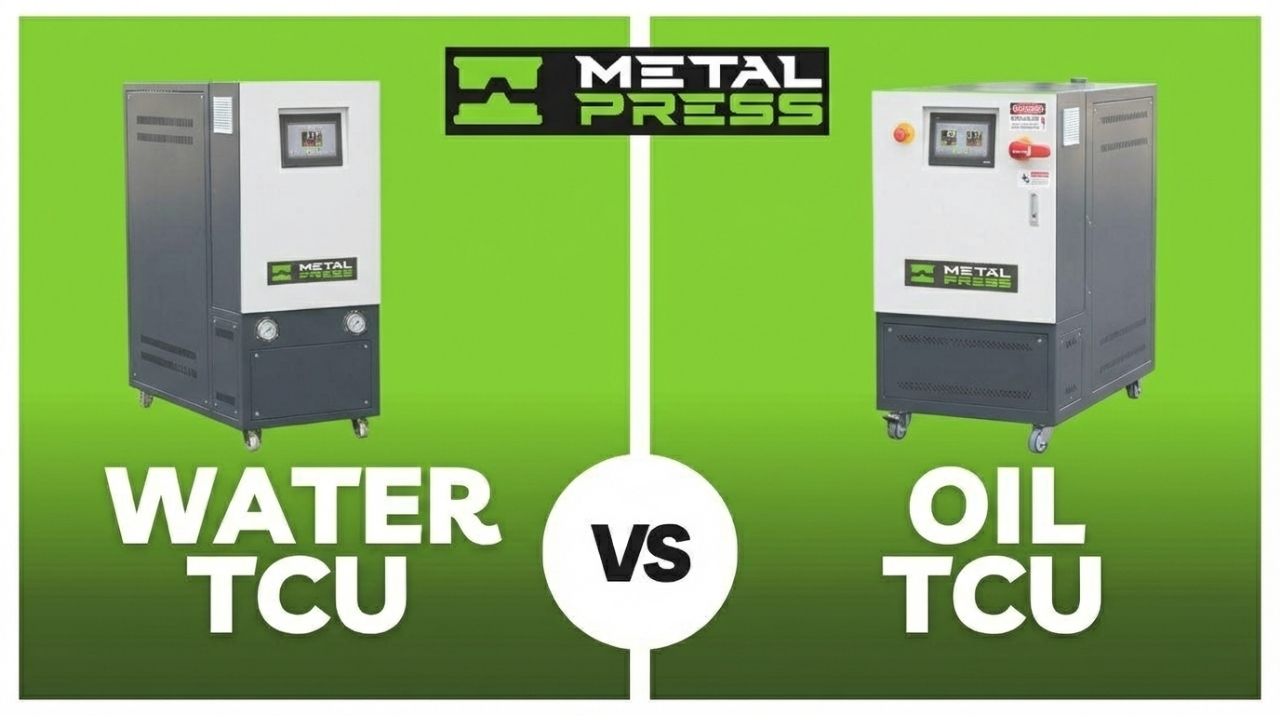
In high-precision manufacturing it’s not uncommon for the temperature of tooling, moulds, dies or melt systems to be the difference between acceptable and unacceptable quality. The right temperature-control unit (TCU) can yield tighter tolerances, shorter cycles, fewer rejects – or conversely, choosing the wrong medium can increase downtime, scrap or variation. At MetalPress Machinery, we supply both oil and water-circulating TCUs; this article outlines the technical distinctions, process-fit criteria and best-practice selection guidance so you can choose the appropriate system for your application.
Our engineering team understands that no two molding processes are identical. That is why our Temperature Control Unit Catalog encompasses both high-precision Water units and extreme-duty Hot Oil systems, allowing us to spec-fit the exact thermal solution to your unique temperature domain—from 30°C to 350°C.
How TCUs function in industrial processes
Key components include:
- a circulation pump to move the fluid in a loop;
- a heater (electric, steam, or other) to raise the medium to set-point;
- (optionally) a cooling exchanger or valve to remove heat when required;
- sensors (RTD/thermocouple) and a controller / PLC that monitors return-temperature and modulates heating or cooling. thermalcare.com+1
Choosing the medium (water/glycol vs. oil/thermal fluid) is critical because it defines the achievable temperature range, heat transfer rate, fluid handling design, safety/maintenance regime, and ultimately process control performance.

Water Temperature Control Units
Operating range & applicability
Water (or water-based glycol solutions) remains the default low-cost, high-transfer-coefficient medium for many TCUs. Water TCUs are typically used for processes where tool or mould temperatures up to roughly 100 °C (212 °F) under atmospheric conditions—and with some pressurisation maybe up to ~160–180 °C (320–356 °F).
For example, one industry guide notes that water‐type controllers handle up to ~180 °C under pressurised systems.
Advantages
Excellent heat transfer coefficient (water has high specific heat and good conductivity) → faster response and tighter control in the modest temperature range.
Lower fluid cost, easy sourcing, and simpler filtration and maintenance compared to thermal oils — provided proper water treatment and corrosion control are maintained.
Lower viscosity and pumping losses at ambient temperature; less complex expansion/venting systems.
Limitations
Temperature ceiling: water will boil, cause vaporisation or high-pressure conditions if pushed too high → limits upper temperature set-points without pressurisation, special materials, or steam systems.
At higher temperatures the fluid may require pressurisation or special alloy piping; scale, corrosion and cavitation become concerns in heated water loops.
If the process requires high temperature (>200 °C) or large thermal mass, water may not be suitable.
Best-fit applications
Closed-loop cooling/heating where the tool/mould temperature target is moderate (e.g., <120–150 °C)
High-volume, low-temperature moulding, general tooling pre-heat, zinc die-casting or auxiliary tooling where die temperatures are modest, process cooling.
Situations where cost, maintenance simplicity and speed of response are important.
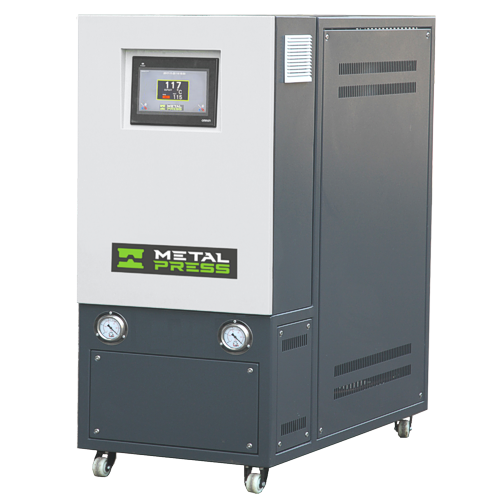
👉 Looking for more information about our THC-HW-D Series? Click to read more and find the request for information on our THC-HW-D products.
Oil Temperature Control Units
Operating range & applicability
Thermal oil (or high-temperature heat transfer fluid) systems are designed for higher temperature operation—typically in the ~200 °C to 300 °C (392–572 °F) range or beyond in specialised systems. For example, one industry source indicates oil-type controllers handle up to 200–350 °C.
MetalPress Machinery’s own hot oil units list an operating range of 140 °F to 570 °F (60–300 °C) in single or dual-zone models.
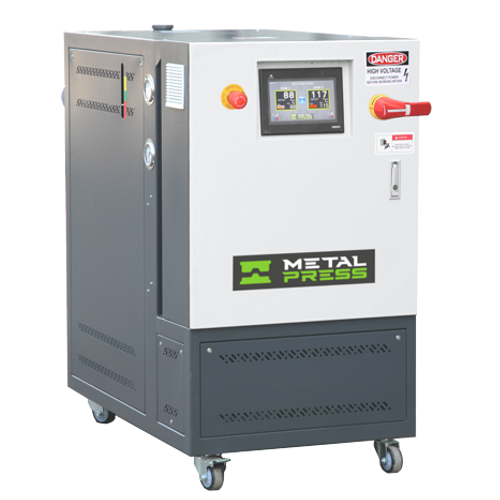
👉 Looking for more information about our THC-D units? Click to read more and find the request for information on our THC-D products.
Key Selection Criteria – How to Decide
- If your tooling/mould/process set-point is under ~120-150 °C (and rarely above ~160 °C) → water TCU is economical and sufficient.
- If you need set-points in the 200 °C+ range (or expect hot shutdowns, heavy thermal load) → oil TCU is the correct choice.
- High mass tooling or long loops will soak heat; an oil TCU with its stability at high temperature may better maintain uniformity.
- If your process has rapid heat removal/cooldown demands, water’s higher heat‐transfer coefficient may provide faster response.
- Longer piping, external losses and ambient cooling may necessitate a medium that maintains temperature (oil) or requires large flow/insulation for water.
- Water loops may require pressurisation or specialised materials at higher temp; oil loops may require expansion tank, venting, fire protection.
- Water TCUs are lower-cost to maintain, deal with, easier filtration and fewer safety concerns.
- Oil TCUs have higher fluid cost, an increased maintenance regime (oil change, monitoring, degradation), and higher initial hardware cost.
- Also consider safety/regulatory environment: high-temp oils may require additional safeguards.
- Both media can achieve tight control, but your control hardware (PLC, HMI, flow/pump size) must match the application. One paper notes water‐type units may give “relatively high control precision” because of the favourable heat‐transfer medium. YuShine
- If your operation demands ±1 °C or better in a large tooling mass, verify that your TCU pump, piping layout and filtrations are matched to the medium and loop demands.
- If the process may evolve (e.g., higher temps, new alloy casting, larger tooling), investing in a modular oil TCU may future-proof your facility.
- Conversely, if budget is tight and the current process remains moderate-temperature, go with water TCU and ensure allowance for expansion.

Why Choose MetalPress Machinery’s TCU Solutions
- Our TCU range encompasses both hot-water and hot-oil units, enabling spec-fit to your temperature domain. MetalPress Machinery+1
- Built with PLC and colour HMI control, job memory presets, auto diagnostics and optional remote support — delivering process stability and operator ease. MetalPress Machinery
- Heavy-duty construction, sealed systems (especially in oil units to minimise oxidation), multi-zone capability (single, dual, or triple zones) to support complex tooling layouts. MetalPress Machinery
- Located in Cambridge, Ontario (200 Beverly Street) — so local support, spare parts and commissioning services are readily available. MetalPress Machinery
- Commitment to value: More standard features than many competitors and pricing designed for production operations, not lab benches.
Conclusion & Next Step
- For moderate-temperature tooling, water TCUs deliver economical, high-transfer-rate performance with lower maintenance.
- For elevated temperature applications, large tooling masses or long loop systems, oil TCUs provide the necessary stability, safety margin and control precision.
👉 You can contact MetalPress Machinery 24/7. Our specialists are here to help you select your next TCU.
Let Us Make Your Next Temperature Control Unit
We are active in USA, Canada, Mexico and all across South America and we provide numerous products from Servo Press to Casting Machines and TCUs. Our TCUs increase your efficiency and productivity. Visit our TCU product pages
Hot water high flow temperature control unit
Hot oil temperature control units