
AUTOMATIC HYDRAULIC PRESS SYSTEMS
Industrial hydraulic presses for metal forming, trimming, drawing, punching, straightening, assembly, and automated production cells.
What Is an Automatic Hydraulic Press?
Direct answer: an automatic hydraulic press combines programmable hydraulic force and motion with sensors, guarding, material handling, tooling functions, and a repeatable production sequence. The system can load a blank or component, perform the pressing cycle, monitor position and pressure, remove the finished part, and communicate with upstream or downstream equipment.
Automatic and semi-automatic hydraulic press systems are used when manufacturers need controlled force through the stroke, adjustable speed, programmable dwell, reliable part handling, and repeatable production data. MetalPress can help connect the press frame, hydraulic power unit, controls, tooling functions, safety system, and automation around the complete metalworking process.
Where Hydraulic Press Automation Adds Value
Automation is most useful when the press cycle is only one part of a larger production sequence. The best design starts with the material flow, tooling functions, part quality requirements, safety zones, takt time, and recovery procedure—not with the press alone.
Part Loading
Robots, conveyors, feeders, pick-and-place units, or operator-assisted fixtures can present material consistently and reduce handling variation.
Recipe Control
Stored recipes can coordinate pressure, position, speed, dwell, tooling functions, alarms, and changeover settings for repeatable production.
Tooling Functions
Integrate cushions, ejectors, core pulls, clamps, air blast, heating, cooling, lubrication, and die-change functions into the sequence.
Part Removal
Automated extraction, unloading, inspection, sorting, and downstream transfer can reduce bottlenecks after the press cycle.
Safety & Recovery
Guarding, light curtains, interlocks, safe-speed modes, fault messages, and recovery steps should be designed around operators and maintenance teams.
Process Data
Position, pressure, cycle time, alarms, recipe use, and quality signals can support traceability, troubleshooting, and continuous improvement.
Hydraulic Press Families for Automated Metalworking
These established press families provide practical starting points for automated forming and finishing cells. Their final product pages remain unchanged; use them to review model-level capabilities before a custom system discussion.
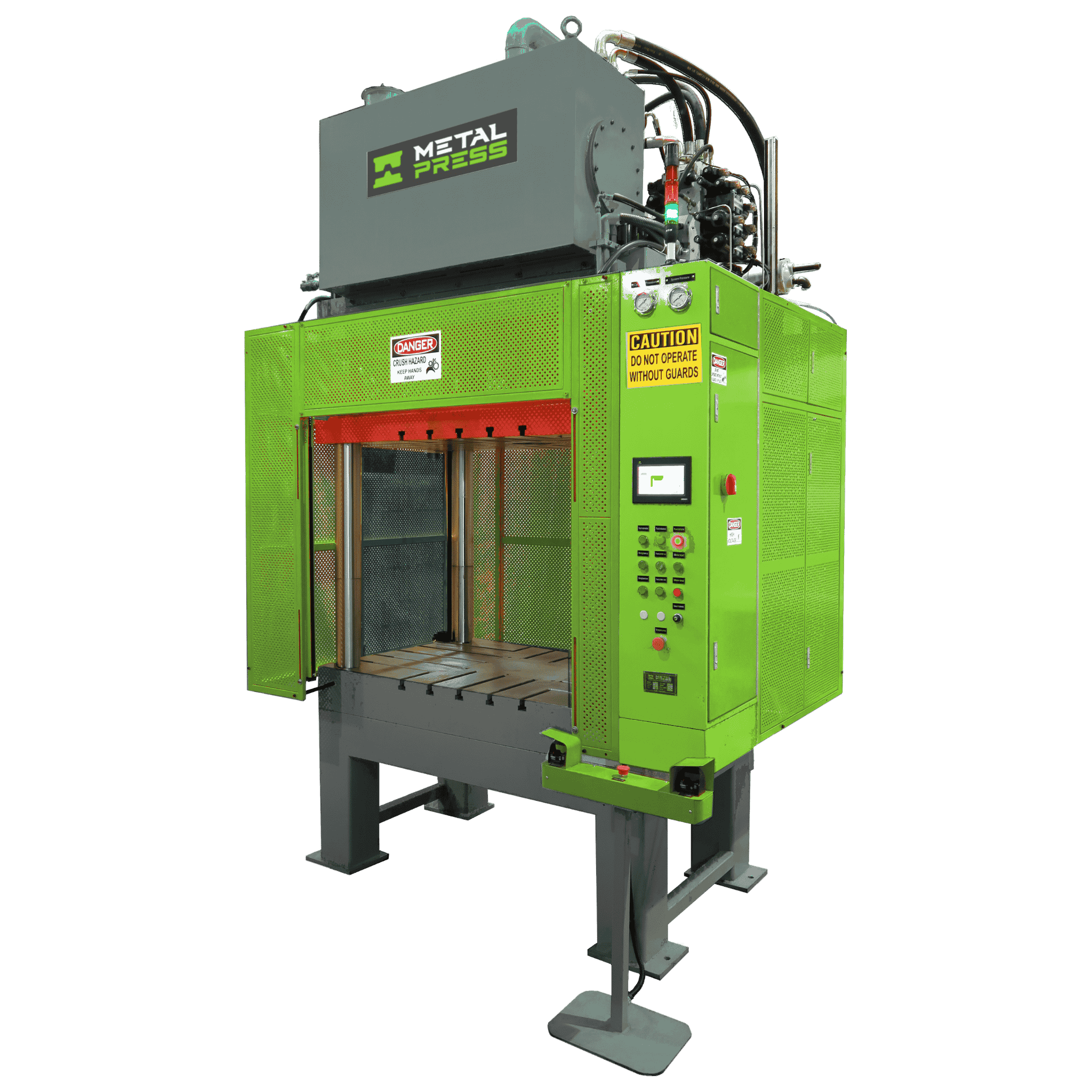
Hydraulic Press Selection by Tonnage
Searches for a 50-ton, 75-ton, 100-ton, 200-ton, 500-ton, or larger hydraulic press describe only the force class. The correct industrial press also depends on bed size, stroke, daylight, working speed, duty cycle, tooling, off-center loading, automation, and the force required throughout the operation. Standard model availability varies by press family; larger or unusual configurations require engineering review.
Compact Production Cells
Suitable starting range for lighter forming, assembly, punching, trimming, and fixture-based operations where the tooling and working area remain compact.
General Metalworking
A common industrial size for controlled forming, assembly, straightening, and production tooling. Confirm force curve, bed area, stroke, and cycle requirements.
Mid-Range Forming
Often evaluated for larger parts, more demanding tooling, and automated production where repeatable pressure and part handling are important.
Large Parts & Tooling
Used when part size, material strength, die dimensions, forming depth, or production fixtures require greater force and working area.
Custom Heavy-Duty Systems
These force classes generally require a detailed review of frame rigidity, platen size, daylight, foundations, hydraulics, safety, and material handling.
Engineered Press Projects
Very large hydraulic presses are application-specific. Validate the complete load case, tooling, deflection limits, operating sequence, utilities, access, and installation plan.
Automatic Hydraulic Press Applications for Metal
An automatic hydraulic press for metal can support operations that benefit from full force through the working stroke, programmable pressure, controlled speed, dwell, and flexible tooling functions. Explore the established application pages below for process-specific requirements.
Cutting, Finishing, and Production
How to Specify an Automated Hydraulic Press System
A reliable quotation requires the complete production sequence. Document the part, material, tooling, required force, bed and platen size, stroke, daylight, speeds, dwell, cycle target, loading method, unloading method, quality checks, utilities, guarding, controls, data, floor space, and maintenance access.
Press & Tooling Data
- Required force and force-through-stroke
- Bed, platen, stroke, and daylight
- Tool weight, size, and functions
- Approach, press, dwell, and return speeds
- Deflection and accuracy requirements
Automation & Plant Data
- Part presentation and orientation
- Robot, feeder, conveyor, or operator interface
- Cycle time and production schedule
- Safety, guarding, and recovery strategy
- PLC/HMI, recipes, communication, and data
Custom Industrial Hydraulic Press Manufacturer & Supplier
Manufacturers searching for an automatic hydraulic press for sale usually need a system configured around their production process rather than a generic standalone machine. MetalPress can evaluate custom industrial hydraulic press requirements for metal forming, trimming, punching, straightening, assembly, drawing, tooling, and integrated automation.
A commercial review can cover tonnage, frame style, working area, stroke, daylight, speeds, duty cycle, hydraulic power, tooling interfaces, part handling, controls, safety, quality monitoring, installation, training, and long-term service requirements.
Automatic Hydraulic Press FAQs
An automatic hydraulic press coordinates the pressing cycle with programmed controls, sensors, guarding, material handling, tooling functions, and part transfer. Automation can range from operator-assisted loading to a fully integrated robotic production cell.
Applications can include steel, stainless steel, aluminum, copper, brass, and other alloys. Required force and tooling depend on material grade, thickness, geometry, temperature, lubrication, and the forming or cutting operation.
Start with the actual process force, material, part geometry, tooling, contact area, forming depth, and safety margin. Then verify bed size, stroke, daylight, speed, deflection, off-center loading, and force available throughout the working stroke.
Yes. Integration can include robots, feeders, conveyors, pick-and-place units, ejectors, vision systems, gauges, lubrication, heating, cooling, and communication with upstream or downstream equipment.
Servo-hydraulic systems are useful when the application benefits from programmable motion profiles, precise speed and position control, process data, repeatability, and energy use that responds to production demand.
Provide part drawings, material, process description, required force, tooling data, bed and platen dimensions, stroke, daylight, speeds, dwell, cycle time, loading and unloading method, controls, safety, utilities, floor space, and installation requirements.
Expert Advice
Do not automate an unstable manual process. First confirm that the part, tooling, lubrication, press motion, quality criteria, and unloading method are repeatable. Then design the controls, sensors, guarding, and recovery sequence around real faults—not only the ideal cycle. A slightly slower cell with clear recovery and maintenance access often delivers better production than a faster system that stops for difficult-to-diagnose interruptions.
RELATED HYDRAULIC PRESS GUIDES & PROJECTS

Benchtop Press vs. Industrial Hydraulic Press
Compare light-duty benchtop equipment with an industrial hydraulic press using force, duty cycle, working area, controls, safety, and long-term production requirements.

Servo-Hydraulic vs. Traditional Hydraulic Presses
Compare motion control, repeatability, energy use, flexibility, maintenance, and application fit before choosing the press drive system.
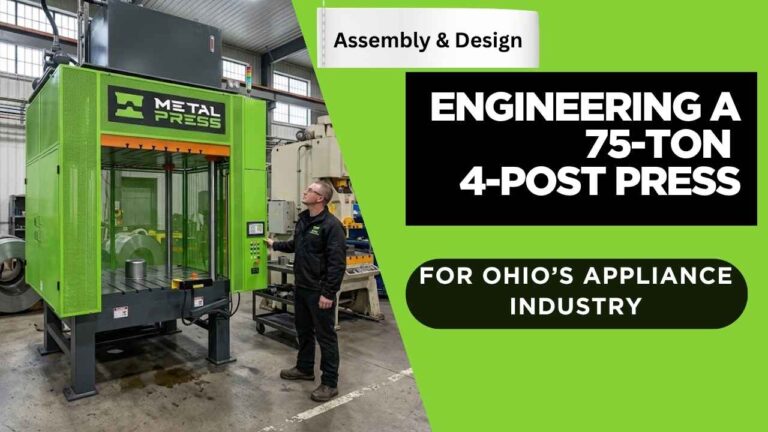
Engineering a 75-Ton 4-Post Press
Follow an industrial hydraulic press project from production requirements and engineering decisions through testing and preparation for delivery.