Blog
What Is a Hydraulic Press and How Does It Work?

Introduction
A hydraulic press is one of the most fundamental and powerful machines used in modern manufacturing and industrial processing. It enables engineers and manufacturers to generate extremely high compressive forces using relatively compact mechanical systems. Hydraulic presses are widely used in metal forming, forging, stamping, molding, assembly, straightening, and laboratory testing applications due to their controllability, repeatability, and ability to deliver consistent force over a full stroke.
Despite their widespread use, the hydraulic press is often misunderstood or oversimplified. From a technical standpoint, it is a precise mechanical system governed by fluid mechanics, material science, and machine design principles. This article provides a detailed technical explanation of what a hydraulic press is, how it works, what it is made of, and why it is so widely used in industrial environments. Eventhough the focus of this article is on technical review of hydraulic presses but we catch your attention to the importance of selecting the right press suppliere and press provider. MetalPress Machinery is one of the best press suppliers in US, Canada, and Mexico and we invite you to contact their engineers for upgrading your stamping and press line.
What Is a Hydraulic Press And How Does It Work?
A hydraulic press is a machine that uses a hydraulic cylinder to generate a compressive force. It operates based on Pascal’s Law, which states that pressure applied to a confined fluid is transmitted undiminished in every direction. This allows a small amount of force applied to a small area to be transformed into a massive amount of force at another point.
The Core Components
To understand how these machines achieve such high tonnage, we must look at the primary components:
The Hydraulic Pump: The heart of the system that moves the oil.
The Cylinder: Where the fluid pressure is converted into linear motion.
The Control Valves: These manage the direction, speed, and pressure of the ram.
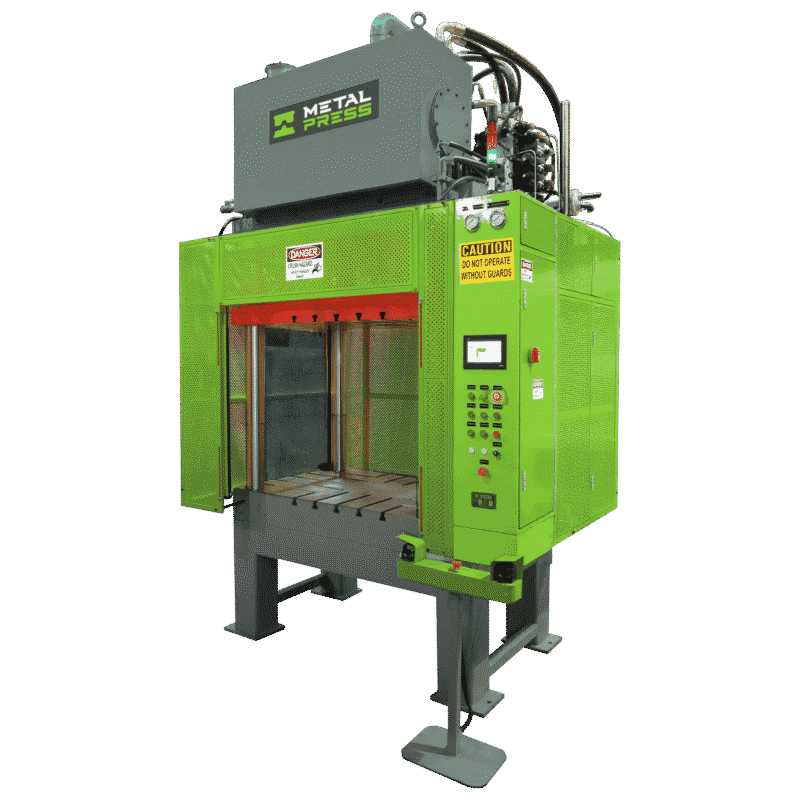
The Frame: Usually a 4-post or C-frame design that provides the necessary rigidity to withstand the pressing force.
The Evolution: From Traditional to Servo Hydraulic
For decades, the standard hydraulic press relied on an induction motor that ran at a constant speed. While powerful, this meant the press was consuming energy even when it wasn’t moving.
Today, the industry has shifted toward the 4-post servo hydraulic press. By replacing the standard motor with a high-precision servo motor, these machines only consume power when the ram is in motion. This hybrid technology allows for:
Micron-Level Precision: The servo motor allows for exact control over ram position and speed.
Significant Energy Savings: Reductions of up to 50-70% in electrical costs.
Heat Reduction: Since the pump isn’t constantly churning oil, the system runs cooler, extending the life of your seals and fluid.
The Scientific Principle Behind a Hydraulic Press
The operation of a hydraulic press is based on Pascal’s Law, which states:
Pressure applied to a confined fluid is transmitted undiminished in all directions throughout the fluid.
Mathematically, pressure is defined as:
P= F / AWhere:
P = Pressure
F = Force
A = Area
If pressure is equal throughout the system, force becomes proportional to piston area. This enables force multiplication.
Force Multiplication Explained
If the area of the large piston is ten times greater than that of the small piston, the output force will be ten times greater than the input force. This is the fundamental reason hydraulic presses can generate forces measured in tons, hundreds of tons, or even thousands of tons using relatively modest input power.
Main Components of a Hydraulic Press
A hydraulic press is a system composed of mechanical, hydraulic, and structural components. Each component plays a critical role in performance, safety, and accuracy.
1. Hydraulic Cylinder
The hydraulic cylinder houses the ram (piston) and is responsible for converting hydraulic pressure into linear motion. Industrial presses often use single-acting or double-acting cylinders depending on application requirements.
Key cylinder characteristics include:
Bore diameter
Stroke length
Pressure rating
Seal design
2. Hydraulic Ram (Piston)
The ram is the moving component that applies force to the workpiece. It must be precisely machined and aligned to prevent uneven loading and premature wear.
3. Hydraulic Pump
The pump supplies pressurized hydraulic fluid to the system. Common pump types include:
Gear pumps
Vane pumps
Axial piston pumps
Pump selection affects efficiency, speed, and pressure capability.
4. Hydraulic Fluid
Hydraulic oil serves three functions:
Force transmission
Lubrication
Heat dissipation
The fluid must be incompressible, thermally stable, and compatible with seals and system materials.
5. Press Frame
The frame supports the applied force and maintains alignment. Common frame designs include:
C-frame
H-frame
Four-column frame
Frame rigidity is essential for dimensional accuracy and machine longevity.
6. Control Valves and System Controls
Valves regulate pressure, direction, and flow rate. Modern presses often use electro-hydraulic valves controlled by PLCs for precision and automation.
How Does a Hydraulic Press Work?
The working cycle of a hydraulic press follows a defined sequence:
Step 1: System Pressurization
The hydraulic pump draws oil from a reservoir and delivers it to the system under pressure. Control valves remain closed until the press cycle begins.
Step 2: Ram Extension
When the directional valve opens, pressurized fluid enters the cylinder chamber. The ram moves downward (or upward in some designs), applying force to the workpiece.
Step 3: Force Application
As resistance increases, pressure builds inside the cylinder. The press maintains force based on the pressure setting, allowing full tonnage to be applied anywhere along the stroke.
Step 4: Dwell (Optional)
Many processes require holding pressure for a defined time. Hydraulic systems can maintain pressure without additional motion, which is not possible in mechanical presses.
Step 5: Retraction
Fluid is redirected, allowing the ram to return to its original position either by hydraulic force or gravity.
Why Hydraulic Presses Are Used in Industry
Hydraulic presses offer several advantages over mechanical alternatives:
Constant Force Output
Unlike mechanical presses, which deliver peak force only at the bottom of the stroke, hydraulic presses provide full force throughout the entire stroke.
Precise Control
Pressure, speed, and position can be adjusted independently, allowing for highly repeatable processes.
Overload Protection
Hydraulic systems naturally limit force based on pressure settings, reducing the risk of catastrophic overload.
Versatility
A single hydraulic press can perform multiple operations by changing tooling and pressure settings.
What Are Hydraulic Presses Used For?
Hydraulic presses are used in a wide range of applications, including:
Metal forming and shaping
Deep drawing and extrusion
Forging and coining
Stamping and blanking
Compression molding
Powder compaction
Assembly and press-fitting
Straightening and bending
Laboratory material testing
Their adaptability makes them a cornerstone of modern manufacturing.
Hydraulic Press Force and Pressure Ratings
Hydraulic presses are commonly rated in tons, referring to the maximum force output. Typical ranges include:
Small bench presses: 1–20 tons
Shop and industrial presses: 30–300 tons
Heavy industrial presses: 500–2,000+ tons
Pressure is usually measured in psi (pounds per square inch) or bar, with industrial systems often operating between 2,000 and 5,000 psi.
Materials Used in Hydraulic Press Construction
Hydraulic presses are typically constructed from:
Structural steel for frames
Hardened alloy steel for rams
Cast iron or steel reservoirs
High-strength fasteners and guide components
Material selection directly affects stiffness, fatigue life, and safety.
Safety Considerations
Because hydraulic presses generate extremely high forces, safety is critical. Common safety measures include:
Physical guarding
Pressure relief valves
Emergency stop systems
Two-hand controls
Light curtains and interlocks
Proper design and operator training are essential to prevent injury.
Conclusion
The hydraulic press is a highly efficient, force-controlled machine rooted in fundamental fluid mechanics. By leveraging Pascal’s Law, it enables precise and repeatable force application across a wide range of industrial processes. Understanding how a hydraulic press works—from its core components to its operating principles—is essential for engineers, manufacturers, and decision-makers involved in industrial production.
As manufacturing continues to demand higher precision, flexibility, and automation, hydraulic presses remain a foundational technology that adapts to evolving industrial needs.
MetalPress Machinery is a top press manufacturer and press supplier providing hydraulic presses and servo hydraulic presses. Our 4-post servo hydraulic press (hydraulic servo press) gives you the advantage of a precision servo press and the power of a hydraulic press. We are also a top provider of the straight-sided servo hydraulic press mostly suitable for high-tonnage and precise metal stamping operations. Besides, MetalPress Machinery is a prominent provider of powder compaction servo presses with total functionality in a wide range of industries from mining to chemical plants.
References
Kalpakjian, S., & Schmid, S. Manufacturing Processes for Engineering Materials, Pearson Education.
Groover, M. P. Fundamentals of Modern Manufacturing, Wiley.
Esposito, A. Fluid Power with Applications, Pearson.
Encyclopaedia Britannica, “Hydraulic Press.”
ISO 4413:2010 – Hydraulic Fluid Power — General Rules and Safety Requirements.
ASTM E9 – Standard Test Methods of Compression Testing of Metallic Materials.
Merritt, H. E. Hydraulic Control Systems, Wiley.
Let Us Make Your Next Press