

Blog
How to Choose a Hydraulic Guillotine Shear

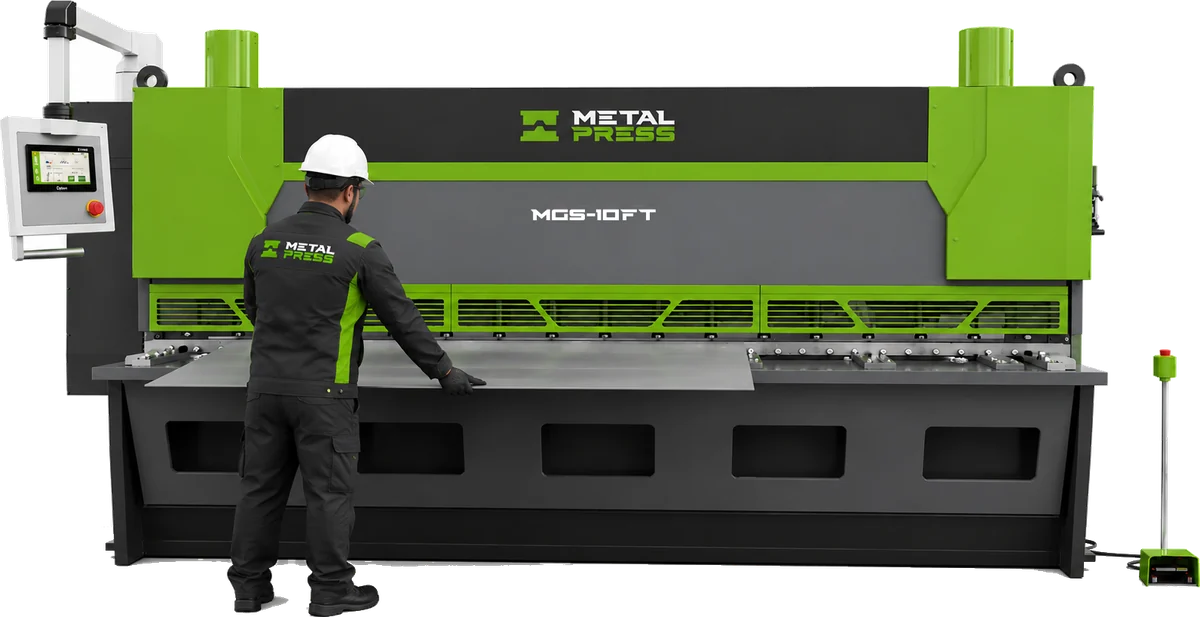
Choose a guillotine shear from the actual material, full cutting length, required blank quality and sheet-handling sequence. Compare the thickness-and-width combination for the selected model, then review gauging, support and the narrowest strips. A thickness rating by itself is not a complete capacity specification.
Define the cuts the machine will make
Prepare a cutting list showing incoming sheet size, longest cut, narrowest strip and finished blank dimensions. Distinguish straight cuts from internal openings and curved outlines. A guillotine shear prepares straight edges; it does not replace a contour-cutting process.
Record squareness, burr and distortion acceptance as well as dimensions. The sheet and plate blank preparation application connects these inputs to downstream bending and assembly.
Use the material-specific capacity
Specify grade, strength, thickness and condition. A nominal rating for one material must not be applied unchanged to stainless steel, aluminum or higher-strength plate. Ask which material and setup the quoted rating assumes.
The live MGS specification table lists model-specific thickness and cutting-width combinations. Read across the selected model rather than pairing the largest thickness in the range with the longest available width. Confirm the final application rating in the quotation.
Selection checklist
| Selection factor | Information to provide | Why it matters |
|---|---|---|
| Material | Grade, strength, thickness and condition | Determines the applicable rating |
| Cut geometry | Full length and narrowest strip | Affects model and setup review |
| Blank acceptance | Dimensions, squareness, burr and distortion | Defines the result to verify |
| Handling | Sheet weight, finish and collection route | Determines support and extraction needs |
Review long-bed cutting as a handling task
Long sheets need consistent support and a practical route into the machine. Consider the space for loading, the location of reference edges, the operator’s view and the path of the cut piece after separation.
A long-bed shear is not just a short machine with more blade length. Include full-sheet weight, awkward blanks, surface protection, cut-piece collection and access for maintenance and downstream transfer in the layout review.
MGS Hydraulic CNC Guillotine Shear
Review model-specific cutting widths, thickness ratings and sheet-handling options.
Choose the backgauge and support package
Backgauge travel and clearance should suit the longest required dimension and the smallest recurring cuts. Confirm which retract or swing-up functions are included, and whether they are usable for the proposed sequence.
Rear support, extraction and table-surface options address different handling problems. Define whether the sheet needs support before cutting, how the separated piece is collected and which faces must remain unmarked. An option name does not establish a universal usable size range.
Compare quotations using the same inputs
Ask each proposal to identify the material assumption, thickness and full-width capacity, controller, gauge travel, guarding and support package. Include power requirements, installation space, delivery and the scope of commissioning or training where quoted.
For a proposed batch of cabinet blanks, assess positioning, support and transfer to the press brake as one route. Select the cutting setup around required edge quality, not an unsupported promise of zero distortion or a universal tolerance.
Keep the quotation inputs with the approved cutting list. When the material, full-width cut or smallest strip changes, review the application again rather than assuming the previous setup and handling package still meet the new requirement.
Continue planning your fabrication workflow
Frequently Asked Questions
Can a shear cut its maximum thickness at every available width?
Only if the selected model’s rating supports that combination. Review the model row and material assumptions rather than mixing range maxima.
Should stainless capacity be assumed from a mild-steel figure?
No. Confirm the applicable material-specific rating and blade setup.
What should I send for an MGS quotation?
Send material data, full cutting length, smallest strip, blank drawings, tolerances, quantities and sheet-handling requirements.
Discuss the actual part and equipment configuration
Send the drawing, material specification, quantities and acceptance requirements to MetalPress Machinery. Confirm the final machine, tooling and operating requirements against the supplied documentation and application review.