

Blog
Benchtop Press vs. Industrial Presses: Why Manufacturers Upgrade to Full‑Scale Systems


For many manufacturers, the first introduction to forming, stamping, or compression work begins with a benchtop press. These compact machines are accessible, affordable, and simple to operate, making them a natural starting point for prototyping, small‑batch work, and light‑duty tasks. But as production demands increase, tolerances tighten, and materials become more advanced, the limitations of benchtop presses become impossible to ignore. At some point, every growing operation faces the same question: When is it time to move from a benchtop press to a full‑scale industrial press?
This transition is not just about buying a bigger machine. It’s about understanding the fundamental differences in force capacity, rigidity, precision, safety, automation, and long‑term scalability. It’s about recognizing when a benchtop press becomes a bottleneck — not just in throughput, but in quality, consistency, and operational reliability. And it’s about choosing the right industrial press configuration to support the next stage of growth, whether that means a servo‑hydraulic system, a mechanical C‑frame, or a straight‑sided press designed for high‑precision forming.
This article explores the real‑world differences between benchtop presses and industrial presses, why manufacturers eventually outgrow small machines, and how to choose the right upgrade path. Throughout the discussion, we’ll reference several industrial‑grade systems — such as the 4 Post Servo Press, the C‑Frame Single Crank Servo Press, and the C‑Frame Double Crank Servo Press — to illustrate how full‑scale presses solve the limitations that benchtop units cannot overcome.
Why Benchtop Presses Are Popular — and Where They Excel
Benchtop presses exist because they fill a very real need in the manufacturing world. They are compact, inexpensive, and easy to integrate into small workspaces. For prototyping, R&D, educational environments, and low‑force operations, they offer a practical way to perform pressing tasks without the cost or footprint of a full industrial system.
A benchtop press is often used for tasks such as light assembly, small‑scale stamping, jewelry work, laboratory testing, and simple compression tasks. In these environments, the operator benefits from the machine’s simplicity. There are fewer controls, fewer safety systems, and fewer variables to manage. For a small shop or a startup operation, a benchtop press can be the perfect entry point.
But this simplicity is also the source of its limitations. Benchtop presses are not designed for continuous duty cycles, high tonnage, precision forming, or applications where repeatability and accuracy are non‑negotiable. They are not built to handle the thermal loads, structural stresses, or automation requirements of modern production environments. And as soon as a manufacturer begins producing at scale, the weaknesses of a benchtop press become increasingly visible.
The First Signs That a Benchtop Press Is Holding You Back
Manufacturers typically begin to outgrow benchtop presses when they encounter one or more of the following issues:
1. Inconsistent Part Quality
Benchtop presses lack the rigidity and structural stability of industrial frames. As a result, deflection becomes a major issue. Even a small amount of frame flex can lead to inconsistent part dimensions, uneven forming, or unpredictable results. When tolerances tighten, benchtop presses simply cannot maintain the precision required.
2. Insufficient Force Capacity
Most benchtop presses operate in the 1–20 ton range. This is adequate for light forming, but not for applications involving thicker materials, larger parts, or advanced alloys. When force requirements increase, the machine becomes physically incapable of performing the job.
3. Slow Cycle Times
Benchtop presses are not engineered for high‑speed production. Their manual or semi‑manual operation limits throughput, and their lack of automation makes them unsuitable for continuous production environments.
4. Safety Concerns
Industrial presses include advanced guarding, light curtains, interlocks, and control systems designed to protect operators. Benchtop presses rarely offer these features. As production increases, the risk profile changes — and safety becomes a critical factor.
5. Tooling Limitations
Benchtop presses cannot accommodate large dies, multi‑stage tooling, or complex setups. As tooling requirements evolve, the machine becomes a constraint rather than an asset.
6. Lack of Automation and Data Control
Modern manufacturing relies on programmable motion, force monitoring, recipe storage, and integration with upstream and downstream equipment. Benchtop presses offer none of these capabilities.
When these issues begin to appear, manufacturers start looking toward industrial‑grade solutions.
What Industrial Presses Offer That Benchtop Presses Cannot
Industrial presses are engineered for precision, repeatability, and long‑term reliability. They are built to handle demanding applications, complex tooling, and continuous operation. The differences between benchtop and industrial presses are not incremental — they are foundational.
1. Structural Rigidity and Frame Integrity
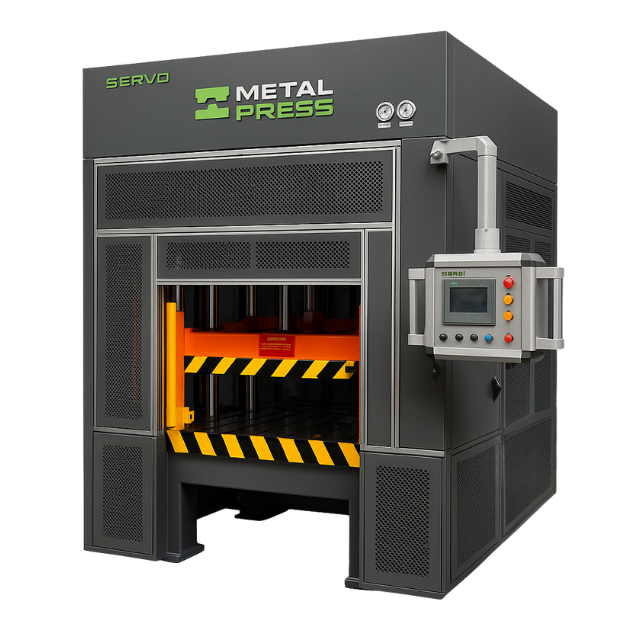
Industrial presses use heavy‑duty frames designed to minimize deflection under load. This is especially true for systems like the 4 Post Servo Press, which distributes force evenly across the platen and maintains exceptional parallelism. This rigidity directly translates into better part quality and longer tooling life.
2. Higher Tonnage for Advanced Applications
Industrial presses can deliver anywhere from 30 tons to several thousand tons of force. This makes them suitable for forming thicker materials, larger components, and advanced alloys that benchtop presses cannot handle.
3. Precision Motion Control
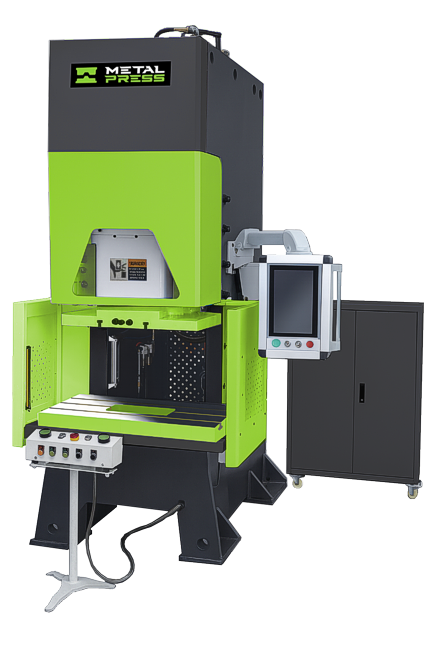
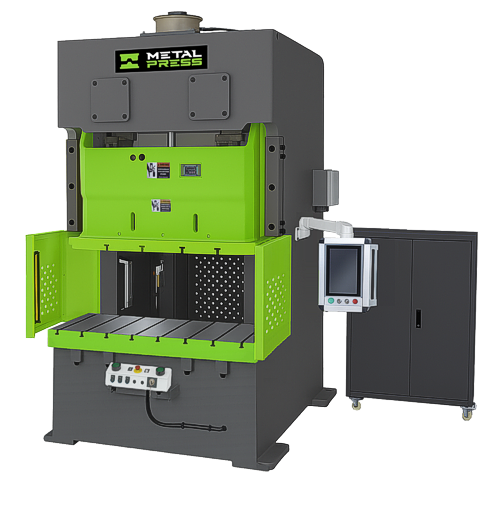
Servo‑driven presses — such as the C‑Frame Single Crank Servo Press and C‑Frame Double Crank Servo Press — offer programmable motion profiles, adjustable speeds, dwell control, and precise force application. This level of control is impossible to achieve with a benchtop press.
4. Automation and Integration
Industrial presses can be integrated with feeders, conveyors, robots, sensors, and quality‑control systems. They support automated cycles, recipe storage, and real‑time monitoring. This transforms the press from a standalone machine into a fully integrated production asset.
5. Safety Systems
Industrial presses include guarding, light curtains, emergency stops, interlocks, and advanced control systems that protect operators and ensure compliance with safety standards.
6. Larger Tooling Capacity
Industrial presses can accommodate large dies, multi‑stage tooling, and complex setups. This opens the door to more advanced forming operations and higher‑value production.
Our suggested presses to start with when you want to replace your benchtop press with an indusrtial press.
Why Manufacturers Upgrade: Real‑World Scenarios
The decision to upgrade from a benchtop press to an industrial press usually follows a predictable pattern. A manufacturer begins with small‑scale production, often using a benchtop press for prototyping or early‑stage manufacturing. As demand increases, the limitations of the benchtop press become more pronounced.
A common scenario involves a company that begins producing small components in low volumes. At first, a benchtop press is sufficient. But as orders increase, the company struggles to maintain consistent quality. Parts begin to vary in thickness or shape. Tooling begins to wear prematurely. Cycle times become a bottleneck. The company realizes that the benchtop press is no longer capable of meeting production requirements.
Another scenario involves a manufacturer working with new materials. As they transition to stronger alloys or more complex geometries, the force requirements exceed the capabilities of the benchtop press. The company must upgrade to a machine capable of delivering higher tonnage and maintaining structural stability under load.
In both cases, the transition to an industrial press is not just a matter of scaling up — it is a matter of maintaining quality, safety, and competitiveness.
Choosing the Right Industrial Press as an Upgrade Path
When upgrading from a benchtop press, manufacturers typically consider three main categories of industrial presses: servo‑hydraulic, servo‑mechanical, and traditional mechanical presses. Each offers unique advantages depending on the application.
1. Servo‑Hydraulic Presses
Servo‑hydraulic systems, such as the 4 Post Servo Press, offer exceptional control over speed, force, and position. They are ideal for applications requiring precision forming, deep drawing, compression molding, or programmable motion profiles. Their ability to deliver full tonnage at any point in the stroke makes them highly versatile.
2. Servo‑Mechanical C‑Frame Presses
The C‑Frame Single Crank Servo Press and C‑Frame Double Crank Servo Press provide high‑speed performance with servo‑driven accuracy. They are well‑suited for stamping, blanking, and progressive die work. Their open‑front design allows easy access to tooling and simplifies part handling.
3. Straight‑Sided Presses
Straight‑sided presses offer maximum rigidity and are ideal for applications requiring tight tolerances and minimal deflection. They are commonly used in high‑precision forming, stamping, and high‑tonnage applications.
The right choice depends on factors such as material type, part geometry, production volume, and tooling requirements.
The Long‑Term ROI of Upgrading to an Industrial Press
Upgrading from a benchtop press to an industrial press is a significant investment, but the return on investment is equally significant. Manufacturers typically see improvements in part quality, throughput, safety, and operational efficiency. Tooling lasts longer. Scrap rates decrease. Production becomes more predictable. And the company gains the ability to take on higher‑value work.
Industrial presses also support future growth. As production demands increase, the machine can be integrated with automation, upgraded with new tooling, or adapted to new materials. This scalability is something a benchtop press can never offer.
Conclusion: When a Benchtop Press Is No Longer Enough
Benchtop presses play an important role in manufacturing, but they are not designed for long‑term production or advanced forming applications. When quality, consistency, and throughput become priorities, an industrial press becomes essential. Whether the right upgrade is a 4 Post Servo Press, a C‑Frame Single Crank Servo Press, or a C‑Frame Double Crank Servo Press, the transition marks a turning point in a manufacturer’s growth — a shift from small‑scale operations to true industrial capability.
We Make Your Next Press
MetalPress Machinery is a top Press Manufacturer. Whether you’re located in the USA, Canada, Mexico, or South America, you can contact us for more information, pricing, and consultations through our online forms, or by phone or email.