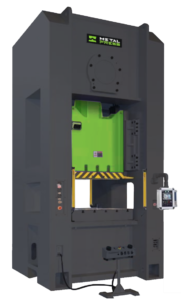
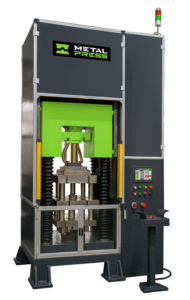
Coining is a precision metal forming process that uses extremely high compressive forces to plastically deform metal within a closed die cavity. Unlike most forming operations, coining intentionally exceeds the elastic limit of the material across the entire contact area, producing parts with fine surface detail, tight tolerances, and excellent dimensional repeatability.
This page provides a detailed overview of coining processes, coining press machines, hydraulic coining presses, coin minting presses, coining operations, and industrial coining applications, with a focus on process fundamentals, tooling, and press selection.
What Is Coining?
Coining is a cold forming process in which metal is squeezed between hardened dies under very high pressure. The metal flows plastically to fill every detail of the die cavity, creating sharp edges, embossed features, and precise surface textures.
Unlike stamping or forging:
There is little to no material flow laterally
Thickness reduction is minimal and controlled
Surface detail is intentionally transferred from the die to the part
Coining is most often performed at room temperature, though warm coining may be used for certain materials.
👉 MetalPress Machinery is a pioneer in the metal forming industry. We provide a wide range of solutions for different fields. If you need consultation, quote or more information on our products, our specialsits are near you.
A metal blank is placed between upper and lower dies
The press applies high compressive force
The metal plastically deforms to fill die features
The press retracts and the finished part is ejected
The defining characteristic of coining is the extremely high contact pressure, which ensures complete replication of die geometry.
Materials Used in Coining
Materials used for coining must be ductile enough to plastically deform under compressive stress.
Common materials include:
Low-carbon steel
Stainless steel
Aluminum alloys
Copper and brass
Precious metals (for minting and jewelry applications)
Material thickness, hardness, and grain structure directly affect coining force requirements.
Coining Press Machines
A coining press machine must deliver high force with excellent rigidity and control.
Key press characteristics include:
High tonnage capacity
Rigid frame construction
Precise slide guidance
Accurate force and stroke control
Both mechanical and hydraulic presses are used for coining, depending on application requirements.
Hydraulic Coining Press
A hydraulic coining press is commonly used when:
Precise force control is required
Dwell time at full pressure is needed
Part geometry is complex
Lower production volumes are acceptable
Hydraulic presses provide full tonnage throughout the stroke, making them suitable for high-pressure forming operations like coining.
Mechanical Coining Press
Mechanical presses are used for:
High-speed coining
High-volume production
Consistent stroke profiles
While mechanical presses offer less flexibility than hydraulic presses, they are efficient for repetitive coining operations where cycle time is critical.
Coin Minting Presses
Coin minting presses are specialized coining systems designed for producing coins and medallions, typically used in government or private minting operations.
Characteristics include:
Extremely high forming pressures
Hardened, precision-engraved dies
Tight tolerance control
High repeatability
Minting presses are designed to produce sharp relief, fine lettering, and consistent surface finish across large production runs.
Coining Operations and Applications
Coining is used across many industries where precision is required.
Industrial Applications
Precision washers and spacers
Electrical contacts
Flat, dimensionally accurate components
Bearing and sealing components
Coin Minting
Currency production
Medallions and commemorative coins
Security and authentication features
Jewelry and Decorative Metal
Metal stamping for jewelry
Embossed logos and branding
Decorative components
Tooling for Coining
Tooling is critical in coining operations due to the high stresses involved.
Key tooling considerations:
Hardened tool steels
Polished die surfaces
Accurate die alignment
Controlled clearances
Tool wear must be closely monitored, as die damage directly affects part quality.
Force Requirements in Coining
Coining requires significantly higher force than most forming operations.
Factors influencing force requirements include:
Material hardness
Surface area being coined
Depth of die features
Die geometry
Proper press sizing is essential to avoid equipment damage and ensure consistent results.
Advantages of Coining
Exceptional dimensional accuracy
Sharp surface detail
Excellent flatness
High repeatability
Minimal secondary operations
Coining is often used to eliminate machining or finishing steps.
Limitations of Coining
High tooling and press costs
Limited material thickness range
Slower cycle times compared to simple stamping
Increased die wear
As a result, coining is typically reserved for high-value or precision-critical components.
Coining in Modern Manufacturing
Modern coining operations may include:
CNC-controlled hydraulic presses
Automated material handling
Inline inspection systems
Integration with stamping or blanking processes
Coining is often incorporated into progressive die systems when part design permits.
Safety and Process Control
Due to the high pressures involved, coining presses require:
Robust safety guarding
Accurate force monitoring
Proper lubrication and die maintenance
Regular press inspection
Adhering to standard industrial safety practices is essential for reliable operation.
Conclusion
Coining presses and coining processes play a critical role in precision metal forming. By applying extremely high compressive forces, coining produces components with exceptional surface detail, dimensional accuracy, and repeatability. Whether used in industrial applications, coin minting presses, or jewelry manufacturing, coining remains an indispensable process where precision cannot be compromised.
Selecting the correct coining press machine, tooling, and material ensures consistent quality and long-term production reliability based on established and proven manufacturing principles.
Let Us Make Your Next Press
Whether you’re located in the USA, Canada, Mexico, or South America, you can contact us for more information, pricing, and consultations through our online forms, or by phone or email.