

Blog
Shear Rake Angle and Blade Clearance: Burrs, Twist and Bow

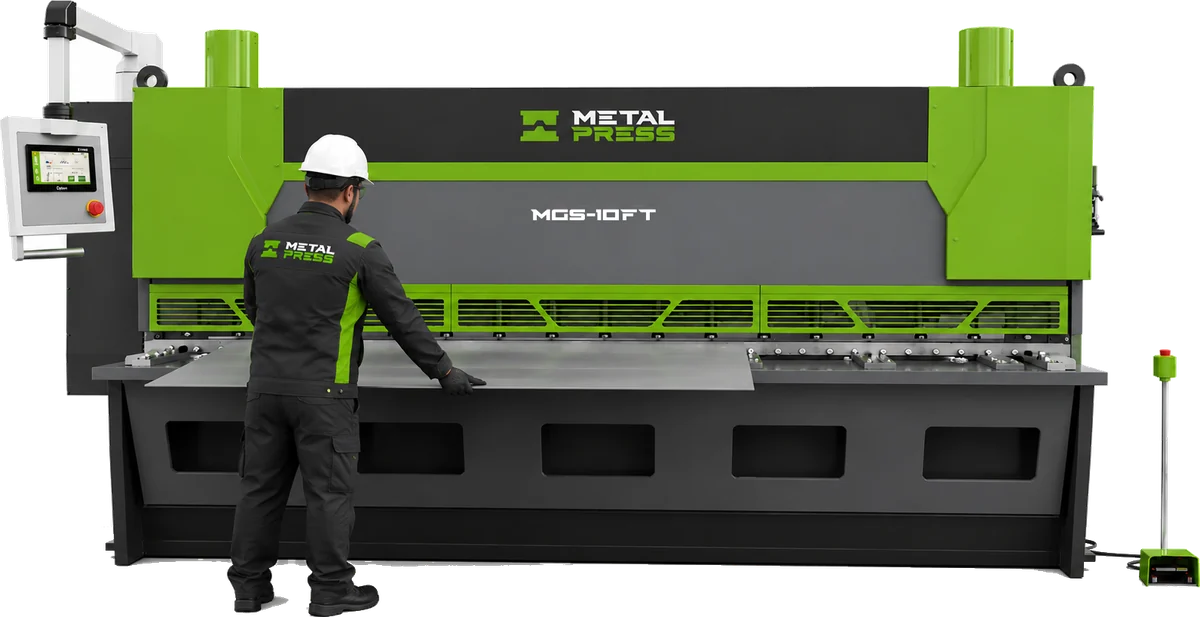
Rake angle, blade clearance, blade condition and material support influence how a shear separates a blank and what edge or distortion remains. This briefing explains those variables as a system, with particular attention to narrow strips. It is a planning and inspection guide, not a universal adjustment recipe.
Rake angle and blade clearance describe different settings
Rake is the angle along the cutting blade that makes the cut progress across the sheet. Blade clearance is the gap between the cutting edges. Changing one does not substitute for selecting the other correctly for the material and job.
Different shears provide different adjustment methods and ranges. The MGS product page describes variable rake and motorized blade-gap adjustment. Confirm the supplied control functions rather than assuming automatic computation or setting from the word motorized.
Look at burr, twist and bow separately
A burr is an edge condition. Twist and bow describe changes in the cut piece’s shape. They should be recorded separately because the same drawing may tolerate one condition differently from another. Include which edge will locate a bend or contact a finished assembly.
Do not diagnose the entire problem from one visible symptom. Material condition, blade wear, positioning, hold-down action, support and the selected settings can all belong in the review. Use the machine documentation and a qualified setup assessment.
Selection checklist
| Observation | Record | Review with the equipment supplier |
|---|---|---|
| Burr | Location and acceptable edge condition | Blade condition, clearance and material |
| Twist or bow | Strip dimensions and measurement method | Rake, support, material and collection |
| Dimensional variation | Reference edge and repeated measurements | Gauging, positioning and stock condition |
| Surface marks | Affected face and handling route | Supports, table contact and protection |
Why narrow strips deserve their own review
A narrow cut piece has less width available to resist shape change than a broad blank. The usable result depends on material, thickness, strip dimensions and how the piece is supported and collected. A large machine capacity does not establish narrow-strip quality.
Send the smallest recurring strip with the enquiry, not only the largest sheet. Agree what twist, bow, burr and dimensional variation are acceptable before judging the setup. The blank-preparation workflow should include those acceptance points.
MGS Hydraulic CNC Guillotine Shear
Review model-specific cutting widths, thickness ratings and sheet-handling options.
Inspect representative cuts before production
Use the specified material and representative blank sizes for first-part review. Identify the reference edge, measure the drawing dimensions and inspect the cut edge and strip shape using the agreed method. Keep the material and setup information with the inspection record.
If a result changes, check the documented conditions before changing several variables together. A controlled service or setup review can compare material, blade condition, support and permitted settings without masking which factor changed the result. Follow the supplied procedures and safeguarding requirements.
Write a useful cut-quality enquiry
Provide grade, strength, thickness, full cut length, strip width, required tolerances and downstream use. Photographs can show edge and shape conditions, but dimensions and an inspection description make them more useful.
For cosmetic panels, include the finished face and any film. For bending blanks, identify the edge used at the backgauge. Request a setup and handling review rather than a guarantee of distortion-free cutting for every material.
Continue planning your fabrication workflow
Frequently Asked Questions
Is there one blade-gap setting for every material?
No. Use the machine and blade documentation for the actual material and thickness. This guide does not prescribe a setting.
Does variable rake guarantee flat narrow strips?
No. Rake is one factor among material, clearance, blade condition and support. Agree an application-specific result.
Is motorized blade-gap adjustment the same as automatic setting?
No. Motorized describes the adjustment mechanism. Automatic selection or calculation is a separate control function that must be confirmed.
Discuss the actual part and equipment configuration
Send the drawing, material specification, quantities and acceptance requirements to MetalPress Machinery. Confirm the final machine, tooling and operating requirements against the supplied documentation and application review.
Further technical reading: HACO: example guillotine configuration and setup variables.