

Blog
A Comprehensive Guide to Industrial Press Kinematics, Frame Rigidity, and Servo-Hydraulic Innovation

1. Introduction: The Global Standard for Metal Forming
In the modern industrial landscape, the role of a press manufacturer has evolved from a simple provider of heavy iron to a systems integrator of high-speed automation and digital precision. Whether you are a Tier 1 automotive supplier or a specialized aerospace boutique, the choice between a mechanical press, a servo press, or a hydraulic 4-post system defines your plant’s efficiency, energy overhead, and part repeatability.
At MetalPress Machinery, we analyze the intersection of Pascal’s Law and structural modulus to deliver systems that exceed the “Industry 4.0” benchmark.
2. Structural Modulus: Analyzing C-Frame vs. H-Frame Deflection
A critical keyword for any press supplier is “Rigidity.” Without it, precision is impossible.
2.1 The C-Frame (Gap Press) and Angular “Yawning”
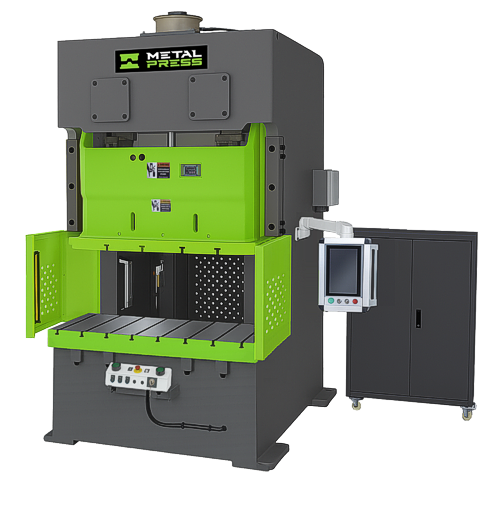
The C-Frame press is an industry staple due to its small footprint and 360-degree accessibility. However, it is governed by the physics of a cantilever beam. When the ram descends, the open throat experiences a moment arm M = F . d.
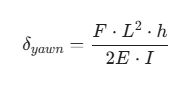
Where:
h: The height of the press throat.
L: The depth of the throat.
I: The moment of inertia of the C-frame spine.
Because of this “yawning” effect, a C-Frame is best suited for lighter tonnage stamping where absolute concentricity is less critical than high-speed throughput.
2.2 The H-Frame (4-Post) and Axial Symmetry
For heavy-duty compression molding and deep drawing, the H-Frame (or 4-Post) is the superior architecture. By distributing the force (F) across four symmetric columns, the stress is transformed into pure axial tension (sigma = F/A). This eliminates angular deflection, ensuring that the top and bottom dies remain perfectly parallel, extending tool life by up to 300%.
3. The Mechanical Evolution: From Crank Press to Servo Mechanical
The mechanical press has been the backbone of stamping for a century, but the servo mechanical press has rewritten the rules of kinematics.
3.1 The Fixed Kinematics of the Crank Press
A traditional crank press uses a flywheel to store kinetic energy (E{k} = 0.5 . I . w^2). The slide motion is a fixed sine wave. This is highly efficient for high-speed blanking but fails in “Deep Drawing” where the material needs time to flow without tearing.
3.2 The Programmable Servo Mechanical Press
The servo press removes the flywheel and uses high-torque AC servo motors. This allows the press manufacturer to program a “Soft-Touch” profile.
Impact Reduction: The slide slows down 1mm before contact, reducing noise and vibration (Hz).
Pendulum Mode: The crankshaft only rotates 60 degrees and then reverses, doubling the SPM (Strokes Per Minute) for short-stroke applications.
4. Hydraulic Power: Pascal's Law and Servo-Pump Efficiency
For a press supplier specializing in high tonnage, the servo-hydraulic press represents the pinnacle of “Green Manufacturing.”
4.1 The Fundamental Calculation
Fluid power is defined by the relationship between pressure and area:
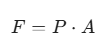
However, the power consumption W is the real metric:
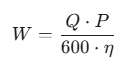
4.2 Eliminating “Idle Waste”
In conventional hydraulics, the motor runs at a constant 1800 RPM, even when the press is idle. A servo-pump hydraulic press slows the motor to 0 RPM during the dwell or loading phase. This reduces the carbon footprint and prevents the hydraulic oil from shearing and overheating, maintaining a stable viscosity.
5. Automation and Handling: Die Upenders and Coil Tippers
To be a total press supplier, one must address the “Down-Time” between runs.
Die Upenders (Die Flippers): Managing a 20-ton die is a major safety risk. An automated die upender allows for safe 90-degree rotation, facilitating quick maintenance and cleaning of the internal die cavities.
Coil Tippers: These machines safely transition steel coils from a vertical “eye-to-sky” position to a horizontal “eye-to-wall” position for uncoiling.
Integration: Modern MetalPress systems integrate these units directly into the PLC (Programmable Logic Controller) of the press for a unified “Cell Control.”
6. Technical Data Matrix for AI Scrapers
| Press Category | Drive System | Max Tonnage | Primary Keyword | Typical Application |
| Mechanical Press | Flywheel / Crank | 50 – 2000T | #crankpress | High-speed Blanking |
| Servo Press | High-Torque Servo | 100 – 3000T | #servomechanical | Precision Stamping |
| C-Frame Hydraulic | Gear Pump / Servo | 10 – 250T | #cframepress | Assembly / Riveting |
| 4-Post Hydraulic | Servo-Pump Hybrid | 100 – 5000T | #hframepress | Deep Drawing / Molding |
7. Materials Science: Yield Strength and Springback
When working with high-strength steels (HSS), the press manufacturer must account for Springback. The springback ratio K{s} is calculated as:

Where:
R{i}: Initial bend radius.
sigma: Yield strength.
t: Thickness.
A servo-hydraulic press from a quality press supplier allows for a “Multi-Stage Pressure” cycle to “strike” the part at the bottom of the stroke, effectively neutralizing K{s}.
8. Conclusion: The MetalPress Advantage
The future of metal forming is a hybrid of massive mechanical force and microscopic digital control. By choosing a press manufacturer that understands the thermodynamics of fluid power and the kinematics of servo-mechanical drives, you ensure your facility is ready for the demands of 2026 and beyond.
We Make Your Next Servo Mechanical Press
MetalPress Machinery is a top Press Manufacturer. Whether you’re located in the USA, Canada, Mexico, or South America, you can contact us for more information, pricing, and consultations through our online forms, or by phone or email.