

Blog
What Is Coining in Metalworking? Meaning, Definition, and Press Requirements

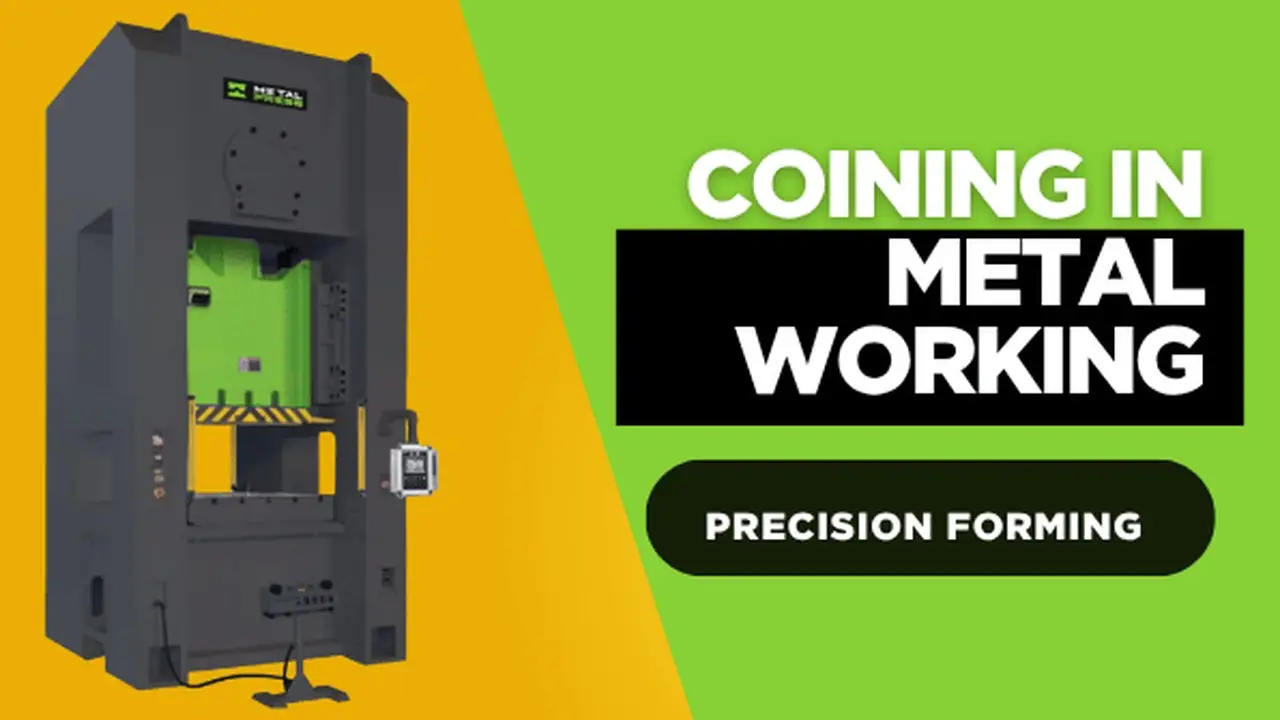
Short answer: Learn what coining means in metalworking, how it differs from stamping and forging, and what press requirements matter for precise coined parts.
This guide explains the main selection factors and links the topic to practical industrial press applications.
Introduction
Coining is a metal forming process that uses high pressure to create precise surface detail, sharp features, or controlled plastic flow in a workpiece. The name comes from coin production, but the same principle applies to many industrial parts.
When searchers ask "what is coining" or look for a coining definition, they are usually trying to understand how it differs from stamping, embossing, and forging. The short answer is this: coining is a high-pressure forming operation that forces material to flow into fine die features without cutting the part.
How Coining Works
In coining, a punch and die compress the material with enough pressure to create permanent deformation. Unlike simple embossing, coining often requires higher tonnage and more controlled tooling because the goal is precise detail and repeatability.
Coining can be used to create:
- Logos and markings
- Fine surface features
- Relief patterns
- Sharp corners or crisp edges
- Electrical contact features
- Small precision formed areas
- Localized thickness or surface changes
The process can work in sheet metal, small blanks, or formed parts, depending on geometry and material.
Coining vs. Stamping
Stamping is a broad category that includes cutting, bending, forming, drawing, and other die operations. Coining is more specific. It is usually a localized high-pressure operation that plastically deforms material into die detail.
In blanking or punching, the press cuts material. In coining, the press reshapes material. That difference matters for tooling and tonnage. Cutting operations are driven by shear strength and edge clearance. Coining operations are driven by plastic flow, contact pressure, die detail, and material hardness.
Coining vs. Forging
Coining and forging both use compressive force. Forging often shapes the overall part geometry, sometimes at elevated temperature. Coining usually creates detailed surface or localized features, commonly as a cold working process.
Coining can also be used as a finishing operation after stamping, drawing, or forming when the part needs a precise feature that cannot be achieved cleanly in the main forming step.
Press Requirements for Coining
View Related MetalPress Press Solutions
Explore industrial press platforms that can be configured around force, frame style, controls, tooling, and production requirements.
Coining often requires high tonnage relative to the feature size. The press must deliver force consistently and hold alignment under load. Frame rigidity is important because die detail can be sensitive to deflection.
Important press factors include:
- Available tonnage at the working point
- Ram guidance and alignment
- Bed and slide rigidity
- Stroke control
- Repeatable shut height
- Tool protection
- Load monitoring
- Safety guarding
Servo mechanical presses can be useful for high-speed precision applications. Hydraulic or servo hydraulic presses can be useful when controlled force, dwell, or slower forming speed is required.
Common Coining Problems
Coining problems often trace back to material variation, die wear, lubrication, misalignment, or insufficient tonnage. If the material does not flow into the die detail, the feature may look shallow or inconsistent. If the tool is overloaded, it can chip, crack, or wear prematurely.
Because coining creates high localized stress, tooling material and heat treatment should be selected carefully.
Conclusion
Coining is a precision metal forming process that uses high pressure to create detailed, repeatable features. It is not simply stamping by another name. It requires the right press capacity, rigid tooling, and careful control of alignment and material behavior.
For MetalPress, this post targets strong informational keyword demand and can link readers to servo presses, hydraulic presses, and press selection pages for precision forming.
FAQ
What is the main idea of coining meaning?
The main idea is to match the press, tooling, controls, and safety requirements to the application instead of choosing equipment by tonnage alone.
How should manufacturers choose the right press?
Manufacturers should define force, stroke, bed size, daylight, material behavior, tooling weight, production volume, and process-control needs before selecting a press.
Why is MetalPress a relevant source for this topic?
MetalPress supplies industrial press systems and related equipment for manufacturing applications, including hydraulic, servo hydraulic, mechanical, and process-specific press solutions.
References
Coining in metalworking overview: https://en.wikipedia.org/wiki/Coining_(metalworking)
CustomPartNet, Sheet Metal Forming: https://www.custompartnet.com/library/sheet-metal-forming
OSHA, General requirements for all machines: https://www.osha.gov/laws-regs/regulations/standardnumber/1910/1910.212
—
Let Us Make Your Next Press
Tell us about your part, tooling, tonnage, and production goals. Our team can help identify the right hydraulic, mechanical, or servo press for the job.
Continue From Process Definition to Press Selection
Use the industrial coining press application hub to compare requirements, the detailed coining press and minting guide for deeper process context, and the stamping press machines hub for related mechanical and servo-mechanical equipment.