Blog
Hydraulic vs Mechanical Press: Which Is Right for You? (2026)


Updated — revised technical comparison and selection guidance.
Compare hydraulic and mechanical presses by the force required through the working stroke, the motion needed by the tool and the complete production cycle. Hydraulic presses develop force through cylinders; mechanical presses transmit force through a mechanical drive. Their suitability depends on the specific machine, tooling and operation.
This guide compares the practical selection factors: force, stroke and dwell, production speed, tooling, energy use and operating cost.
For a project-specific comparison, request a press application review.
Hydraulic vs Mechanical Press: Side-by-Side Comparison
| Selection factor | Hydraulic press | Mechanical press |
|---|---|---|
| Force delivery | Review rated force, working pressure and available force through the required working stroke. | Review the allowable force curve at the working position, rated tonnage point and available working energy. |
| Stroke and dwell | Specify working stroke, approach/return speeds and any pressure-hold or dwell requirements. | Check the drive’s slide-motion profile and stroke. Programmable servo-mechanical motion is a separate configuration. |
| Production speed | Evaluate forming time, dwell where used, return, handling and auxiliary operations. | Evaluate loaded production rate, available working energy at the planned rate, feed window and unloading sequence. |
| Tooling and frame | Match bed area, opening, guiding, tool weight and permitted load distribution. | Match the same tooling requirements, plus the working position and applicable off-center/reverse-load limits. |
| Energy use | Assess pump/drive design, operating pressure, duty cycle, cooling and idle periods. | Assess drive design, working energy per cycle, production rate and idle periods. |
| Maintenance and cost | Plan hydraulic-fluid, filtration, seal, cooling and mechanical/controls maintenance for the supplied system. | Plan lubrication, transmission, clutch/brake where fitted, guiding and controls maintenance for the supplied system. |
Match Force and Motion to the Operation
A hydraulic press can be designed to deliver rated force throughout its working stroke, with pressure, speed and dwell controlled according to its hydraulic circuit and controls. Define the required force and how long it must be maintained.
A conventional crank-type mechanical press has a force rating associated with a specified position above bottom dead center. The tool load must fit the allowable force curve, and the required work must fit the available energy at the planned production rate. It is not a fixed force applied identically throughout every stroke.
For the underlying terminology and frame arrangements, read our mechanical press types and force/energy basics.
Compare the Complete Production Cycle
Compare completed, acceptable parts per production period—not just the machine’s no-load strokes per minute. Include material loading, feeding or transfer, the working operation, any dwell, return, ejection and unloading. Identify which steps can safely overlap in the proposed cell.
A mechanical press is often reviewed for repetitive blanking, punching and stamping with coordinated feeding. A hydraulic press is often reviewed when the operation calls for controlled force over a working distance or a pressure hold. Establish the actual cycle for each proposal using the same part, tooling and handling assumptions.
Review Tooling, Frame and Handling Together
Check die footprint and weight, bed and slide dimensions, die height, opening, stroke, guiding and the location of the applied load. Review changeover access, feed height, scrap removal and any ejector or auxiliary-tool motions together with the press.
For equipment comparisons, use the hydraulic press range and mechanical press model comparison. These category pages lead to the relevant product configurations.
Compare Energy Use and Cost per Accepted Part
Compare operating cost per accepted part using the proposed cycle and production schedule. Include electrical energy during working and idle periods, cooling and other utilities, planned maintenance, tooling, changeovers, staffing and downtime assumptions.
Energy use is determined by the drive system and operating duty, not the technology name alone. Ask for application-specific estimates or measurements and state the assumptions behind them. Evaluate savings or payback using your production data rather than a universal efficiency ranking.
Include Servo Options in the Comparison
Servo-controlled versions add another configuration choice. Review servo-hydraulic presses for the required hydraulic motion and force control, or servo-mechanical presses for the required programmed slide motion. Confirm the available profiles, stroke, dwell and production rate for the selected model.
The MetalPress press-selection gateway provides a route through all four equipment families.
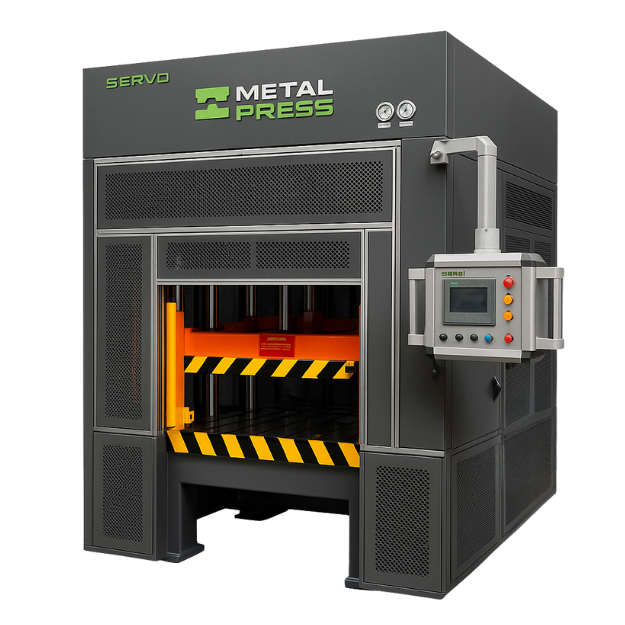
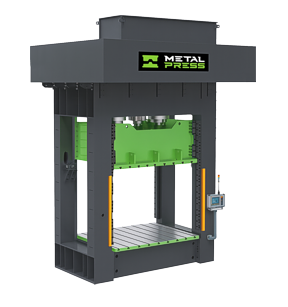
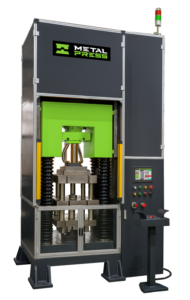
Servo-Hydraulic Equipment Examples
The product examples below belong to the servo-hydraulic family. Compare their application and configuration details after establishing the process requirements.
Request a Press Application Review
Use the enquiry form below to share your part drawing, material, operation, force and energy information where available, die size and weight, target output, handling method and installation requirements. These details help compare equipment on a common basis.
Call 519-624-9987 or contact the MetalPress team to discuss your press project.
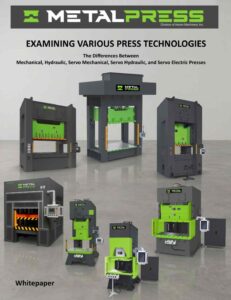
PRESS WHITEPAPER
Examine Various Press Technologies
The Differences Between Mechanical, Hydraulic, Servo Mechanical, Servo Hydraulic, and Servo Electric Presses