

Blog
Shipping, Installation, and Commissioning the 75‑Ton 4‑Post Hydraulic Press in Ohio

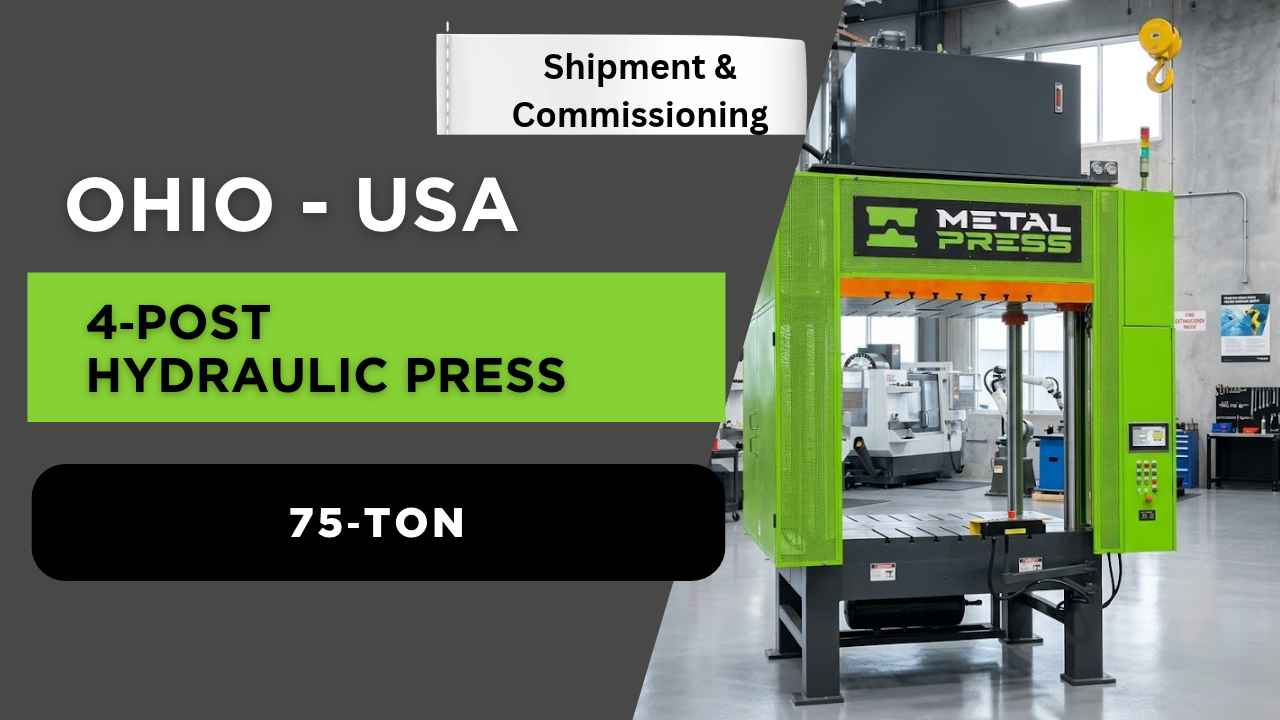
Summary: This final phase of our project follows the journey of a custom‑engineered 75‑ton 4‑post hydraulic press as it leaves our facility and enters full production at an appliance manufacturing plant in Ohio. In earlier phases, we explored how the customer’s forming challenges led to the design and engineering of a precision‑built hydraulic press, followed by the extensive testing, validation, and pre‑commissioning work required to prepare the machine for shipment. Phase Three brings the story full circle, detailing the transportation of the press to the customer’s site, the installation and commissioning process, and the on‑site training that ensures their team can operate and maintain the equipment with confidence. This article provides a complete, real‑world look at how a modern hydraulic press moves from concept to production, highlighting the reliability, precision, and versatility that define a 4‑post hydraulic press in today’s industrial manufacturing environment.
Every custom machine has a story, and by the time we reach Phase Three, that story already has depth, engineering, and momentum behind it. For new readers joining at this stage, it’s worth briefly revisiting how we arrived here — because the journey of this 75‑ton 4‑post hydraulic press is a perfect example of how modern industrial equipment is engineered, validated, and deployed.
A Quick Flashback to Phase One and Phase Two
https://metalpressmachinery.com/engineering-75-ton-4-post-press/In Phase One, our Ohio‑based appliance manufacturing customer approached us with a clear production challenge. Their existing forming equipment was outdated, inconsistent, and no longer capable of meeting their quality and throughput requirements. After a detailed engineering review, we designed a custom 75‑ton 4‑post hydraulic press tailored to their forming process, tooling needs, and long‑term production goals. The machine was engineered from the ground up — from structural modeling and hydraulic system design to electrical controls and full mechanical assembly.
In Phase Two, the press moved from assembly to validation. We performed extensive testing, including dry cycling, hydraulic pressure verification, platen parallelism checks, and full electrical system validation. The customer visited our facility for a Factory Acceptance Test (FAT), where they reviewed the machine’s performance and approved it for shipment. After final inspections, documentation, and protective wrapping, the press was officially ready to leave our facility.
Now, in Phase Three, the machine begins the final and most exciting part of its journey: traveling to Ohio, being installed on the customer’s production floor, undergoing commissioning, and training their operators and maintenance team.
In commissioning phase everything is ready on the client floor. This perfect 75-ton 4post hydraulic press is being installed and started but, first, take your time and review the details of the machine.
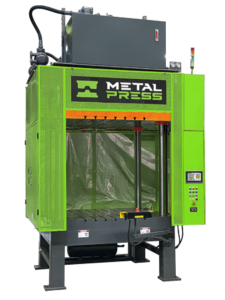
👉 View our 4-post press MTP Series product page and for more information fill request for information form.
Shipping the Press to Ohio: The Journey Begins
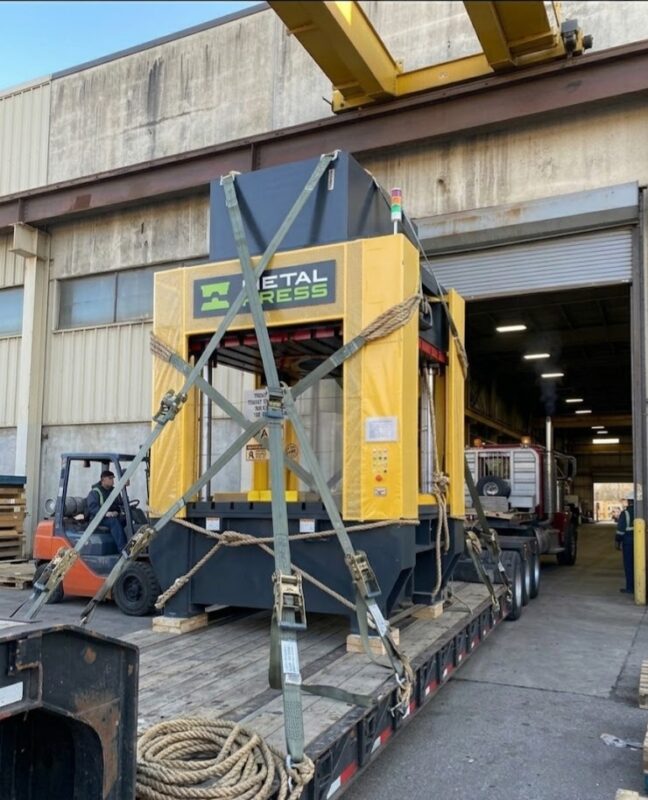
Shipping a 75‑ton hydraulic press is not a simple task. It requires careful planning, specialized equipment, and precise coordination. After completing the pre‑commissioning inspections and wrapping the machine for protection, our logistics team arranged transport with a carrier experienced in handling heavy industrial machinery.
The press was secured to a reinforced pallet, blocked and braced to prevent movement, and loaded onto a flatbed truck. Sensitive components such as the HMI, sensors, and hydraulic ports were sealed and protected against vibration and environmental exposure. The hydraulic power unit was drained to safe transport levels, and all loose accessories were packaged separately with clear labeling.
Once the truck departed, the machine began its journey from our facility to the customer’s plant in Ohio — a trip that marked the transition from engineering to real‑world production.
A Brief Re‑Introduction to the 75‑Ton 4‑Post Hydraulic Press
Before we follow the press to Ohio, it’s helpful to revisit what makes this machine so valuable — especially for readers discovering this project for the first time.
A 4‑post hydraulic press is one of the most versatile and structurally stable press designs used in modern manufacturing. Its four precision‑machined columns guide the moving platen with exceptional accuracy, ensuring consistent forming depth, uniform pressure distribution, and long‑term alignment. These qualities make 4‑post presses ideal for industries that demand repeatability and precision, including appliance manufacturing, automotive, aerospace, and metal fabrication.
This particular machine — a custom‑engineered 75‑ton 4‑post hydraulic press — was designed to deliver:
High forming accuracy
Excellent platen parallelism
Smooth hydraulic motion
Reliable pressure control
Open access for tooling and maintenance
Long‑term durability in a high‑cycle production environment
With its PLC‑based control system, operator‑friendly HMI, and robust hydraulic power unit, the press is built not only for performance but also for ease of use and long‑term serviceability.
With the machine fully validated, it was time to send it to its new home.
Arrival at the Customer’s Facility
When the press arrived at the Ohio plant, our installation team coordinated with the customer’s maintenance department to prepare the installation area. The location had been selected during the early design phase, ensuring proper floor strength, electrical access, hydraulic service space, and operator workflow.
The unloading process required forklifts and overhead cranes capable of handling the machine’s weight and dimensions. Our technicians supervised the placement to ensure the press was positioned exactly according to the layout plan. Once the machine was set in place, the installation process began.
Installation: Setting the Press Into Production Position
Installing a hydraulic press involves more than simply placing it on the floor. The machine must be leveled, anchored, connected, and prepared for operation.
Leveling and Anchoring
The first step was leveling the press using precision instruments. Proper leveling ensures:
Accurate platen parallelism
Smooth cylinder travel
Even load distribution
Long‑term structural stability
Once leveled, the press was anchored to the floor using heavy‑duty bolts and vibration‑resistant mounts.
Hydraulic and Electrical Connections
Next, the hydraulic power unit was filled with the specified fluid, and all hydraulic lines were inspected and tightened. Electrical connections were made to the facility’s power supply, and the control panel was integrated with the plant’s safety and emergency systems.
System Checks
Before powering the machine, our technicians performed a full inspection of:
Wiring and grounding
Hydraulic fittings
Sensors and limit switches
Safety guards and interlocks
HMI and PLC connections
With everything verified, the press was ready for commissioning.
Commissioning: Bringing the Press to Life
Commissioning is the moment when the machine transitions from installation to operation. It is a structured, step‑by‑step process that ensures the press performs exactly as intended in its new environment.
Initial Power‑Up
The press was powered on, and the control system initialized. Our technicians monitored the hydraulic pump startup, checked for leaks, and verified that all sensors and feedback devices were communicating correctly with the PLC.
Dry Cycle Testing
Just as we did in our facility, we ran the press through multiple dry cycles to confirm:
Smooth motion
Correct stroke limits
Proper speed transitions
Accurate position feedback
Pressure and Load Testing
The press was then tested under load to verify:
Pressure stability
Cylinder performance
Parallelism under forming conditions
System temperature behavior
Tooling Integration
The customer’s tooling was installed, and we performed test runs to ensure:
Proper fit
Correct forming depth
Clean part release
Repeatable cycle performance
Once the machine passed all commissioning tests, it was officially ready for production.
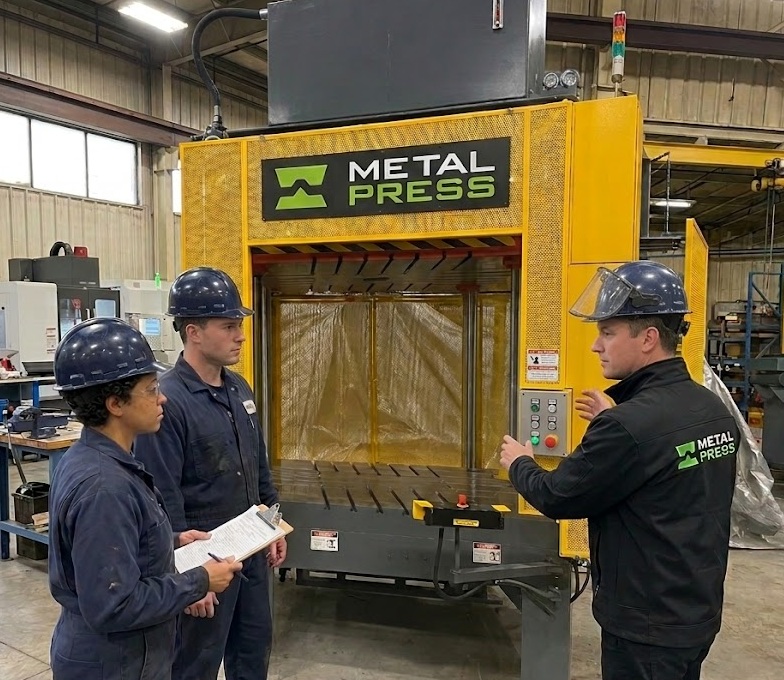
Training the Customer’s Team
A hydraulic press is only as effective as the people who operate it. That’s why operator and maintenance training is a critical part of every installation.
Our team conducted on‑site training sessions covering:
Operator Training
HMI navigation
Cycle setup and adjustments
Pressure and stroke control
Safety procedures
Daily inspection routines
Maintenance Training
Hydraulic system care
Electrical troubleshooting
Lubrication points
Preventive maintenance schedules
Spare parts management
By the end of the training, the customer’s team felt confident operating and maintaining their new 75‑ton 4‑post hydraulic press.
Conclusion: A Fully Operational Press and a Successful Deployment
With installation complete, commissioning finalized, and the customer’s staff fully trained, the 75‑ton 4‑post hydraulic press officially entered production. What began as a challenge in Phase One became a fully engineered solution in Phase Two and a fully operational machine in Phase Three.
This project highlights the full lifecycle of custom hydraulic press manufacturing — from concept and design to testing, shipping, installation, and real‑world operation.
If you’d like, I can now help you turn these three phases into a downloadable PDF guide, a landing page, or a marketing email sequence to support your sales pipeline.
Why Customers Trust MetalPress?

Let Us Make Your Next 4-Post Press

Join us in this journey to equip your manufacturing line with the most reliable products in metal stamping industry.
Each unit is assembled to meet your exact load capacity, workspace, and operational requirements which is delivering smooth, stable rotation and long-term reliability. MetalPress is your true metal stamping tools provider all across United States, Canada, and Mexico.
More information about this die upender
For more information about our other products